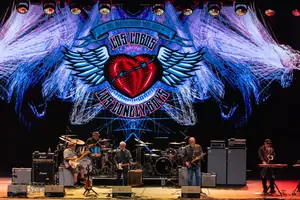
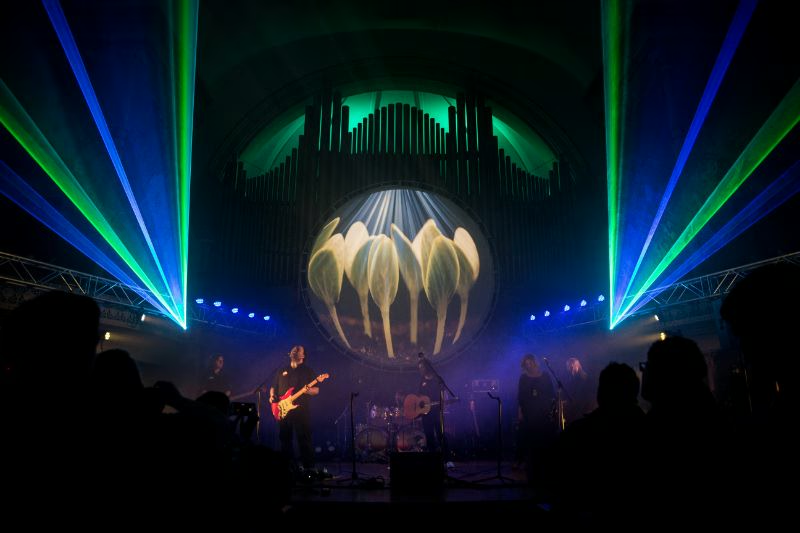

The air inside Windsor’s Olde Walkerville Theatre carries a specific kind of weight. It is a mix of century-old dust, spilled rye and the static charge that only comes from a stage cluttered with vintage Hiwatt stacks and enough floor pedals to confuse a NASA engineer. This is the setting for PIGS, a band that has somehow managed to carve out a niche in the overcrowded tribute market by being aggressively, almost stubbornly, authentic to a version of Pink Floyd that most fans only know through grainy bootlegs.
The tribute band industrial complex is usually a shiny, Vegas-style affair. You get the lasers, you get the note-for-note studio recreations and you get a sterile experience that feels like playing a high-fidelity CD in a dark room. But PIGS operates differently. They are five core members, bolstered by two touring musicians, and they are bringing their brand of psychedelic archaeology to Southwestern Ontario on Apr. 11.
The name itself is a bit of a middle finger to the flowery, predictable titles most tribute acts adopt. Josh Szczepanowski, the band’s guitarist and resident David Gilmour surrogate, knows exactly how it looks on a marquee.
"PIGS is an odd name for a band, unless you’re Canada’s most authentic Pink Floyd tribute, then it all makes sense," Szczepanowski says.
And he is right. In a world of "Echoes of Floyd" or "The Australian Pink Floyd Show," PIGS feels raw. It suggests the grit of the 1977 *Animals* era, a time when Roger Waters was busy spitting on fans and the band was disintegrating into a beautiful, cocaine-fuelled mess. Most tributes want to be the 1994 *Pulse* tour—safe, backlit and polished. PIGS wants to be the band that might actually break a string or have a mental breakdown mid-solo.
"We’re all about bringing a lovely Pink Floyd experience to everybody. Our jam is all about being really as authentic as we can. Sometimes it’s a little bit like going to see people do karaoke and it doesn’t have that rock and roll authenticity. We’re trying to be authentic and as much of a rock and roll show as possible. This is accomplished by having one person doing each character, if you will, instead of a whole bunch of people doing whatever they want," Szczepanowski says.
That "character" element is vital. Most tributes treat the music like a sacred text to be recited. Szczepanowski treats it like a screenplay. If you have three different guitarists swapping parts, the internal logic of the performance vanishes. By assigning roles, PIGS captures the specific tension that existed between Gilmour and Waters. It is a theatrical choice that pays dividends when the band leans into the improvisational stretches of the mid-seventies.
But the gear is where the obsession truly manifests. You can see it in the way the light hits the specific curves of the Stratocasters on stage. This is not off-the-rack equipment. This is a collection of hardware curated with the surgical precision of a museum conservator.
"We try to use all of the right equipment that we can, we try to make song choices that are logical and make sense. We try to put on the whole show the way that it would have been in the late seventies including playing songs in the same live format as they were at the time. So we’ll do different arrangements and live arrangements. It’s not like just sitting there listening to the album. It’s the way it would have been if you went and saw them," Szczepanowski says.
This distinction is crucial. If you want the album, stay home and put on your headphones. The "In the Flesh" tour of 1977 was notoriously volatile. The songs were stretched, distorted and often played with a ferocity that the studio versions lacked. PIGS is chasing that ghost. However, being a critic means acknowledging the danger of being *too* accurate. The actual 1977 tour was often a technical nightmare.
"Well yes and no. That’s the touchstone for us, sort of artistically. The arrangements we like to use have the look and feel that we go for. However, if we’re totally honest with ourselves, if you listen to any bootlegs from that tour, they were not played very well. If we played the songs exactly the same as on that tour, everyone would think we were terrible. So we start from that and spruce it up a little bit," Szczepanowski says.
It is a refreshing bit of honesty. The nostalgia for the seventies often forgets that the technology of the time was held together by duct tape and prayer. PIGS filters that era through a modern lens of competence, ensuring the "sprucing up" does not sacrifice the soul of the performance.
If we’re totally honest with ourselves, if you listen to any bootlegs from that tour, they were not played very well. If we played the songs exactly the same as on that tour, everyone would think we were terrible. So we start from that and spruce it up a little bit.
And then there is the looming shadow of *The Wall*. With the 40th anniversary of that monolithic record passing, there was a temptation to just play the hits. But the market is currently saturated with Roger Waters clones.
"Well sure, absolutely. We thought about doing that. But to be perfectly honest with you, it wasn’t all that long ago, five years ago, six years ago, that Roger did his big Wall tour and he did 192 shows and people were probably slightly tired of just hearing The Wall. So just playing the wall would have been a bit boring. But what we have done to pay homage to that anniversary and that era is to lean into the Roger side of things a little bit. People who come to see us are going to be hearing a little bit more of things from Animals and The Wall and the final content," Szczepanowski says.
The decision to lean into the "Roger side" suggests a setlist that is darker and more cynical. It is a brave choice for a theatre crowd that usually just wants to hear "Money" and go home. But PIGS seems to trust their audience. Even the name of the band itself is a holdover from a previous era of the group, one that they have finally come to peace with.
"I used to blame this all the time on our original Roger who was with us for the first six years of the band because he chose the name. But now he’s back actually for this tour so I can’t really give him a hard time about it. But basically it was that it would look good on posters. We want things to be right and I think sometimes tribute acts get their names from lyrics and they just get out of control so this is very simple and straight forward," Szczepanowski says.
There is a strange irony in a group of musicians in their mid-thirties obsessing over a band that stopped being a cohesive unit before some of them were out of diapers. It raises the question of whether you can truly channel an energy you never actually witnessed in person.
"No, I don't think any of us in the band have actually seen them. We've seen their various members at different times on tour of course over the last 20 odd years. But you know, they stopped touring almost 25 years ago now. And unfortunately, with most of us being in our mid-thirties, we just weren't old enough. I think I was in grade 10 when they did their last tour and I did not manage to go," Szczepanowski says.
Does it matter? Probably not. The "rock and roll spirit" they are chasing is more of an ideal than a memory. By avoiding the slick, corporate polish of the massive international Floyd tributes, PIGS manages to feel more "real" than the bands that actually have the multi-million dollar budgets.
"Well we just thought it would be more interesting, because as you pointed out, the two biggest ones in the world, the Brit Floyd and the Australian one, which, as far as I understand were actually one band originally split apart. They very much went for the modern recreation of Pulse and the Division Bell era of Pink Floyd. And that's great. You know, everybody likes that stuff and it gives you a chance to have big fun with a bunch of lights, but it doesn't really cut to the original rock and roll spirit of Pink Floyd, and so we thought we would go for the 70s way instead. We still have plenty of lights and lasers and a big screen and all the rest, but we're going for, like I said, the way they were in the mid-seventies," Szczepanowski says.
He continues to hammer home the venue size as a factor. "Actually when they were doing their original Dark Side tour, they were playing a bunch of theaters and things that were very similar in size and everything else as the ones that were playing on these tours. So we're trying to make it as similar to that era and that feel. It's just a different feel, more rock and roll. It's a vital loud rocking show instead of an easy listening show with lights."
The Olde Walkerville Theatre is the perfect laboratory for this experiment. It is a space designed for intimacy, not the cavernous, soul-crushing expanse of a stadium where the band members look like ants.
"I think that's part of why we have studied very carefully everything we can find from that era. It's a more intimate feel. They are still reasonably large shows, but it gives us a chance to be a little bit more intimate. Once they got into their original, In the Flesh tour, they were playing some places that were 60,000, 70,000 people. And obviously this was the beginning of what caused them to write The Wall in the first place because they hated it and there was no interaction with the audience. No connection. So in some ways, it's a real blessing to play in theaters that are 700 to 1000 seats because then you can actually see everybody. You can have a connection with the audience as well, which is pretty important I think," Szczepanowski says.
Of course, "intimate" does not mean "low-tech." The band still has to contend with the visual expectations of a Floyd crowd. You cannot play "Comfortably Numb" in front of a beige curtain. You need the circular screen. You need the lasers. But PIGS keeps the production in-house, giving it a DIY edge that matches their seventies ethos.
"Well, I think it's probably a lot easier than they had it. It's still not super easy. It takes a lot of work. We have a very dedicated and eccentric lighting guy who works very hard to get the lights and lasers going. And I spend quite a lot of time either rebuilding or making from scratch, all of the footage that goes on the screen. So it's a lot of work to put all that stuff together, but when it all flows, it can make for a really, really neat experience for the audience and if you're bored by the music, of course, you can just watch TV on the big screen," Szczepanowski says.
The sound in these smaller rooms can be punishing. There is a specific technical critique to be made here: Pink Floyd’s music relies on space and breath. In a 700-seat room, that space is often filled by the sheer volume of the amplifiers. Szczepanowski is aware that his rig is a literal wall of sound.
"Yeah, we don't get a lot of complaints. I think people really enjoy it. I think the only complaints are usually from the three people that are sitting directly in front of my amps on that side. So if you're going to get tickets, be careful in that one spot. But otherwise it's a great show and everybody loves it," Szczepanowski says.
For the gear nerds, Szczepanowski’s setup is a pilgrimage in itself. He is not just playing a guitar; he is managing a complex ecosystem of signal chains and boutique electronics. He is chasing the Gilmour tone—the most elusive "white whale" in the guitar world.
"Oh boy. Well, we've gone through many, many different stages of it over the years. It is quite difficult. It's very hard to keep up with Mr. Gilmour because of course he's a millionaire and I am not. But we've done our very best. This last tour that we've been doing, I went whole hog and did a bit of a cross between his late eighties set up and his Wall set up. So basically I'm playing with more or less his eighties set up at this point even though we're not really playing a lot of those songs. So I built a big complicated rack system. I get pedals and things built by Pete Cornish over in the UK, who, of course, is the guy that has been building Gilmour's things for many, many years. I mean, right down to the Evidence audio cables that I use, the same cables. We try to use everything that's the same as much as we possibly can. But it is complicated. Yes, programming this whole system is very hard. I mostly have it right. But every once in a while, I'll screw up something," Szczepanowski says.
The commitment to the specific era extends to the lumber in his hands. He swaps guitars not just for the sound, but for the visual continuity of the era they are inhabiting at that moment in the set.
"For most of the show I'm playing of course, my David Gilmour signature Strat, it's the black Strat that everybody knows. That's probably the one that he's obviously the most famous for and it's the one that's used for most of the things. So I'd probably play that for at least half the show. But of course, there's also various other ones. I have another black Strat with a Rosewood neck on it because that looks more correct for when we do Animals tunes, even though really, I'm sure, I don't even know anybody's ever noticed, but there you go. And you know, a pile of different Telecasters and stuff. He actually used Telecasters quite often. I use a couple of those to do various songs like Dogs or Run Like Hell. So Telecasters and a red Strat, of course, to do a couple of modern tunes. I switch it up to basically just to follow the tunes. Whatever is correct for the song, that is what I'll be playing. And that rule applies to everybody in the band, they will all play what is correct for what we're doing," Szczepanowski says.
As the tour winds its way toward Windsor, the fatigue of the road is apparent, but so is the excitement of playing a room with actual character. The Olde Walkerville theatre is not a "black box" venue; it is a space with a soul.
"Well, I really hope so. We're going to do our best, but it's always wonderful when we can get to a nice old theater like that because they always sound and look great and the audience has always really enjoyed it too. It's always a real pleasure to get off the stage afterwards and shake everybody's hand and talk to everybody. So, yeah, I can't wait," Szczepanowski says.
If you are looking for a note-perfect, sanitized recreation of a Pink Floyd record, go elsewhere. But if you want to see what it feels like when five musicians try to grab the lightning of 1977 and bottle it in a theatre in Windsor, PIGS is the only show in town. Just don't sit directly in front of the amps.