Some stories are old enough that adapting them straight feels like a dare. Homer's Odyssey has survived three thousand years of retellings, parodies, and half-hearted big-screen attempts, and none of them have fully earned the word epic. Christopher Nolan's version does. This is a masterstroke, full stop, the kind of filmmaking that treats an ancient text with the grace it deserves while still finding real excitement in every turn of the journey home.
Matt Damon anchors the film as Odysseus, and he plays the role less as a mythic hero than as a man being slowly worn down by two decades of war and water. There's weariness under every choice he makes, and Damon lets that weariness show without ever tipping into self-pity. By the time Ithaca comes back into view, the character has earned the reunion the audience has been waiting on since the opening frame.
Anne Hathaway's Penelope could have been reduced to a waiting figure, patient and passive on the far end of the story. Nolan doesn't let that happen. She's given her own weight to carry, her own siege to survive at home, and Hathaway plays it with a controlled fury that makes the eventual reunion land twice as hard.
Tom Holland, as Telemachus, gives the film its coming-of-age spine, a son growing into responsibility in his father's absence. It's a quieter register than Holland usually works in, and he holds it well. Around him, Nolan has assembled a genuinely stacked ensemble: Robert Pattinson coiled and dangerous, Lupita Nyong'o's Athena carrying real divine authority, Charlize Theron's Circe a highlight in her limited screen time.
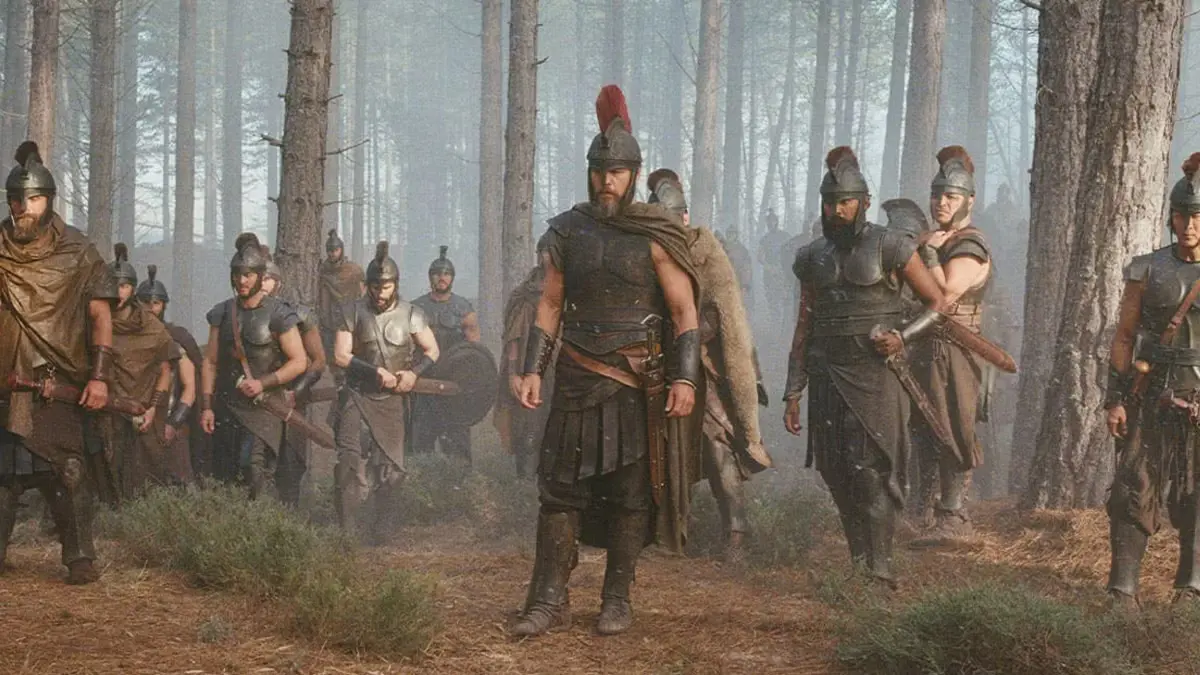
Shot on newly developed IMAX film technology, the scale of this thing is staggering. Storms swallow the frame whole. The Cyclops sequence has a tactile menace that CGI-heavy blockbusters rarely manage anymore, because so much of it was built and shot practically rather than conjured after the fact. Hoyte van Hoytema's cinematography treats the Aegean like a character in its own right, vast and indifferent to the men crossing it.
And here's the thing worth saying plainly: this is a film built for the biggest screen available, but it doesn't fall apart without one. Watching it outside a 70mm presentation, the picture still felt enormous, still felt gorgeous in ways that had nothing to do with format bragging rights. That's rarer than it sounds. A lot of IMAX-first filmmaking collapses the second you're not sitting under the format it was designed for. This one doesn't.
Ludwig Göransson's score threads through all of it without ever swelling into empty grandeur, restrained where a lesser composer would have reached for bombast. Jennifer Lame's editing keeps a sprawling, multi-stranded odyssey legible, cutting between Ithaca and the sea without ever losing the emotional throughline connecting them.
If there's a place the film's ambition outpaces its execution, it's in a handful of the episodic stops along the way. Nolan is adapting one of the most famous multi-part journeys in Western literature, and a couple of those vignettes, the ones that work best as isolated stories on the page, feel a touch small when placed against a film operating at this scale. It's a minor complaint inside a movie this accomplished, but a fair one.
Nolan has built a career on bending time and structure to serve emotion rather than spectacle, and The Odyssey is no exception, even with a text this ancient pulling against him. He treats Homer's episodic structure less as a checklist of monsters and more as a study of what twenty years away from home does to a man, and to the people who waited.
There will be arguments about whether this belongs beside Oppenheimer in Nolan's own filmography. Let them happen. What's not up for argument is that The Odyssey is the rare literary epic that earns its own myth-making, a film that understands both the scale Homer demands and the human cost underneath it.