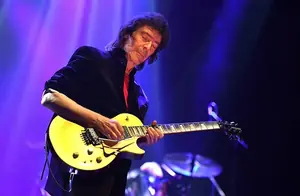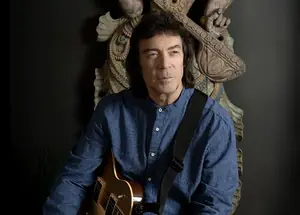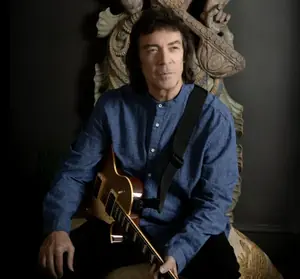
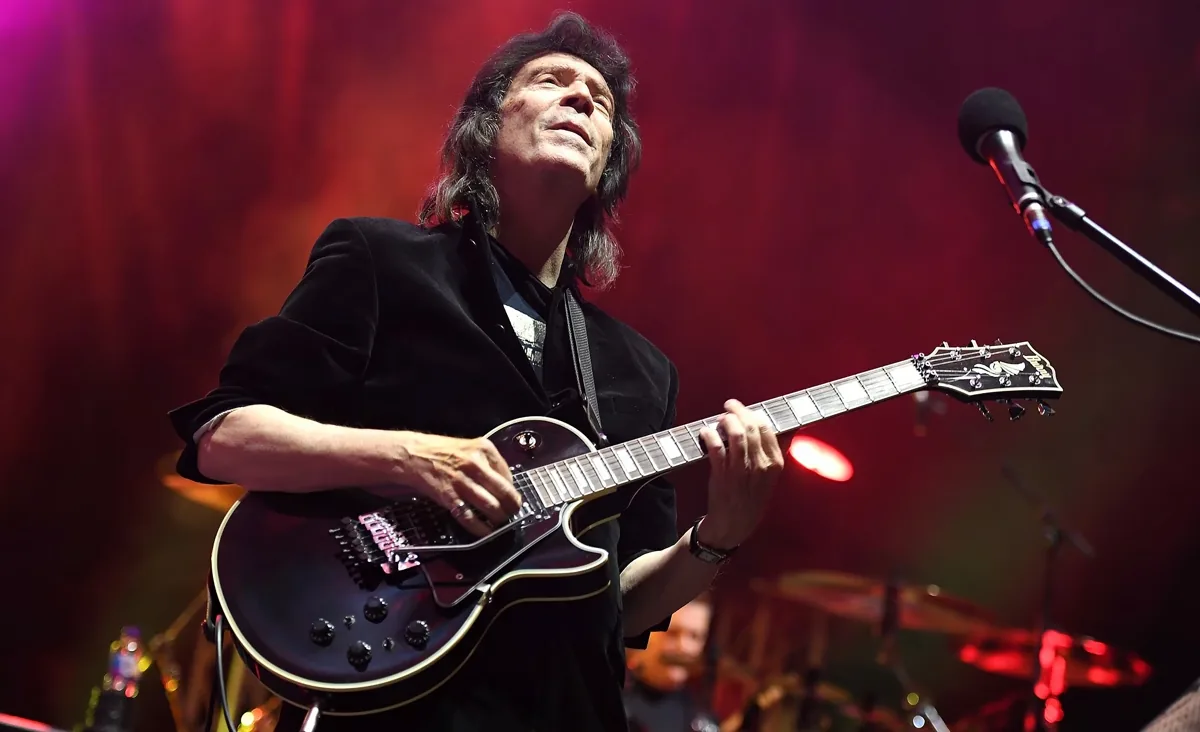

Looking at the raw transcripts from our Jan. 16, 2020 conversation with Steve Hackett feels like opening a time capsule. The legendary Genesis guitarist was calling from London, mapping out a North American tour built around the band’s magnum opus, Selling England by the Pound. He spoke of a busy year ahead with the casual certainty of an artist who had spent five decades on the road. But of course, none of us knew the world was just weeks away from a hard stop.
Revisiting his words now adds a layer of historical weight. He was celebrating a past that felt immortal and planning a future that felt guaranteed. At the centre of it all was that 1973 masterpiece, an album Hackett holds in the highest possible regard. He doesn’t just play these songs; he evangelizes for them, framing them not as nostalgia but as enduring works of art.
“We do ‘Selling England by the Pound’ in its entirety from 1973,” Hackett says, his pride in the work undiminished by time. “I know it sounds like a long time ago, but it was from a time when John Lennon said that Genesis was one of the bands that he was listening to. So I'm still very proud of that album.”
That Lennon co-sign has always been a crucial piece of the Genesis mythos. It validated their strange, pastoral and uniquely English prog-rock for a global audience. Hackett understands this better than anyone. He sees that era as a time when albums were grand journeys, closer in spirit to Pink Floyd than the hit-single factory Genesis would later become. It was a period of long-form composition and artistic ambition, and he remains its most dedicated custodian.
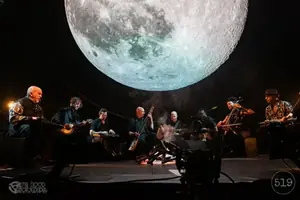
The show he was planning wasn’t just a simple playback. It was a sprawling two-and-a-half-hour affair, complete with an intermission. It included solo material from Spectral Mornings and his then-new album At the Edge of Light. But the core, the main event, was always Genesis. He was even including “Deja Vu” a track co-written with Peter Gabriel that was cut from the original album, restoring it to its rightful place in the narrative.
And that’s the thing about Hackett. His passion for the material he helped create is fierce and absolute. He left Genesis because he felt creatively stifled, a man with solo ambitions in a collective that demanded total focus. “It was too restrictive working within the band, even though I felt I was playing guitar in the world's best band at the time,” he explains. “I was given an ultimatum and I decided to take my muse with me and go elsewhere, but I never abandoned the music that we wrote as a group.”
He speaks of the band’s writing sessions as a place of creative friction and immense pressure. These weren’t just collaborators; they were five future solo stars locked in a room. Think about it. A TIME magazine article in 1986 noted that every principal member was in the top 20 charts simultaneously: Gabriel with “Sledgehammer” Phil Collins as a global pop force Mike + The Mechanics churning out hits and Hackett himself with GTR, his project with Yes guitarist Steve Howe.
It was from a time when John Lennon said that Genesis was one of the bands that he was listening to. So I'm still very proud of that album from that time.
That concentration of talent and ego made for brilliant music but also inevitable conflict. It’s the same dynamic that has made a full reunion of that classic lineup impossible. Hackett is candid about the attempt back in 2005. “We all had to get together, but I don't think there was enough common ground for everyone to agree on what we should play,” he admits. The boat, as he says, has sailed. Power plays and divergent musical paths have made it an impossibility.
So Hackett carries the torch himself, authentically but not slavishly. He honours the spirit of the original recordings without being trapped by them. He understands that songs like “Firth of Fifth” and “The Cinema Show” are living things, still capable of surprising an audience and the man playing them.
His solo career was born from that same fire. He recounts the sessions for 1979’s Spectral Mornings with a mix of exhaustion and glee. The band was holed up in a studio in Hilversum, Netherlands during a brutal cold snap. “It was 15 degrees below zero,” he recalls. “All you could really do was to work and party. So we made that album on plenty of Scotch and Coke, and so we were kind of fueled up. But we were having a party and we had a blast on that album and that's how it came out.”
The result was an album crackling with joy and frantic energy, the sound of a newly liberated artist letting his first proper touring band loose in a massive studio. He pushed himself to the brink, functioning on no sleep for two months, ending the project “completely exhausted physically, emotionally and economically.” But it was worth it. The album stands as a landmark of post-Genesis prog.
Of course, his innovations started long before. On 1971’s Nursery Cryme, Hackett quietly introduced a guitar technique that would change rock music forever: two-handed tapping. He developed it trying to emulate the dexterity of a keyboard player, treating the fretboard as a piano. You can hear it in the frantic arpeggios of “The Musical Box” and the intro to “The Return of the Giant Hogweed.”
“Eddie Van Halen picked up on that technique and many others,” Hackett notes. “It's part of the language of speed metal players. It enables you to play so fast, you know, tape can barely capture it.” It’s a foundational piece of his legacy, a technical innovation that rippled through generations of guitarists.
Hackett is also a sharp analyst of his own history. He correctly identifies the moment Genesis finally broke in North America: when Peter Gabriel embraced theatricality. The music was complex and deeply British, a tough sell for American audiences until it became a visual spectacle. The costumes, the lighting, the stage scenery—it gave the audience a way into the dense storytelling. It gave the music depth and context.
That flair for the dramatic continues in his modern work. He speaks with immense pride about his collaborations with orchestras, particularly the Live at the Royal Festival Hall recording. He sees the fusion of rock and classical not as a gimmick but as a powerful way to elevate the material. Hearing a full orchestra crash in at the finale of “The Musical Box” he says, is “mighty.”
And he’s not just looking back. He argues that his 25th solo album, At the Edge of Light, is his best studio work ever. It’s a globalized record featuring musicians and instruments from India Azerbaijan and Hungary. He calls it a “United Nations of music” and a “film for the ear.” The description is apt. The album is a cinematic journey that proves his creative well is far from dry.
It’s that duality that defines Steve Hackett in the 21st century. He is both the faithful curator of a sacred rock canon and a restless forward-looking artist. He honours the past without being imprisoned by it, a rare feat for any legacy musician. He is still climbing the mountain, every new album a fresh challenge against the shadow of his own monumental past.
519 Magazine Archive: We are thrilled to officially unearth the 519 Magazine Digital Vault. This isn't just a re-post; it's a high-fidelity restoration of a pivotal era in music journalism. By pairing original print dates with modern retrospectives, we’re bridging the gap between historical rock-and-roll grit and the lightning-fast performance of today’s web. These stories—once locked in physical print and lost URLs—are now back, fully searchable, and optimized for a new generation of fans.
We are thrilled to officially unearth the 519 Magazine Digital Vault. This isn't just a re-post; it's a high-fidelity restoration of a pivotal era in music journalism. By pairing original print dates with modern retrospectives, we're bridging the gap between historical rock-and-roll grit and the lightning-fast performance of today's web. These stories—once locked in physical print and lost URLs—are now back, fully searchable, and optimized for a new generation of fans.