
Listening back to this raw archival tape from Oct. 5, 2011, is a trip. The audio is thin, crackly. You can hear the unmistakable sounds of a city street, a car door slamming and the clipped exchange of a cab fare. In the middle of it all is Dominic Cooper, an actor on the absolute precipice of a career-defining moment, apologizing for paying his driver mid-interview. It’s a beautifully candid snapshot of an artist in motion, literally and figuratively.
This was the year Cooper appeared in five films. A dizzying schedule. But two roles defined his 2011. The first was a slick, foundational piece of a world-eating franchise: Howard Stark in Captain America: The First Avenger. He was the charismatic industrialist, the MCU’s progenitor of genius and swagger. A perfect bit of casting that would echo for years. But that wasn’t the performance that had the industry talking. It wasn’t even close.
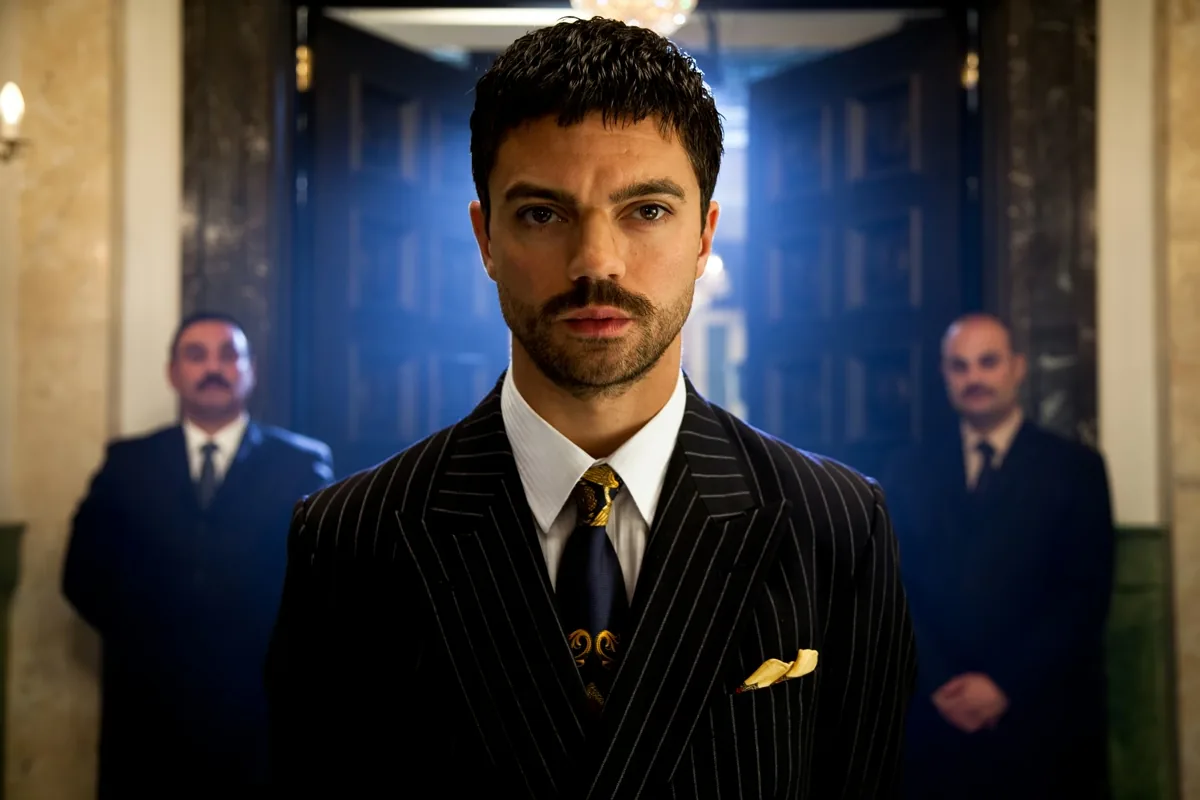
The real story, the one that hums with a dangerous current through this entire conversation, is The Devil's Double. A brutal, hyper-stylized dive into the inferno of Saddam Hussein's regime, seen through the eyes of two men who shared a face. One was Uday Hussein, Saddam's monstrous, psychopathic son. The other was Latif Yahia, the body double forced into his service. Cooper played both.
It was a move of staggering ambition. And listening to him talk about it now, with the benefit of hindsight, reveals the intense calculus required to pull it off. He tells me, “I think it was more the opportunity just to play two very different parts in the same film that drew me to those particular roles.” A simple enough motivation. But the execution was anything but simple. It was a high-wire act over a pit of cinematic clichés and technical nightmares.
The history of film is littered with actors playing twins or doppelgängers, often to gimmicky effect. Think Hayley Mills in The Parent Trap or the broad comedy of Eddie Murphy. But Cooper was aiming for something far darker, more in the vein of Jeremy Irons’ psychological fracturing in Dead Ringers. The success of the entire film rested on one critical illusion.
And he knew it. The pressure was immense. “You can't… if for a moment while watching that film you were unaware of which character you're watching at any given time, it wouldn't work,” he says, the urgency still palpable in his voice. “The whole thing would fall to pieces. So it was really exciting for me to come up with ideas and ways to allow that to happen.”
This wasn't just about different costumes and a slight change in posture. Cooper had to build two souls from the ground up. He speaks of a meticulous process, of crafting distinct internal rhythms and vocal signatures for each man. It was about architecture, not just acting.
He explains his method with a craftsman’s precision. “Latif is a man who is very composed and thinks thoroughly before he says anything… because he knows the effects of the word,” Cooper details. “Uday has no care for that. So he's very quick-paced. He's more educated so he speaks more quickly.” This is the deep character work, the stuff that separates a performance from a mere impression. It's about understanding that one man weaponizes language while the other is wounded by it.
You never really know how they're gonna come out. If you're happy with them, then it's a pleasure to talk about them.
But this intellectual work had to translate under the cold, unforgiving eye of the camera. The technical challenge of playing scenes opposite himself was, by his own admission, grueling. It strips acting down to its most sterile components. There is no scene partner, no spontaneous reaction, no energy to feed off.
He describes the void of the process. “One of the wonderful things about acting is reacting and responding to certain events and scenes that take place… and that's what creates a trigger and spark,” he says. “If you don't have that and you're acting against no one, it becomes very difficult. So you have to very much use your imagination as to what the performance is going to be that the other character that you do is going to give.”
This is the lonely labour of the dual role. Performing in a vacuum, first as Uday, then having to remember every physical tic, every eyeline, every micro-expression to deliver Latif’s side of the scene. The slightest error, a glance aimed a centimetre too high, and the entire illusion shatters. Verisimilitude dies.
It’s here, however, that a minor critique can be leveled. The technical achievement is so profound, so front-and-centre, that at times it risks overshadowing the emotional core. The film, directed by Lee Tamahori with a kind of Scarface-on-the-Tigris bravado, is a spectacle. And Cooper's performance is its central, dazzling special effect. It is a stunning feat, but occasionally one is more aware of the feat than the feeling.
And then there's the question of the source material itself. The real Latif Yahia. Cooper met him, a decision fraught with its own set of ethical and artistic tripwires. How much do you ask of a man who has endured the unimaginable? How do you honour his trauma without exploiting it for cinematic gain?
Cooper’s handling of this was, frankly, masterful in its empathy and self-awareness. He recognized the line between research and intrusion. He knew the film was not a documentary. It was a heightened narrative, a gangster film painted in the colours of a political horror story. A story, not a biography.
“The scars are both physical and mental on Latif,” Cooper recounts with a quiet respect. “And once I realized this was not a biography but a story, I didn't feel the need to necessarily indulge in his horrific experiences. I let him tell me whatever he wanted to tell me and didn't want to pry too deeply.”
That distinction is everything. It gave him the artistic license to create, rather than merely imitate. He wasn’t beholden to a minute-by-minute recreation of events, something he insists no one could truly know anyway. Who knows what was said in those private rooms? Who knows the real psychology of these men?
The film took that unknown and forged a compelling, if not entirely historically accurate, narrative. It was a story about power, identity and the corrosion of the soul. Cooper’s performance was the engine that drove it, a terrifying display of range that showed Hollywood he was more than a charming supporting player in musicals and superhero flicks.
Looking back from today, The Devil's Double stands as a singular entry on his filmography. It’s a loud, violent and audacious piece of work anchored by a performance of immense technical skill and psychological commitment. It was the moment Dominic Cooper proved he could be a leading man of terrifying complexity.
He was right about one thing he said on that crackling phone line from a New York cab. When you’re proud of the outcome, it’s a pleasure to talk about it. And the sheer force of his work in that film is something worth talking about, even all these years later. It was a declaration. And the industry heard it loud and clear.
519 Magazine Archive: We are thrilled to officially unearth the Rockstar Weekly Digital Vault. This isn't just a re-post; it's a high-fidelity restoration of a pivotal era in music journalism. By pairing original print dates with modern retrospectives, we’re bridging the gap between historical rock-and-roll grit and the lightning-fast performance of today’s web. These stories—once locked in physical print and lost URLs—are now back, fully searchable, and optimized for a new generation of fans.
We are thrilled to officially unearth the 519 Magazine Digital Vault. This isn't just a re-post; it's a high-fidelity restoration of a pivotal era in music journalism. By pairing original print dates with modern retrospectives, we're bridging the gap between historical rock-and-roll grit and the lightning-fast performance of today's web. These stories—once locked in physical print and lost URLs—are now back, fully searchable, and optimized for a new generation of fans.