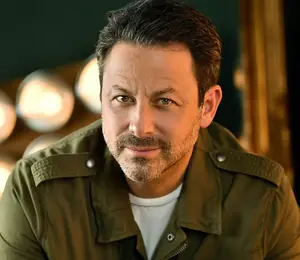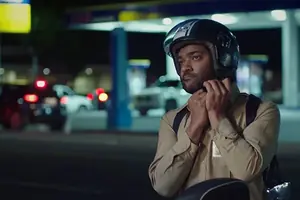

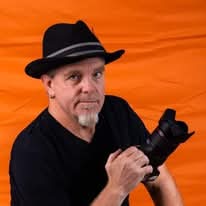
Sitting across from Oliver Masucci, you don’t see the monster. You don't see the dictator or the drug-addled filmmaker. But you see the mileage. The man has been in the trenches for 40 years, a veteran of the German theatre boards since he was 12. He spent decades as a secret weapon in European television before the 2017 Netflix juggernaut *Dark* turned him into a global commodity. Now, he’s in North America filming alongside Jamie Foxx and Dave Franco. It is a long way from the woods outside Berlin.
Our conversation drifts toward his recent turn in *Enfant Terrible*, a biopic of the legendary and legendary-difficult German filmmaker Rainer Werner Fassbinder. The film is a jagged, neon-soaked fever dream. It doesn't play like a standard Hollywood biopic; it feels like a stage play captured on celluloid during a nervous breakdown. Masucci tells me the project was a long time coming, born from a collaboration with director Oskar Roehler.
"We were discussing it a lot, the director and I, because I was doing another film with him and he always wanted to do a movie about Rainer Werner Fassbinder," Masucci says. "Oskar Roehler is his name; he’s a pretty famous German artsy-fartsy director and somehow he sees himself in that character a bit."
The production was a legal minefield. Fassbinder’s estate is a notoriously protective fortress, and the road to getting the film made was littered with bureaucratic corpses. Masucci explains that the Rainer Werner Fassbinder Foundation, led by a woman claiming to be the late director's wife, was a constant hurdle.
"Actually, there were several German filmmakers who wanted to make a film about him, which was pretty problematic because there is a Rainer Werner Fassbinder Foundation and it’s run by his maybe-wife," Masucci notes. "A long time after he died, she said they would have married somewhere in the US or in Hawaii but they threw the paper away so she has no proof. At the end, she got the whole Fassbinder films as a heritage and she always tried to intervene so lots of the projects about Rainer Werner Fassbinder wouldn’t happen."
To bypass the legal stranglehold, Roehler pivoted to a different source: the memoirs of Kurt Raab, a frequent Fassbinder collaborator. By framing the story through Raab's perspective, the production found a loophole. It wasn't a biography; it was a memory.
"And then Oskar said, 'I want to do this movie about Rainer because then we have no legal problems because it’s another person talking about him and memories.' So that was a way to do it," Masucci explains. "There have been a lot of problems doing the movie; every sentence has been proofed by a lawyer because they tried to stop the movie. I was set for this movie. Two years before, we were talking about it so there was no audition or casting or anything like this. We wanted to do it together because we know each other pretty well."
The resulting film is a brutal look at a man who was as sadistic as he was brilliant. Watching Masucci on screen, you see a man physically dissolving into the role. He gained 25 kilos for the part, a physical burden that mirrored the emotional weight of playing a man who seemed to hate himself as much as he loved his art.
"In the beginning, I found him pretty ugly," Masucci admits. "When I started, I even didn’t want to come so close to this character; I thought, it’s such an extreme human. I thought in my life I put the extremes behind me and as a person living with three kids, it’s quite difficult to get close to somebody like this, but I found during the making lots of empathy for this guy."
The production was a chaotic sprint. Originally budgeted at 8.5 million euros for a 60-day shoot, the financing collapsed. They ended up shooting the entire thing in 24 days on a shoestring budget of 2.7 million. The lack of resources forced a radical aesthetic choice: the sets were sprayed onto the walls of a studio like graffiti. It was a risky, avant-garde gamble that could have easily looked cheap.
"The film was scheduled for about 60 shooting days and 8.5 million euros of production value," Masucci says. "At the end, nobody wanted to finance the film and we had to shoot the film in 24 days and 2.7 million. What we did in the end was just shoot it one thing after the other; we couldn’t even cover everything and just went on and on and somehow we made this into art. The subject of not knowing if we would succeed doing the whole movie for the money somehow also became the subject of the movie."
The physical toll was immense. Masucci was drinking heavy beer in the mornings to maintain the Fassbinder "groove," a method that felt more like an endurance test than acting.
"We started doing one scene after the other without any pause and sometimes I really felt like I would get a heart attack because I was gaining weight," he says. "This was in fact the only preparation I did for the role. I gained 25 kilos so I was very fat and I couldn’t move very well anymore and I was short of breath; I didn’t feel good. The director had a refrigerator and he put lots of Weizenbier, which is a very heavy beer, and he wanted me to drink two or three beers in the morning so that my stomach blows up more and that I get into the groove of the role because he was drunk all the time."
I think we need people like Rainer Werner Fassbinder who are not politically correct because the time will show if we can do politically correct artworks. If this is still art in 20, 30 or 40 years and if we could do it in a politically correct way, I think it’s not possible somehow and so I think we have to differ between the artist and his artwork.
Masucci’s philosophy on playing intoxication is as direct as his performance. He believes in the "little booze" method to find realism, a technique that would make a Hollywood safety officer faint but fits the gritty reality of German independent cinema.
"It’s always better to play when you’re on a little booze and to play sober than if you are sober and you have to play like you’re drunk because that I think is more realistic," he claims. "In the end, it was just a ride. We didn’t even know what we were doing because we were doing it so fast."
Despite the chaos, Masucci found a way to humanize a monster. He drew from his 30 years in the theatre, channelling every difficult director he had ever encountered into a single "super artist" character. He saw Fassbinder not just as a tyrant, but as a man desperately, tragically seeking a love he couldn't handle.
"I remember when I was coming for preparation, I knew a lot of Fassbinder; I saw a lot of his movies and I knew lots of people who met him and had been working with him and everybody was telling me their version that they knew him better than the others and he lived in their apartment for that period of time and stuff like that. In the end, I didn’t listen to any of those because that was just too much," Masucci says. "I watched all the movies the week before and the documentary stuff and, in fact, there is not so much about him as a documentary; he didn’t give many interviews anymore. But I knew as a theatre actor working 30 years in theatre starting at age 12, I had met lots of directors who felt like Rainer Werner Fassbinder and behaved like him. In the end, I put all these guys together in one character and that was my super artist I was playing."
Masucci’s Fassbinder is a man of contradictions. He was a genius who didn't trust his own talent, a man who explored the intersection of power, violence and money because he didn't know how to find anything else.
"I think somehow he was genius and he always wanted to be genius, but he didn’t trust himself that he would be one so there was always a lack of something because he thought he wasn’t good enough," Masucci explains. "Maybe this comes from his mother never accepting him like he was, or there was no father figure for him, but in a way he was genius."
The conversation turns toward the modern landscape of art and the stifling nature of political correctness. Masucci argues that someone like Fassbinder—someone who refused to be pinned down by any political wing—is exactly what the world needs right now. He views the current trend of mixing an artist's personal politics with their work as a mistake.
"I think we need people like Rainer Werner Fassbinder who are not politically correct because the time will show if we can do politically correct artworks," he says. "If this is still art in 20, 30 or 40 years and if we could do it in a politically correct way, I think it’s not possible somehow and so I think we have to differ between the artist and his artwork. So in the moment, we mix it all together. I don’t know how it is in the US. But in Germany, that’s pretty correct that people are thinking about people and artists, whether they are politically correct, whether they're left-wing or right-wing, or whether we can consume that art or not and this is somehow ridiculous. Rainer Werner Fassbinder, you could never grab him whether he is on this side or that side."
This lack of "correctness" is what makes Masucci's work so vital. He isn't afraid of the abyss. He isn't afraid of the ugly parts of being human. Whether he's playing a tragic filmmaker or, in the case of *Look Who's Back*, Adolf Hitler, he goes for the throat.
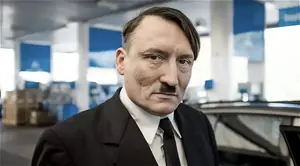
In *Look Who's Back*, Masucci played Hitler as if the dictator had suddenly reappeared in modern-day Berlin. It was a *Borat*-style social experiment that involved Masucci interacting with real people while in character. The results were chilling.
"The casting process was pretty weird because the studio wanted a famous actor and he didn’t want a famous actor because then everybody would recognize the actor on the street, so he needed someone who was not popular at that time so it came to me," Masucci says. "The director told me he wanted to make it like Borat does it."
The preparation involved five hours of free improvisation with psychologists who were told Masucci was a schizophrenic man who believed he was Hitler. When he finally hit the streets in costume, the reaction from the German public was a revelation of the country's hidden right-wing undercurrents.
"It’s very difficult, and to go as Hitler on the streets and interact with people, I had to learn this, I had to cross a line, and I had to prove myself doing this. In the end, I found out it worked," he notes. "The film brought out in a Borat test that there was lots of right-wing thinking in the heads of lots of Germans. I mean, here is a guy who dressed like Hitler, looked like Hitler and claims that he is the real Hitler. And they asked me, 'What are you doing?' And I said, 'I’m shooting a documentary to see what the proper German thinks about Germany.' And they always would say that this is somehow critical and I said, 'No, it’s not critical, it’s totally racist, I’m a racist, I don’t like them. You know, all the black guys, the gay guys, we have to throw them out of the country.' And they would say, 'Are you serious about this?' And I said, 'Yes, of course, but you are not because you don’t dare because you’re a proper German.' Somehow this opened something in the people and then all this shit came out."
Masucci recalls the danger of the role, including being physically attacked by women on the street. Yet, the most surreal moment came during a Nazi rally where he appeared on a balcony, waving to the crowd and throwing both the police and the protestors into a state of total confusion.
"I was waving on the balcony like this and then the right-wing guys, they were looking and then the left-wing guys, the ANTIFA said, 'You can't bring an Adolf Hitler here!' to the right guys, and the right-wing guys said, 'He's not from us.' Everybody tried to say no, no, he’s not from us," Masucci laughs. "Then the media came and I was in character and nobody else could speak to the press so they said to me, 'The right-wing people said they didn’t call you?' And I said, 'Yeah, of course they won’t, because they never stand to their own opinion, you know? These are stupid guys, they don’t even dare to say I’m a National Socialist because this is something which you couldn’t say in Germany, you get arrested when you do this. A Nazi gets arrested when he says I’m a Nazi, luckily.'"
Despite his penchant for controversy, Masucci’s global fame is anchored by the mind-bending sci-fi of *Dark*. He tells me he only realized the scale of the show's success when he was recognized on 5th Avenue in New York while filming another project. It was a far cry from the German critics who initially dismissed the show for looking "too American."
"The press always asks, 'Do all the shows have to look like American stuff now?' And I said, 'Yeah, but what’s German? When it looks shitty?'" Masucci says. "So, you only find out that you’re popular when you travel to the countries. I was on Fifth Avenue and people asked me to do a photo. And I said, 'Yes, of course, I can do a photo of you, give me your cell phone.' And they said, 'No, not of us, of you.' And I asked them, 'But why do you want a photo with me?' and they said, 'You’re the guy from the Dark show, right?' This was the moment I realized that I was a bit popular, more popular than before."
His work continues to span genres, from the dystopian *Tribes of Europa* to the wizarding world of *Fantastic Beasts*, where he stepped in during a period of production turmoil.
"Johnny Depp was replaced with Mads Mikkelsen, which was very funny because in Germany they always call me the German Mads Mikkelsen and now we’re in the same movie having magic wands and playing around; I like him very much," he says. The pandemic didn't slow him down; it just forced him to get creative with an instant pot in a London hotel room during a lockdown that felt like *The Shining*.
Now, he’s embracing the Hollywood machine with *Day Shift*, playing a German vampire alongside Jamie Foxx. Even a broken arm sustained on his way to the US couldn't stop him. He hid the injury from the production until he was safely on American soil, knowing the bureaucracy might have kept him in Germany.
"I wanted to do this movie so we skipped a bit because of the COVID cases and now the arm is healed so I’m fine now. I love being here. I mean, everything’s open," Masucci says. He finds a poetic irony in the fact that he was vaccinated in Atlanta with the BioNTech-Pfizer vaccine—a German invention he couldn't easily access back home.
Oliver Masucci doesn't take the easy roles. He chooses the "thinking roles," the ones that offer a lived experience and a bit of fun. Whether he’s gaining weight for Fassbinder or waving from a balcony as Hitler, he is an actor who understands that the abyss is where the best stories are found.
"Yeah, that’s why I choose them," he says with a shrug. "I choose stuff where I have fun just to think about it which gives me something where I can make some experience for my life at the end.