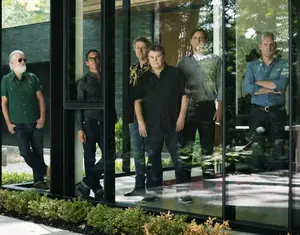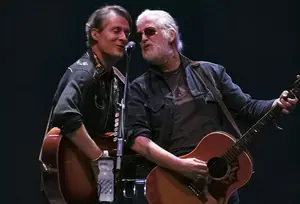

Greg Keelor is less a man and more a permanent fixture of the Canadian geography. As one half of the songwriting engine behind Blue Rodeo, his voice has the weathered, reliable texture of a Hudson’s Bay blanket. It is familiar, slightly frayed at the edges and entirely essential. He is an Officer of the Order of Canada, a title that sounds stiff until you realize Keelor carries it with the casual indifference of someone who probably forgot where he put the medal.
His latest solo effort, *Share The Love*, arrived this year as a quiet companion to a country still reeling from the collective exhaustion of the pandemic. It is a record steeped in his signature brand of musical melancholy. But it is more than just a sad-sack diary entry. It is a sophisticated collision of art and accidental magic.
The version of the album that eventually hit the shelves was never supposed to be the final product. Keelor had spent months meticulously crafting a studio version, only to pivot at the eleventh hour to a live-off-the-floor session. It was a move that prioritized feeling over polish. We caught up with the icon to discuss the logistics of heartbreak, the absurdity of the American road and why hash is still the best co-writer.
Last year, Keelor united with his long-time partner Jim Cuddy and a choir of virtual Canadians to revive "Lost Together" for a nation in lockdown. The song, already a staple of the Canadian songbook, suddenly felt like a communal prayer. We asked if that experience re-validated the track for him.
"Well, it’s funny," Keelor says. "There was one before that to the Fleming College in Peterborough and I had asked my friend, Melissa Payne, to put together a song and she chose 'Lost Together'. I did it first with a whole pile of Peterborough musicians and when I saw the finished video, I was so blown away by it—I thought it was quite beautiful and emotional. Then Canada Sings did it, and the same thing happened. It’s funny how words in a song take on a certain resonance in a different time."
Context is everything in songwriting. A line about being lost in 1992 hits differently when you are literally forbidden from finding anyone in 2020. The song’s origins, however, were far less about global health and much more about the grinding, unglamorous reality of trying to break the American market.
"It was originally written when we were in some suburb of Detroit on an American tour in the early 90s," he explains. "There was a lot of frustration and futility in touring America—there’s a gig every 100 clicks, and you could do it for the rest of your life. It doesn’t mean it’s going to help you get ahead in your career at all, it just means that you will be playing in little bars for the rest of your life. So this was a particularly frustrating time. It was just one of those Spinal Tap pathetic sort of gigs where we were on one side of a canal and the audience was over on the other side of the canal, sort of like a park."
There is a specific kind of indignity in playing your heart out to a crowd separated by a body of water. It turns a concert into a zoo exhibit. Keelor recalls the scene with a dry wit that suggests the sting has finally faded, replaced by the absurdity of the memory.
"So there’s this canal in between us and we’d be playing our set," Keelor says. "I guess this would have been the Casino tour, because that’s when we had the big American release. Every so often boats would go by and most of them were little boats, but the bigger boats created a noise and obstruction that emphasized the absurdity of doing things like this. I got back to my little hotel room and just started writing the song. It was partially a love song to my girlfriend at the time and then partially a frustration with the powers that be, but in the end love is the only answer."
That pivot toward love as a resolution defines much of his new work. The title *Share The Love* sounds almost suspiciously optimistic for a man who usually mines the darker corners of the psyche. But the title track was born from a place of genuine emotional wreckage—a classic Keelor juxtaposition.
"Well, in many of my songs there’s that sorrow, melancholy," he admits. "The song starts with 'There’s a darkness in the soul. You got to close and it took its toll, don’t leave me now or I’ll lose control. There’s a darkness in the soul'. And so I’d gone through a break-up and the death of a friend. They happened around the same time. I was feeling pretty low. I have a penchant towards melancholy just to start off with, so I find it almost a pleasant place to hang out and invite her in and ask her if she’d like a cup of tea or hang out for a while; have a chat."
There is a comfort in that sadness. For Keelor, it is not a pit to escape but a room to furnish. He found the eventual light for the record during a trip to a remote community on James Bay, a place that felt like the literal edge of the map.
"So I was in one of those sort of heartbroken spots and we went up to a gig up on James Bay, on a reserve," Keelor says. "It really felt like the end of the world. I was in this little hotel room and I had this verse for the song. Sometimes when I’m in that sort of deep melancholy, this sort of parallel universe uncovers and I can feel like the monsters that generate this sorrow can become the opposite and lead me to a positive place. I was walking around this reserve up north and there was this beautiful folk art piece that was on the wall of a building and it just said, 'Share the Love'. It just sort of lifted me out of my blues. I just thought it was such a beautiful phrase and it just shot a beautiful light in my heart. So it became the chorus of a song."
The technical execution of the album is where Keelor really shows his veteran status. In an era where every vocal is tuned to death and every drum hit is snapped to a grid, he opted for the high-wire act of live-off-the-floor recording. It is a risky move that relies entirely on the chemistry of the room.
"This record has a funny story for sure," he says. "You know, a lot of this record came out of heartbreak and a lot of this record came out of meeting a new love and the infatuation that comes with that. We would just sit around, smoke some hash and sing and sing and sing. Then we decided to do a record folk/country covers. We started doing that and as we were doing that I had some original songs hanging around, so we would do them if we finished early. By the time we finished the country record, we had finished, five or six of my songs. Then I realized that was not too far off from putting together a whole record together. So I recorded a few more songs and had the original studio version of 'Sharing The Love' done to the point where we got acetates back—it was ready to go."
The record's great, but there was just something about a band playing these songs live in a room that had an energy that we couldn’t resist. ... I thought I was just doing some promo videos for the record, but it ended up being the record and that doesn’t happen too often.
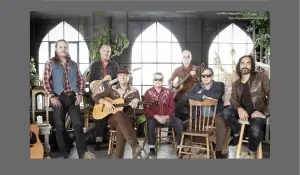
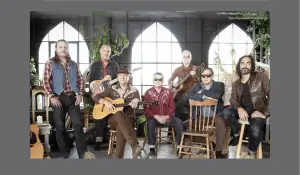
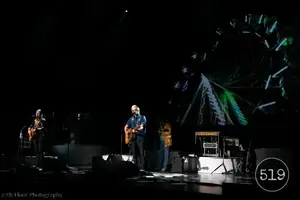
But the studio version lacked the grit of the moment. To generate promotional content, Keelor and his band retreated to Gores Landing on Rice Lake. They set up in a small community hall, the kind of place that smells of floor wax and old wood, and simply played.
"These days, you want to have a lot of visual information for the release of your record," Keelor explains. "So we went over to this little community hall over on Gores Landing over on Rice Lake, about a half hour East of here. I live in a little town, about an hour outside of Toronto, and it’s like a totally different world, a lovely little valley. So we went over to Gores Landing, we set it up and we filmed the whole thing. We recorded the whole thing and when we got it back, everybody liked it better than the record. The records great, but there was just something about a band playing these songs live in a room that had an energy that we couldn’t resist."
The decision to scrap a finished studio album in favour of a live recording is the kind of move that makes label executives sweat. Fortunately, Warner Music Canada head Steve Kane saw the vision.
"We sent that to Steve Kane, the head of Warner Music in Canada, with a little suggestion that we like the live thing better than the actual record, and he agreed," Keelor says. "So now that the record is from the live performance from Gores Landing, every song was filmed and they did a fantastic job too. It’s a nice problem to have. They’re talking about releasing the original recording from the studio, on National Record Store Day, so there’ll be two versions."
There is a visceral, gut-level reaction when you listen to *Share The Love*. You can hear the air in the room. You can hear the slight imperfections that give the music its humanity. It feels isolated but intimate, a byproduct of the strange times in which it was conceived.
"I would go with that," Keelor agrees. "I’ve played a lot of music during COVID with these people. Jimmy Bowskill has a studio in Cobourg, and it’s nice that we can spread out and still play music, just singing old country songs, old folk songs or pop songs, we just sit around with guitars and play music. We all love guitars and songs so much that, given the chance, I had a batch of songs, it attracted a great group of people. I think everybody just really enjoyed being able to play in that way, that it was being recorded, and filmed. Everybody was comfortable and relaxed with the material. You can plan these things and it never works out. There’s no guarantee when you do this stuff. That was a nice surprise. I thought I was just doing some promo videos for the record, but it ended up being the record and that doesn’t happen too often."
For many, the pandemic was a period of stagnant "funk." For Keelor, it was a necessary reprieve from the physical toll of the road. His relationship with touring has become complicated over the years, mostly due to the sheer volume and the neurological tax of constant travel.
"Well, for me not being on the road was really good for my head," he says. "My ears are very sensitive and then they can get blown out. When I start a tour, with each gig, my ears and head just get a little worse, and I don’t play electric guitar anymore. There’s no amps on stage. It’s still the travel, the volume, the consistency of playing every night. We’ve chopped it down immensely, but it still wears me down mentally and physically—my head gets really sore and tired and confused, and it can get a little neurotic and paranoid as it gets more fatigued. It was nice for me to have a little break from all of that. Then it was nice to be able to spend time with songs and just not having to go through getting unbalanced again by going on the road first stretch."
This forced hiatus allowed him to sink into a creative bubble in Northumberland. While Blue Rodeo is a democratic machine that requires all gears to be in the same city, Keelor’s solo work is more agile. It is built on the immediate surroundings of his farm and the local talent nearby.
"It was a group of songs that came together at a certain time inspired and motivated by the same circumstances," Keelor says. "Blue Rodeo wasn’t scheduled to make any record or do any recording. Blue Rodeo has a harder time during COVID because we’re all in different places. I have this lovely little creative bubble out here in Cobourg and Peterborough area. Peterborough has had bad COVID incidents, but where I live Northumberland, it’s been minimal and the same with Cobourg. But then I had no desire to go into the city anyway, and because I’m a 66 year old diabetic, I’m in that high risk. If I get the regular flu, I end up in the hospital because of the diabetes."
Keelor admits that the early days of the pandemic sent his imagination into overdrive. He wasn't just cautious; he was convinced a dystopian film was unfolding outside his front door.
"When it first started, I had friends shopping for me, I didn’t even go out—I was that freaked out," he says. "I thought it was going to be way worse than it is. I thought it was going to be the hazmat army patrolling the streets and picking people up and taking them away, I got total Spielberg about it. It was nice to have this group of people around, and to be around these inspiring musicians, so we just kept on recording."
One of the standout tracks, "Wonder," anchors the emotional weight of the record. It is a song that bridges the gap between the mourning of a friend and the electric shock of a new connection.
"That’s the song about a very dear old friend of mine who died," Keelor says. "Around the same time, a relationship ended and that would have been the beginning of the summer ‘19, ‘18. I was totally devastated. It’s a funny thing, my life, these devastations on a cycle or a pattern, and I really had to examine why this kept on happening to me. So it was a tough summer. I was writing all these heartbroken songs and then at the end of the summer, we had a gig out in Vancouver at the Skookum Festival. It was so great. So many of my friends were there hanging out. Whitehorse was there, Sarah McLachlan was there, Buffy Sainte-Marie was there, Barney Bentall and Dustin Bentall was there and it was just a great scene. I was still feeling low and when I get low, it takes its toll. And I started dragging my heart around."
But the Rickshaw Theatre in Vancouver provided the setting for a turning point. It is a gritty, legendary room where the ghosts of punk and folk collide, and it was there that Keelor’s luck shifted.
"After the show, Dustin Bentall brought a friend of his backstage to meet me," Keelor recalls. "Her name was Kaylee and it was a little bit of love at first sight. We went to the Rickshaw, which is a bar in Vancouver, where there was an after party going on. After the festival, Whitehorse was playing, Jim was playing, Dustin Bentall was playing, a lot of people at the Rickshaw were playing. The song says 'We were hanging out at the Rickshaw listening to the band through the wall, your eyes and smiles sparkle like the sound of that steel guitar'. It’s a song about infatuation, and describing the moment that I met Kaylee and hung out. It’s a nice little snapshot of that moment."
The album opens with "White Dove," a track that feels like a mission statement for Keelor’s lifelong obsession with the six-string. It was a choice suggested by his manager, Susan Gentile, following a near-miss booking at Massey Hall.
"That song was written by Susan Gentile, my manager and friend," he says. "She called me up to tell me that when Massey Hall was closing, they were thinking of doing a show where we (Blue Rodeo) would open up for Gordon Lightfoot. Gordon Lightfoot and Blue Rodeo have played Massey Hall more than anybody. Gordon’s played 150 times, and we’ve played it 37 times. We’re in second place to Gordon’s Gretzky record, never to be broken. It never came about. But after she called me, I was just dumbfounded with the luck and success that I had had as a singer, songwriter and guitar player."
The song is a time machine. It takes Keelor back to the mid-70s in Lake Louise, long before the platinum records and the Order of Canada.
"I just thought back to the first guitar that I ever picked up," Keelor says. "I worked in Lake Louise for a couple of years, from ‘74 to ‘76. It was the first winter that the Chateau Lake Louise was ever opened. Jim had a Mann guitar and I had a little white dove on the headstock and doves on the pickgard of mine. I would sit in the room that we shared in Lake Louise and he had two song books. He had The Everly Brothers and Gordon Lightfoot and I would learn the chords from those two books, singing those songs over and over. I just thought those moments where if you could just go back and tell that guy, you’re gonna play Massey Hall the most times, second Gordon Lightfoot, it’s just something that I would never believe. So that song is just a reflection on my younger self, and how much I love guitars."
Keelor’s love for the instrument isn't about hoarding expensive gear. It is about the specific utility of the wood and wire. He is a player who looks for a feeling rather than a serial number, though his "tools" are certainly enviable.
"I’m not a big collector, in that sense," he insists. "I need a few different guitars for the sounds that they provide, like this guitar here—a 1958 D-18 guitar is about as perfect a guitar for songwriting as you can imagine. It’s intimate, the tone is gorgeous. I like to get high when I’m playing guitar, there’s no doubt about that. I have a few Gretsches, I’ve got a few Martins. I just love what guitars do. How we can share music together, join voices together, it’s like a drug."
And then there is the actual drug. Keelor has never been shy about his affinity for hash, a substance he views as a legitimate creative fuel. In a post-legalization Canada, he finds the newfound transparency of the culture refreshing, even if it hasn't changed his personal habits much.
"Yes, it’s very nice that I don’t have to worry," Keelor says. "I never worried too much about it anyway. I’ve been out on this farm for 30 years. All my heroes smoked hash—they played, smoked and wrote. Leonard Cohen, Neil Young, John Lennon, Bob Dylan—they all talk about how they like hash and the songwriting."
When asked which track stands as his definitive tribute to the substance, he doesn't hesitate.
"Well, I think I have a song," he says. "'Tired of Pretending' is a little love song to a piece of hash burning in the ashtray."
It is a fitting image for Greg Keelor: sitting on a farm, guitar in hand, a bit of smoke in the air and a song that manages to be both heartbreaking and hopeful at the same time. *Share The Love* isn't just an album; it is the sound of a man who has finally stopped trying to beat the American road and decided to enjoy the view from the valley.