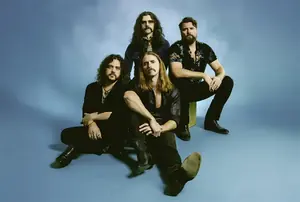

Sitting in a cramped green room with a lukewarm coffee, you realize the narrative of the "overnight success" is almost always a lie. It is a convenient fiction sold by labels to make the grind look like magic. But for The Blue Stones, the Windsor duo consisting of Tarek Jafar and Justin Tessier, the magic is actually just a decade of scar tissue and highway miles. They have been at this for nearly 10 years, playing to empty rooms long before the industry decided they were the next big thing.
The trajectory changed recently. Their single Shakin’ Off The Rust did not just climb the charts; it parked itself at number one on the Canadian rock radio rankings. Then came the JUNO Awards nomination for Breakthrough Group of the Year. It is the kind of validation that usually changes a band, but Jafar and Tessier still carry that blue-collar Windsor chip on their shoulders. And that is exactly why they are winning.
The calendar is currently a blur of service stations and soundchecks. They are hitting Canadian venues throughout Mar. before pivoting to a massive US run that lasts most of the summer. It all leads to a heavy-hitting date at RIFF Fest at the DTE Energy Music Theatre in Detroit on Jul. 18. Sharing a bill with Rob Zombie and Halestorm is a long way from the small clubs on Ouellette Avenue.
Tarek Jafar calls in to talk about the madness. He sounds tired but wired, the typical state of a musician whose life just accelerated from zero to 100. We start with the sheer weight of the last 24 months. The transition from local heroes to national contenders is a jarring shift for anyone.
"Not too shabby, that’s for sure," Jafar says regarding the recent accolades. "We’re obviously super honoured to even be nominated and it’s been a pretty crazy year. We’re just having fun enjoying the ride and very, very excited for what’s to come as well."
The band is not entirely new to the JUNO circuit. They were part of the chaos in London last year during Juno Fest. It was a trial run for the madness they are currently experiencing. Watching them navigate those crowds, you could tell they were taking notes, scouting the industry players like athletes watching film.
"We were a performer there at the Juno Fest," Jafar says, reflecting on the London experience. "It’s nice to be in the city with all of these Canadian artists gathered around. A lot of the Canadian industry is in the same city as well, so it was a fun experience to be a part of."
This year, the circus moves to Saskatoon. The stakes are higher now that they are actual nominees rather than just another band on the showcase list. But the schedule is punishing. There is no time for the champagne-soaked parties the public imagines.
"We’ll be there," Jafar says about the Saskatoon trip. "We’re going to be hopping between the dinner and the show that we have to play, but the work never stops."
And that is the reality of the Canadian music industry. You can be the biggest rock band in the country and still be "hopping" between a formal dinner and a loud club show in the same night. But for a band from a border town like Windsor, the domestic recognition carries a specific weight. For years, The Blue Stones were a classic case of a band being more famous in the US than in their own backyard.
"It’s an amazing way to be recognized by your own country," Jafar says. "For a long time, we didn’t think Canada was really into our stuff, even being Canadians. We are a little bit more well received in the States. It feels good though to finally have our home country give a little bit of recognition. We feel like we’re doing something for our country."
There is a distinct pride in that statement. Canada has a habit of ignoring its own until they find success elsewhere. But Jafar is a fan of the scene he is now leading. He talks about the JUNOs not as a trophy hunt, but as a fan of the craft.
It’s an amazing way to be recognized by your own country. For a long time, we didn’t think Canada was really into our stuff, even being Canadians. We are a little bit more well received in the States. It feels good though to finally have our home country give a little bit of recognition. We feel like we’re doing something for our country.
"There’s always good performers," Jafar says. "Even this year there’s some amazing performances that are going to be present. I know Glorious Sons are performing and they’re an absolutely amazing live band. I think that’s probably what sticks out to me, is the performers that have been at this award show. Daniel Caesar, I believe is one this year too, which is going to be great."
The conversation shifts to the song that broke the doors down. Shakin’ Off The Rust is a rare beast: a rock song with a groove that actually works on modern radio. Most rock bands today try too hard to sound like the 1970s or the 1990s. The Blue Stones just sound like they are trying to survive the 2020s. Jafar recalls the moment he realized the song had hit the summit while they were in the heart of the industry machine.
"It’s funny because we were in Toronto and then we had just left the label’s office and they sent us a message saying, 'Hey guys, guess what? You guys are number one on rock radio,'" Jafar says. "It was nice having just left the offices, and feel oh wow. They’re probably pretty happy about that one. Yeah, we were in Toronto. we were ecstatic. It’s like super exciting."
But the song was born from a place of genuine creative anxiety. It was not a calculated hit. It was a desperate attempt to get out of a rut. Jafar describes a period of writer's block that would have broken a lesser artist. He was staring at the success of their previous album, Black Holes, and feeling the walls close in.
"It was actually one of our more recently written songs," Jafar says. "I was just in my apartment and I had come off of like a stint into writing songs that I really didn’t like. Everything I was writing felt like it wasn’t good enough. It wasn’t bashing the caliber that I thought we had set for Black Holes, the album previous. I just felt like I wasn’t doing it well anymore. Then I just took things back to the roots. I started with an easy four on the floor beat, nice stomp beat, and a cool riff that I was playing around with in my head. I wrote this song around the idea of not thinking that you’re good enough and not thinking that what you’re making is of a good quality, but sort of brushing your shoulders off and coming through with something that you’re confident in."
The visual identity of the band is also evolving. The video for the track felt different—less like a standard performance clip and more like a commentary on our digital isolation. It featured a VR-based concert theme that felt uncomfortably prophetic.
"Yes it was," Jafar says of the video shoot. "It was just a one day shoot. The director had this really quirky idea of playing with the idea of having a VR based concert, sort of like a funny black mirror vibe to it, but it was a lot of fun. It was like a lot of high spirits on the set. It was nice to have the fans as our extras because it felt like a family affair that way."
Then there is the new single, Grim. If Shakin’ Off The Rust was the bridge, Grim is the destination. It is darker, leaner, and carries a rhythmic DNA that you do not usually find in a guitar-and-drums duo. It is where Jafar’s personal listening habits finally bleed into the band’s output.
"Grim is more of a representation of the sounds that are to come," Jafar says. "I think it’s a good example of our wide influences. I listen to a lot of hip hop and R and B, and I feel that is injected into a rock which is the grim rift. That’s probably my favorite song that we have ever written. It’s just so much fun to play live too. It translates really, really well. Yeah, that’s got my hip hop and R and B influences in there for sure."
The video for Grim documents their recent European trek. It is a travelogue of a band realizing they have a global footprint. For a couple of guys who started in a Windsor basement, seeing their lyrics shouted back at them in a different time zone is a surreal experience.
"Honestly, shockingly well," Jafar says of the overseas reception. "It was amazing to have, but we had about 10 sold out shows on our European run. It was amazing to see people on the other side of the Atlantic, just absolutely loving the songs and knowing the lyrics through and through, and singing along to the music. I mean, we’re just a couple of guys from Windsor. We would’ve never expected that, but it was shockingly positive. I mean that goes to say for a lot of Canadian bands right now. I feel like Canadian music is really taking the world by storm. It’s funny how many people are at our shows reference other Canadian bans that were like, yeah, it’s just a movement right now and we’re just so happy to be a part of that."
This evolution is not accidental. The jump from Black Holes to the new material shows a band that has grown tired of the "garage rock" label. They are aiming for something more polished, yet somehow more aggressive. It is a difficult needle to thread.
"I think it is a mix of both," Jafar says regarding their organic versus purposeful growth. "I mean definitely, organically, Black Holes was a great way to put our foot in the door of the public eye, but then after that album, we were feeling it was written a long time ago. Over time we changed as people, we changed as musicians. It’s organic in the sense that our natural evolution of influences over the past six years has now been ejected into the new music. It was purposeful in a way where we want to make sure we show people that we’re still the Blue Stones that you know and love, but there’s something more than just your standard rock duo to us."
A major factor in this sonic shift is the presence of Paul Meany. As the frontman of Mutemath, Meany was a pioneer of blending organic instrumentation with high-level production. His influence on the new Blue Stones tracks is obvious. The drums are crisper, the textures are deeper, and the overall "theatre" of the sound has been elevated.
"We started working with a new producer, Paul Meany, who’s been an absolute hero of ours since 2009," Jafar says. "He was a front man of a band called Mutemath, which we both adore, but bringing his production mind to the whole project was amazing. He has such an awesome perspective on our music while still maintaining an anchor to who we are. He doesn’t want to change us. He just wants to amplify and show us as an evolved version of ourselves and he did an amazing job of that. He definitely has a slicker approach to production, but definitely in a way where you can still hear the grit. It’s just polished."
If you are looking for a roadmap of where the band is going, look no further than these two tracks. They are not outliers. They are the new standard.
"They’re definitely a sample of what’s to come," Jafar says. "I think by listening to Shakin’ Off The Rust and Grim, you’ll get a pretty good idea of what kind of music that is in store for the next album."
Reflecting on the 10-year journey, it is clear that the duo’s biggest strength is their limitations. Being a two-piece forces you to be clever. You cannot hide behind a wall of session musicians. Every note has to count, especially when you are translating studio wizardry to a live stage.
"I guess that’s tough to say," Jafar says of their decade-long evolution. "I still think both Justin and myself play the music that we want to hear. That’s just always been our motto. I feel like over time we’ve become more experienced as far as musicians, just playing a lot of live shows and hitting the road so much. You just have that knowledge and experience from that and then also playing with a bunch of different bands, you draw influences from them. I feel like there’s a little bit more of a purposeful angle to our studio time where we’re constantly thinking, how is this going to translate live, because our live show is so important to us. When we are recording something in studio, we’re thinking, 'Okay, how are we going to do this live?' In a way that could be limiting, but to us, we see it as a welcome challenge because it’s just a cool way to take a studio song that has more than just two instruments on it and trying to figure it out how we’re going to perform that one live, with just us two guys."
But with success comes the inevitable weight of expectation. The "sophomore slump" is a cliché for a reason. It is the moment where the industry’s pressure starts to poison the creative well. Jafar admits they felt the heat, but they found a way to navigate the noise by looking back at their own history.
"I guess there was an extent of pressure," Jafar says. "We felt because of the relative success that we had with Black Holes, we had set a bar for ourselves that we wanted to exceed. There was always this looming idea of the sophomore album slump that we wanted to avoid as much as possible. In a way, there were some times where we felt as if we didn’t know what we’re doing was good enough and are we doing anything better than what we used to do. I think that dissipated over time and we realized that we were comparing our demos for the new album to a completely mixed and mastered song that was on Black Holes. When we went to visit the old demos of the Black Holes music, we realized they were in the same position as these ones were now. I think we got over that pressure pretty quick."
The Blue Stones are no longer just Windsor’s best-kept secret. They are a case study in why the long game matters. And if the new tracks are any indication, the rust is not just off—it is long gone.