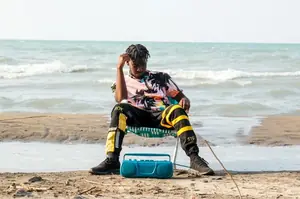


Watching Gramps Morgan sit back in a Nashville studio, you see a man who has finally figured out how to merge the jagged edges of a touring life with the smooth finish of a premium rum. He is a Jamaican titan, a Grammy winner, and a record executive who carries the weight of the Morgan Heritage dynasty on his broad shoulders. But his latest solo effort, *Positive Vibration*, feels less like a corporate obligation and more like a long-overdue exhale.
Holding the physical pressing of this record, you can almost feel the humidity of Kingston clashing with the crisp air of the Tennessee mountains. It is a strange, beautiful hybrid. The album is the result of an unlikely pairing with Canadian country mainstay Johnny Reid. On paper, it sounds like a label-forced gimmick. In reality, it is a soul-deep collaboration that bridges the gap between the islands and the prairies.
Gramps is not just a singer; he is a bridge-builder. His life is a series of Canadian connections that go far beyond the recording booth. He is married to Dr. Annabelle Manalo, a Canadian-born cell and developmental biologist who has spent her career pushing the boundaries of medical science to save their son. This is a family that lives at the intersection of faith, science, and the creative power of the plant.
When asked about the genesis of this new collection, Gramps leans back, his presence filling the room. He says, “Well, the album is full of sunshine, it is truly something that I believe the world needs now. Of course, there’s always been great Reggae albums and great Country Albums. But this is one of the first I believe that we were able to accomplish. I don’t know how it happened, but the universe brought me and Johnny Reid together. It is truly an example of two amazing worlds coming together to say one amazing message and it’s to stay positive, enjoy your family.”
There is a technical precision to the production that Reid brings, a Nashville polish that does not strip away the grit of the reggae rhythm. It is a delicate balance. Gramps finds himself in a new headspace, one defined by a specific kind of geographic peace.
He continues, “I feel fun wearing Hawaiian shirts where I reached a point in my life that I can just relax, take a sip of rum and then think of myself being taken away, whether it’s in Gatlinburg, Tennessee in the mountains visiting Dollywood, or going to the islands of Jamaica, Cayman Islands or the Bahamas. But I find that space where it’s your peace, when anyone’s looking for you, you saying hey man, it could be in my backyard by my pool, it could be my family at a barbecue, or down by the lake, but to find that inner peace within yourself, that’s what I was able to accomplish within this pandemic.”
It has been nearly a decade since his last solo outing in 2012. In the industry, that is an eternity. Most artists would have faded into the background or become a legacy act. But Gramps was waiting for a spark. He was busy being the anchor for Morgan Heritage, the "day job" that has seen him traverse the globe dozens of times over.
His son, Jemere, was the one who kept poking the fire. Gramps recalls the pressure from within the family. He says, “During touring, my son, Jemere Morgan, which is also on this album, he always said to me, ‘Dad, when are you gonna work on a new solo album, it’s just something special when you do a solo album?’. Of course he was there during the first one and the second one and people really got a chance to enjoy my voice.”
The timing had to be organic. You cannot force a record like this. It requires a specific alignment of stars, or in this case, a specific meeting at a sports arena.
He explains the delay with a shrug, saying, “The focus was with me and my brothers, Morgan Heritage throughout the years, that’s my day job, but it’s something special when I do a solo album and I told my son, when the right time comes for the right reason and with the right person. I didn’t know who it was gonna be, I didn’t know when it was gonna happen. I didn’t know if it was gonna be 10 years, 20 years from now and boom, I walk into a hockey game here in Nashville, Tennessee at my home. And I go to this hockey game, and I meet Johnny Reid. And I’m like, Okay, cool. And he wasn’t doing anything. We were kind of bored, everybody else was talking in the lounge, and I’m watching the hockey game experience in this game that I love.”
That chance encounter turned into a professional courtship. Reid, known for his blue-collar anthems and massive Canadian following, found a kindred spirit in the reggae giant. They did not talk business at first. They talked about the craft.
Gramps says, “He invites me to his recording studio and he said, Hey, man, how’s it going with the pandemic. And I told him, Hey, man, I just want to become a better songwriter, you know, if I could take the time to become a better songwriter, I’m happy with what I was able to accomplish with all the awards and all the audiences that we’ve played around the world, but I would love to improve that.”
The humility is striking. Here is a man with a trophy case full of hardware asking for lessons in composition. It worked. Reid opened the doors, and the floodgates followed.
Gramps describes the sessions with a grin. He says, “He said, Hey man, come on over mate. Come on over to the studio mate. And I said, Okay, and went to the studio, and we just started writing some songs, and I’m like, wow, you’re an amazing songwriter. He was a fan of me. I ended up being a fan of him. And it just produced this magical things. So God, and the universe said, Okay, this is the right guy. This is the right time. And each song was magical. My son was just like, Yes, Daddy yes Daddy, and remind you this is a big grown kid, which he’s now doing his own music as well. But he’s been one of my biggest supporters and my fans from day one, as well as my brothers, they always want to say Yo, push yourself, because I’m kind of like, easy.”
This "easy" nature is his trademark, but the album shows a more disciplined vocal performance than we have seen in years. He credits his team in Toronto, Halo Entertainment Group, for keeping the momentum. He says, “I just want everybody to be happy and barbeque and good vibes. I never really pushed myself. And with this project, it allowed me to just be an artist relaxing, my team there in Toronto - Halo Entertainment Group - Tracey, just, I’ve been blessed, you know.”
One of the standout tracks, “A Woman Like You,” serves as a definitive lesson in adaptation. Originally a Reid staple, Gramps flips it into a reggae-infused anthem that feels entirely original. The music video is stripped down, avoiding the flashy, distracting tropes of modern pop.
Gramps breaks down the production of the track. He says, “Oh, thank you so much. It was amazing. Johnny Reid makes me, as a producer, many people may probably know him as a producer, but an amazing songwriter, as an amazing performer and artist. But working with Johnny and when I sang that song, it was just like, the reggae version of it. It was just a beautiful song already. Right? But I felt some of my audience would love to hear this rendition, a reggae rendition of the song. Because the lyrics are for grandmother. It’s for the auntie. It’s for a father experiencing his first child that happens to be a daughter, so it’s not necessarily a love song to your personal relationship, but it’s the love song to the female gender. It’s a love song to your daughter, your grandmother, your auntie many men have been grown by their grandmothers or their aunt, or sometimes even their sister.”
My mother used to be a babysitter for the Jackson Five in New York City... My mom was one of the babysitters, they wanted a strong Jamaican woman to keep Michael, Tito and the others in line and to keep them disciplined. Caribbean nannies have always been something special. We are people of discipline, principle, culture and love, which a child needs out of all of that, especially when their parents are not around.
It is an emotional pivot. He is not just singing about romance; he is singing about the maternal and familial bonds that define the Caribbean experience.
He continues on the song’s depth, saying, “So it’s a song of appreciation, a song of devotion and dedication. That’s the kind of song that this really is. ‘Hey, have I told you’ (sings) you know, it’s like, who sings like that? Who says those words and that is what I’m talking about when you talk about the songwriting and knowing the right words to say because there’s been many love songs. But not many songwriters can write a love song the way it’s supposed to be.”
Visually, the record’s singles—"People Like You," "Runaway Bay," and "A Woman Like You"—embrace a minimalist aesthetic. In an era of over-produced, CGI-heavy visuals, Gramps opted for something that lets the lyrics breathe.
He says, “Yeah, it really is and shooting my latest videos. I did “People Like You”, “Runaway Bay” and “A Woman Like You”, and one of the things I’ve learned, even me and Johnny brainstorming together is that when there’s too much in the music video, it’s like it takes the viewer away from the song and the essence of the song, if you understand what you know. I’ve learned that working with Johnny that when the videos more simple people listen, you’re still, right? But if it’s like boom, here and in a beautiful shot here and you’re distracted from the true mission of the words absorbing your heart and your spirit, that’s what I believe that we are able to accomplish with this project, even shooting the music videos.”
Naturally, the solo success raises questions about the future of Morgan Heritage. Fans are always wary of a "hiatus" becoming a permanent split. But Gramps is quick to dismiss the idea of a breakup. The band is a brotherhood, quite literally.
He clarifies the band's status, saying, “Not at all, like I said, it was nothing planned. We were just home like the rest of the world and the pandemic and we had nothing to do and I went to a hockey game, right? This is at the beginning before they shut down sporting events and it was just to be careful and wear a mask and I want to tell you, there was no A&R there was no big marketing team and, you know, we’re just kind of catching up to this project because it formed out of the universe, if you understand what I mean, it kind of just came out of nowhere. We’re kind of like having to catch up and so it’s no indication.”
Family is the tether. There is no escaping the Morgan bloodline. He adds, “We say, Morgan Heritage for life, actually, they are my biggest fans. They’re like, go, go, go, go. Gramps you sounded amazing, so, whatever happens, we’ve accomplished so much and toward the world. I will always tour with my brothers and that’s my family. How do you get away from your family that you love, you know, some people want to be away from some of their families, but I don’t have that problem. So it’s a situation where they are my biggest fans, and they are pushing me like, dude, you can’t stop now you got to keep going, you got to keep going wherever it leads to, and I look to take my music to the four corners of the earth.”
He even envisions some extreme Canadian tour dates. He says, “I’d love to play and all the way up in Halifax, Canada, when it’s 40 below, and I want to experience that wearing a big fur coat singing for the Eskimos, so for me, it’s not really about, okay, an indication of going on hiatus again. But it’s just following the universe. It could be next year, me and Johnny Reid touring. Some of that time could be divided between Morgan Heritage touring, Gramps Morgan touring with India Arie or anything’s possible, but no indication of another hiatus.”
To understand the second generation, you have to look at the first. Denroy Morgan, the patriarch, was the one who set the blueprint. Gramps recalls a childhood steeped in the haze of creativity and smoke.
He says, “Growing up, we saw dad writing songs and smoking his joint on the couch and writing songs, and it would be like, What is he doing? So, like I say to a lot of people, parents are their children’s first role model. So you really have to be careful as a parent raising a child on what you expose them to. Thank god my father exposed me to music and watching him prepare rehearsal. I remember one tour, he was going out with Frankie Beverly and Maze, which I had no idea who that was, I just saw my dad doing this thing and playing music. I didn’t realize his life until I got a little older. I was like, wow, dad, that’s what that square vehicle was in front of the house. It was a tour bus. It just shows the innocence and pureness of a child, there was no hype. I just saw my dad going into this big bus and pulling off and they had radios and headphones in the bunks. I’m like, oh, wow, this was in what may be 1983.”
Denroy’s sacrifice was the family’s gain. He stepped back so they could step forward. Gramps notes, “My dad has really done so much for this music. But what I love him more so is for putting into me and my brothers and sister, it’s not easy to put down your own career, and all of a sudden begin to invest in your children, and he saw the talent in us.”
Interestingly, Gramps almost took a different path. He was a football player first. It took a blunt conversation with a coach to steer him back to the stage.
He says, “I used to play American football and after I left high school, and my dad kind of said, that’s not your true calling, and my football coach, Mr. Coach McGlothin, a very strong Irish man, I would say hello to him. I just thank him for looking at me and say, Hey, you can play football till maybe in your mid 30s. But you can sing forever. So it’s your choice. And it’s the greatest advice he could have ever gave me. And I took his advice and made the choice to focus on music. And here I am today speaking with you.”
The musicality was innate. He was a prodigy before he even knew what the word meant. He says, “Absolutely, from a very small age, just pictures of me playing the piano at two years old. My dad would tell me stories that I would mimic his songs with one finger. There was a song called “I am not coming back with water but with fire”, and I would play it with one finger and my dad turned around and said, “Oh, my God, who just played that?”, and it was me at the piano at two years old, playing with one finger and at that point, he said this kid is gonna be something.”
That "true calling" is what he now preaches to his own children. He says, “So it’s just a blessing to have him here still in the flesh and share stories like that with me as a grown man to say ‘What I did that?’ and then it makes sense and makes me understand the true calling because way of life in the journey of life, we can sometimes get distracted or be even inspired, if you want to call it that. But your true God given gift is a lot of times your parents see at first, and that’s why I always push my friends to listen to the elders around you, your auntie, your mother, your grandmother, your uncle, because they’ve been through things that you haven’t been through and are going to go through, which will help to guide you.”
The Morgan family history is a tapestry of hustle. From Jamaica to the streets of New York, the stories are legendary. His mother, for instance, was once the disciplinarian for the biggest pop stars on the planet.
Gramps shares, “I knew my father was a butcher and he was a barber. I knew my mother used to be a babysitter for the Jackson Five in New York City, when they used to leave from Gary, Indiana to have business meetings in New York City at their record label. My mom was one of the babysitters, they wanted a strong Jamaican woman to keep Michael, Tito and the others in line and to keep them disciplined. Caribbean nannies have always been something special. We are people of discipline, principle, culture and love, which a child needs out of all of that, especially when their parents are not around.”
That immigrant spirit is the bedrock of his success. He says, “Those are just some of the things and the fun things I’ve heard as an adult to say, Wow, you even if it was one day, a babysitter for Michael Jackson and his brothers and then you hear about my dad coming to the United States with $100 in his pocket and trying to find life. So I always say to my dad, ‘Daddy, no matter what you were able to come to this country. And as long as you have more than $100 in your pocket, you’re in a profit zone. So be thankful and just continue to share your story. He has such an amazing story, the story of an immigrant to say you can come from anywhere in this world, which makes North America one of the greatest countries in the world. Especially between Canada, a lot of Jamaicans have come to Toronto, Montreal, and Vancouver, where people come and try to find a better way of life to take care of their families. That’s one of the greatest things about my history, knowing my father, knowing how to take an opportunity and turn it into something.”
Morgan Heritage’s longevity is no accident. It is the result of a work ethic that borders on the obsessive. In an industry of flash-in-the-pan viral stars, they are the marathon runners.
Gramps explains, “Our willingness to work hard, that’s the greatest thing. Our willingness to work hard, our work ethic, and a lot of people’s work ethic, they want to get to the big dance, but don’t want to know the process, the process to working to get there, nobody wants to do the work. But everybody wants to get there. That’s the difference between my band Morgan Heritage and a lot of other bands that they’re not willing to put into work or make the sacrifice. There are a lot of times that we spend away from our family.”
He recalls the lean years with a sense of pride. He says, “I remember there was a time when we toured for 18 months with 11 days off. It’s a situation where it’s just the energy of knowing and doing. You know your mission, you know what you’re trying to accomplish, and you just got to stay on it, and we’ve made the sacrifice. I remember playing at this venue called, Cat’s Cradle in North Carolina, and there was only one person that paid to come and see us. one ticket we were able to sell in 1994. My dad said, ‘It’s okay. It’s okay. Go out there and perform like it’s 10,000. This is your lesson, and you will remember this show for the rest of your life.’ And he was right. You know, it’s not the great shows where I played for 300,000 people opening up for Lenny Kravitz or Jewel, you remember those two, but it’s what brought you to where you are today and I’ll never forget that show Cat’s Cradle in Greensboro, North Carolina.”
On *Positive Vibration*, you get the man, not just the band member. It is a more intimate, vulnerable vocal take. He says, “With this last Morgan Heritage album, it’s a collective of some of our greatest hits, which is called Legacy and with the Gramps Morgan project. First of all, you get a lot more Gramps Morgan vocals. With the Morgan Heritage it’s split between me, my brother Mojo and my sister Una. So, you get sprinkles of Gramps, here it is where somebody says, Oh, I want to hear more of Gramps. Here you go. Here it is, right. And you get to enjoy that number one and number two, you get to enjoy my emotions. Because I’m a very emotional, lovey, I’m a big teddy bear. And I love people. I love so many different cuisines. I love different people from different parts of the world, that’s Gramps, if you get to know me, I bring people together from all different walks of life. I’m known for that.”
The album reflects a man who has reached a state of "Hawaiian shirt" bliss. It is about slowing down. He says, “But one of the biggest things is that when you listen to this album, it is truly the definition of where I am in my life today. I never drank alcohol my entire life because I just thought it was like, okay, focus, workout, stay healthy, focus. But at this point of my life, now, it’s almost like, you’re ready to retire. I got my Hawaiian shirt on, I just feel comfortable, and I feel fun. And when I have on shirts like this, I don’t know what it is, it makes me feel like I’m in the islands, no matter where I am, I could be in Alaska and it just gives me the essence of where I am in my life, you know, enjoying my kids.”
The pandemic was the catalyst for this realization. He says, “The pandemic is what really made me tune into that, because the world stood still. No one could go anywhere. I had five months of tours lined up and God said, ‘No, relax, take it easy. Put on a mask.’ It’s the small things like going to have an ice cream with my son, taking my kids bowling and just enjoying the small things. A lot of times when it’s my birthday I was on tour, my birthday was July 7, it was amazing. This is two birthdays now I’ve been home. That never happens, so it’s the small things that you took for granted, or you didn’t really take the time to enjoy, and now I am enjoying that. So you get a chance to see me just relaxing. Now I’m taking a sip of rum, once every three weeks, maybe once a month.”
It is a communal energy he wants to share. He says, “I’m enjoying it now and understanding what somebody enjoys when they go on vacation to Jamaica, and has a little stick around on the resort and is just enjoying life and then they go back to work. So this is where I want to share that energy of positivity. Getting up in the morning and kissing your wife. A lot of men just rediscovered their wife through this pandemic because they’re like, wait a minute. Oh, hi. I guess that’s my wife, because before that we’re just so busy. Everybody’s working, trying to attain things to impress people that hate you, but now the world stood still. Now people are working from home, people are doing Zoom calls. The brick and mortar business is probably shutting down now because nobody needs to go to a building to be efficient. I actually think a lot of corporations in the world probably have more efficiency now instead of people coming into work. So for me it’s really that.”
The album features a heavy-hitting guest list, including Shaggy, Sting and India Arie. These are not just features; they are friendships.
He notes, “Shaggy has been in a friend of mine for over 25 years, we came up together and I saw him when he got his first hit record. Seeing him perform for Michael Jackson, I witnessed all of that, you know, his greatness, and he has so much experience in this industry today that is gonna come and help a lot of other artists. Like I said, the project was really just a bunch of friends. My dad is on the album, my son Jemere, Shaggy, that’s been a friend for 25 years. India Arie has been a friend for over 10 years. So it was like, Okay, I’m doing an album, guys. ‘What? You’re doing an album?’ I said, Yeah, I don’t know what’s gonna happen with it. But I hear your voice on the song. And I was in Jamaica at the time, I’m sitting in the backyard and Shaggy’s at his house, and I’m playing some of the songs for him.”
Shaggy’s ear for a hit proved invaluable. Gramps says, “And he’s like, wow, wow, wow. He said in the song that I actually wanted Shaggy to sing on. He didn’t, he said, this one’s good. But I like THIS one, which is a song called “Float Ya Boat”, just easy man which is Jamaican for whatever makes you happy. Make sure you do that. The greatest thing in this pandemic is that we’ve realized that life is short. And we’ve lost a lot of people and that time is not promised to no one. So just float ya boat, man, you know, whatever floats your boat. And he said, that’s gonna be a hit record. I said, You think so? For me, it was it’s a fun song.”
Then there is India Arie, who brings a celestial quality to the track “Paradise.” Gramps describes the vibe: “Then with India, it was just like, this amazing Love Song talking about paradise. You and your wife going to the islands or your girlfriend or your significant other to just enjoy the moon. Have you ever seen a moon set on the ocean? Have you ever seen it just glowing? It looks like it’s setting but it’s glowing on the ocean, almost like a sunrise? It’s if you haven’t, you have to see it. So that was the project working with Shaggy.”
And then there is Sting. The story of their collaboration is the stuff of industry legend. Gramps recalls the moment clearly: “With Sting, it was after our second nomination as Morgan Heritage and he said come by the studio. I came by the studio and Sting is in a red shirt. And I’m like, Are you kidding me?
Get Tickets