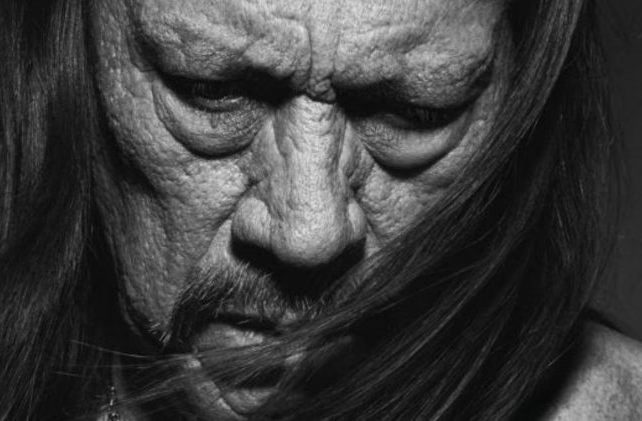
Sitting in a darkened screening room, watching the deep, tectonic rifts of Danny Trejo’s face fill a 40-foot screen, you realize you aren't just looking at an actor. You’re looking at a map of American incarceration, addiction and eventual, improbable grace. It is the kind of cinematic presence that filmmakers Jhod Cardinal and Adam Scorgie didn’t just stumble upon; they captured lightning in a bottle with *Inmate #1: The Rise of Danny Trejo*. But the real story isn't just Trejo’s—it’s the narrative of two Canadian documentary makers who managed to pivot from the indie grind to the hallowed halls of Universal Pictures.
The film is currently making waves on Super Channel here in Canada, with a global rollout via Universal scheduled for later this month. It’s a massive win for the Edmonton and Vancouver-based duo, marking a rare moment where Canadian documentary grit meets major studio muscle. I sat down with Jhod and Adam to pick apart the mechanics of this "overnight" success that was actually two decades in the making.
We started with the "why." In a world obsessed with scripted blockbusters, why choose the unscripted, often thankless world of documentaries? Jhod’s answer leans into a lifelong obsession with the factual.
"Ooh, good question. Jhod, do you want to start?" Adam asks, deferring to his partner.
"Yeah, sure," Jhod says. "My whole life I’ve been a National Geographic junkie. So always leaned towards that side of things, just as my reading went. I got into film sales and distribution 20 years ago, and at the time, you really couldn’t survive on docs. It was hard to find a place to sell them, except for a few. The world just wasn’t as connected. About 10 years ago, as digital opened up, I was super stoked because I was comfortable in new technology. I had already been doing sales for about a decade and realized that this space was going to open up because I could reach those niche markets. So I was definitely, at that point, frustrated with following films that were just cast generated. I got a lot of questions like 'who was in my film' rather than the creative concepts of it. So very, very easily was happy to move over to the doc space. So that’s myself."
And that’s the rub. For years, the Canadian documentary scene was synonymous with the CBC—venerable, sure, but often perceived as safe or educational rather than visceral. Jhod credits a Canadian icon for his early spark, even if his current lifestyle is a bit more modest.
"I think of David Suzuki and The Nature of Things as the big influencer for me," Jhod says. "And the odd thing is I live two blocks away from him now. Not nearly as nice of a house, but I see him at the local cafe often enough. You’re right, I am inspired by what CBC brought us over the years."
Adam’s path was less about nature and more about the raw energy of the New York stage. He was chasing the spotlight before he realized the real drama was happening in the streets.
"I know for me, it’s a little different path because I’m more of the front side of things," Adam says. "But I actually started in front of that. I think like most of us getting into the film industry, we looked at traditional filmmaking and dramatics. I was actually studying to be an actor in New York. Wasn’t very good, but got better at it. I was getting parts and then when I came to Canada, it was great when Super Size Me was hitting and Bowling for Columbine, The King of Kong: A Fistful of Quarters, where I think people really looked at documentaries in a different way. They were like, 'Wow, these are super entertaining. They’re actually getting theatrical releases now outside of just the National Geographic thing.'"
The turning point for Adam wasn't a paycheck; it was the electricity of a packed theatre. He recalls the moment the documentary bug bit him hard during the 2007 Vancouver Film Festival.
"I originally looked at doing our first one, the marijuana industry," Adam says. "I felt like, 'Man, if you could do something like Super Size Me, but about the marijuana industry that’d be really interesting.' And then I know the moment where I was hooked, I was going to have to find a way to make this a business. We were premiering at the Vancouver Film Festival back in 2007 and walking up to the Granville Theater and I was like, 'Holy cow look at the lineup for that movie. Whoever’s premiering tonight. That’s crazy busy.' And it was a line up for ours and there was only rush tickets left, 425 seats, not an empty seat in the theater. And I remember sitting down and watching it for the first time with an audience that big and really seeing it affect people. People were laughing, and they were emotional. I remember going like, 'Wow, I am never going to be able to do something else that just earns a paycheck with some numbers on a piece of paper.'"
Finding a subject is like dating; there has to be a spark, or the next two years of your life will be a slog. For Cardinal and Scorgie, the shift from hunting subjects to being hunted by them has been a significant career marker.
"When we first started Ice Guardians, The Culture High, the union role stuff we generated brought them to life," Jhod says. "And now fortunately, we’ve gotten a bit of a track record. So now people are coming to us and Adam, 'We’ve seen your other stuff, you know what you and your team put together is amazing. Would you like to do this?' So Danny Trejo, his story came like that where one of our producing partners, we were working on another film, a Sci-fi film that I was helping out as, and then he’s like, 'You should do a story on Danny.' And I was like, I only knew Danny as the actor then."
But an actor’s resume isn't enough to carry 90 minutes of non-fiction. You need soul. You need a narrative arc that doesn't just feel like a press junket.
"So I said, 'Well, you’d have much more than just being a cool actor to have a feature film,'" Jhod says. "And then from there, he said, 'You need to check out a Danny’s story.' Once we checked out Danny’s story, I was like 'Man, we have to tell that.' Danny and Michael Bisping approached us and now other people. So of course we always like to meet the person too. Once you met Danny, and you heard his incredible story, we had to tell it. And then same with, once you meet Michael Bisping, and you see that he’s not the villain that he was sold as in UFC for all those years. It’s like the British bad guy. He’s actually the super witty, funny guy that has a true life Rocky story. Then we dive in. So yes, now we’re getting to pick and choose which ones, because we know it’s going to be about a two year process from concept to delivery. So we were seeing what will work, what we know we can sell and then what we’re passionate to dive into for a long time."
The logistics of *Inmate #1* were a nightmare. Shooting in prisons isn't like booking a studio in Burnaby. It requires a level of bureaucratic navigation that would break most creative spirits.
"No. No docs are like that, and we explain that to all the talent because they’re always like, 'So when’s this going to be done?'" Adam says. "And I tell them, 'Well, if we could just schedule everything for next month, we could have it done in seven months.' But when you’re dealing with real life, and unscripted, for example Danny, when are you going to go speak at a prison? Next is when to capture the moment when you’re doing it an alcohol anonymous talk. Inmate took a little longer to get into some of the prisons which is really important. Danny does all that work all the time. I couldn’t get cameras in there so that he was doing it for a reason. The person in charge of the media in the prisons was not missing any prisons. We like to try to get them done within two years, but the timelines do vary depending on live events and stuff as we go."
Then there is the issue of Danny himself. At 76, the man has more hustle than most 20-somethings in the industry. He is a working actor, a restaurateur and a drug counsellor, which makes pinning him down for an interview a feat of scheduling gymnastics.
"Yeah. That was another time when Danny," Adam says. "I mean, because Danny, even though he’s 76, the guy is working all the time. We were constantly saying like, 'Oh, he’s booked on meetings so he can’t go.' And they were like, 'Cool. I’ll come on site of the movie.' 'Well, no, this movie won’t let you on or with visiting, he’s still like, 'They’re one of the only sports UFC networks down, they just got rid of it. So he’s still traveling all the time and my team is actually down because we can’t hire people, so we’ve hired some local guys, and our director is working via Skype right now. They’re doing a last touch up interview with him."
There is a technical critique to be made here: the film’s reliance on Skype for some of the final touches could have felt disjointed, but the grit of the subject matter allows for a certain aesthetic looseness. Trejo’s face is the ultimate special effect. It’s weathered, iconic and deeply cinematic.
"I would agree," Adam says. "I would argue that Johnny has the most recognizable face in Hollywood that you don’t necessarily know his name right off the top. A lot of people, when we said we were making this film, people were like, 'Who?'. And then we’d show the picture like, 'Oh, that guy. I just watched him in Sons of Anarchy.' Or he was in Heat. He’s got such an iconic face and when you dive into a story, the other thing that people would always say was funny. They’d be like, 'Aw man, he looks pretty rough, ey?', and I’m like 'Pretty good for 76,'. And they reply, 'He’s 76?' I’d say, 'Yeah.' They’re like, 'Okay. I take it back. He looks fantastic for his age.' And he really does stay pretty fit and active, but I mean, you would have to. When you see the doc of what that man has been through, it would take me six lifetimes to accomplish what he did."
The list of Trejo’s "accomplishments" is a harrowing journey through the American penal system.
"He’s a heroin addict when he’s 13, armed robbery when he was in his teens, in and out of juvie, 10 years in federal prison, gets out and becomes a drug counselor for 10 to 15 years," Adam says. "Then starts his movie career by the time he’s in his late 30s, early 40s, and now arguably becomes the most successful Mexican American actor in Hollywood history and became a restaurateur in his 70s. I don’t know how many Nintendo lives I would take to have to try to accomplish all that, but I think it would be much more than three or four."
The highlight of the production was undoubtedly the prison shoot in Arizona. It’s one thing to watch a prison movie; it’s another to stand in a yard surrounded by men in orange jumpsuits while holding expensive camera gear.
"There’s one more time, we finally got in thanks to a family friend of Danny’s, Caitlin," Adam says. "She got us into one in Phoenix, Arizona, because we wanted the same aesthetics as far as hot, California, that aesthetic in the background and because Danny spent all his times in the California correctional institutions. So when we finally got in there, there’s one moment we’re shooting. It’s slow-mo scenic shot with all the inmates walking in their orange, in slow motion and all they’re going by. And we’re in there with one prison guard, And I remember being like, okay, there’s one guard. There’s me. There’s a sound guy and a director. There’s 20 inmates so if these guys go to cause a problem, we are in for a shitstorm, and we’re looking at him like, Sergeant, 'Are we good? We’re surrounded by 20, 25 guys right now.'"
The sergeant’s response was a cold reminder of the stakes inside.
"And he’s like, 'Man, these guys are all.' They wouldn’t let us into maximum security. Right? They only let us into minimum security," Adam says. "He said, 'All these guys are due to get out in less than five years, some of them six months. And if they even look at you with hostile intent, they’ll get an extra three to five years. So you don’t have to worry.' But even though they said that, at times you’d walk around, there would be 10 of them and you’re by yourself, like, oh, I want to get back over to Sarg. Right? So it was, it was an interesting, interesting day for sure. Long day. Because we went in, we had to get briefs with the warden and everything and safety measures and what to expect and what we can and can’t do."
Despite the tension, the production gained a level of authenticity that money can't buy.
"I think it actually worked out better going somewhere that was so much more accommodating because we were able to just get so many great visuals, and they let us shoot just about everything," Adam says. "They almost let us take out one of the buses for the day...But they didn’t have a driver there. So they were like, 'Well, we don’t have a proper driver so we can let you on the bus, but we can’t actually take it out for a drive.'"
So Danny Trejo, his story came like that where one of our producing partners... he’s like, “You should do a story on Danny.” And I was like, I only knew Danny as the actor then. So I said, “Well, you’d have much more than just being a cool actor to have a feature film.” And then from there, he said, “You need to check out a Danny’s story.” Once we checked out Danny’s story, I was like “Man, we have to tell that.”
Jhod notes that Danny’s willingness to return to these places is the most telling part of his character. Most people run from their trauma; Danny walks right back into it to help others.
"And you know, Adam, all the references to those scenes too, when we spoke with some of Danny’s older acquaintances that spent time in jail, they really pointed at the fact that once you leave prison, you don’t want to go back at all," Jhod says. "And here Danny has gone back so many times to support and to help out. And it was kind of neat to hear that, that there was his friends looked up to him for just consistently going back, and whenever he’s filming in different towns, he tries to make sure he connects to the correctional institute nearby somehow and give speeches. He’s a pretty remarkable guy."
To the men inside, Trejo isn't Machete. He’s the guy who made it out.
"I wouldn’t just say some of it. He is a hero and Jhod said that to hear from the guys, once you get out and you’re a free man, you don’t ever want to go back," Adam says. "And Danny constantly is going back. And you can see it in the footage when we go in and they’re making him take off his metal, and they’re putting on the metal detectors. There’s an awkwardness for all of us going in, but for him it’s much worse. Right? There are celebrities that do their charity work and go through the motions to get their tax write offs, and then there’s somebody like Danny Trejo. And because you made a promise to God that he will always give back to his fellow man. Right? If you let him die with dignity."
Trejo’s life changed in 1968, facing the gas chamber. That kind of brush with mortality creates a different kind of philanthropist.
"He was facing the gas chamber back in 1968," Adam says. "And he always does, he always, always goes back and is always giving. We got so much more footage that we just weren’t able to fit in. If he saw a couple of homeless people, and he would be like, 'Pull over, pull over.' We’re like, 'What’s going on?' He’s like, 'Oh, these people here, they’re having a hard time. Let me, I’ve got some socks in the back. And some perishable food items and non perishable. And I can give them.' He is always wanting to give back because he knows he was steps away from being there."
The screen persona of the "tough guy" was a survival mechanism Danny had to unlearn.
"He can portray those guys so well because he did," Adam says. "He actually, when in the film, he talks about how he had to untrain that from him because people were scared of him. Because in prison, as he always says there’s predator or prey, and he didn’t want to be prey. So he trained himself to be the ultimate predator and ultimately intimidating because he was involved in several prison riots. Right? And he said the goal to a prison riot is that you look so intimidating and bad-ass that when you’re lined up to fight somebody else in the yard it’s about to go down, the guy’s like, 'Well, I don’t want to go to that guy. He was too crazy. I’ll fight the guy next to him.' Right? Or I’ll go after that guy. So Danny’s whole life from like 13 years old, his uncle teaching him to be this armed robber would intimidate so bad that nobody wants to mess with you."
Breaking down those walls was a lifelong project for Trejo.
"And then when he got out of prison, he had to break that down," Adam says. "So now he’s super engaging. In fact, you see him tire himself out because when you’re in a room, every new person that comes in he has a big smile saying, 'Hey, how you doing? I’m Danny?' And it wears him down and because he’s trying to be non-confrontational and just totally break down any assumption that you have, that he’s this aggressive, scary guy. He lost a lot of his childhood in juvenile detention and in prisons, he’s the biggest joker now. It’s almost like the kid in him is really having fun now because when he’s on set, that’s where we fell in love with Danny."
The lack of ego on Trejo’s part was a breath of fresh air for the production team.
"When director Fred Harvey and I first met him, there’s no attitude," Adam says. "It’s like, I’m a celebrity. And he’s just cool, and he’s cracking jokes. And he’s self-deprecating, and he’s making fun of everybody else, you’re like, 'Oh my God, I have to work with this guy.' The tough guy just comes easy for him on camera because when they’re like, 'Okay, we need you to intimidate.' He’s like, 'No problem.' He just changes his face in two seconds. And then people are like, 'Holy shit. That was really scary.'"
One of the most humanizing moments of the shoot involved a countdown of Danny’s many on-screen deaths.
"I’d probably say the funniest moment we have is we did this part with him, the 10 greatest screen deaths of Danny Trejo," Adam says. "And we had them on this one because it was like, 'Oh Danny, have a little bit of fun. Be honest about how these moments happened on screen, but then also give some of that killer...' And you would see him switch in a moment when he’d be like, 'And I’m Danny Trejo. I am, these are my greatest screen deaths.' And it’s like, why? Because they’re mine and you see a face just trucked out. And you’re like, oh, where can he go because we didn’t get to really see that crazy side of him and in the doc he was always being the funny guy and telling true stories, but then you would see him go the highs and lows. So during that we were all having to cover our microphones when he was going through the greatest screen deaths. Because you’ve talked about it and the different things that happened on set, it was just an awesome experience."
The moment of truth came during a private screening. For a director, showing a subject their life story is the ultimate vulnerability.
"Adam, I like the story to tell when he watches the first screener, and he approves of it," Jhod prompts.
"Oh yeah," Adam says. "So we did a private screening. It was supposed to be closed, just Danny, his son, his agent and Craig his head of security and one of his best friends. It was also supposed to be really small. 30 people showed up for this thing. We’re like, 'Guys, this is a rough draft. It’s still working things out.' Now the director and I are getting nervous thinking oh, okay. And then we’re in there and we’re sitting in the back and we can see them chalk playing and then, 'Oh God man, I can’t believe they captured that. And that looks so good. How did they get this photo?' It’s going well, and credits start rolling up. We’re biting our nails like 'Are we way off? Are we close? How big the changes we need to...' And Danny stands up, and he has tears in his eyes. And he looked around the room and he goes, 'Well, I’m Danny Trejo, and I approve of this movie.' And then we’re like, 'Yes.' Because then we knew the arguments that his agent had were going to be easy, if they’re like, 'Well you need to change this.' I’m like, 'Well, Danny stood up in front of everybody and said he liked it. So there’s nothing drastically that needs to get changed.' He had like two tiny notes. He’s like, 'Ah, this is a little incorrect, and that’s a little incorrect', but everything else he’s like, 'Don’t touch it'. So then no matter how many sups tried to get into that point where like Danny said, don’t touch it. So we’re going to just go with his notes."
Then came the Universal deal. For a Canadian indie team, this is the equivalent of getting called up to the NHL.
"Yeah. I’ll let Jhod explain that," Adam says. "Other than just from an excitement standpoint on my side, is I can tell the day when Jhod gave the phone call to the team right before we’re going, who we going to go to? Netflix, HBO, Showtime? We knew we had something special. And when Jhod was like, 'Guys, I got an offer from Universal'. I know our LA producers were kind of like, 'You mean Universal proper? Like the studio Universal?' And Jhod was like, 'Yes, Universal proper.' It was a pretty amazing day."
Jhod explains that the relationship with Universal grew out of their work on other sports documentaries.
"Yeah. It was... Adam and I have worked together on quite a few films, and we’ve fully been climbing that ladder and obviously next foot forward, you want it to be a little bit higher up," Jhod says. "And we’ve been talking to Universal because they heard we were doing Michael Bisping’s autobiography, and they did the Conor McGregor UFC documentary as well. And I said, 'You know what guys, we haven’t done that for a while. However, you should check out this Danny Trejo doc.' And that there was a little bit of timidness going, 'Oh, well, I think we know Danny Trejo', and I 'Just watch it'. And they came in a little late in the game and it was during TIFF. Now we weren’t premiering at TIFF or anything like that, but that’s when the conversation started. And they came back really aggressive, saying 'Well, we want this. Let us know what we can do.' And for us, that really is a bucket list to get that studio deal. We did get fortunate enough to do a Netflix one, but we’ve been in the industry for quite a long time. Well before Netflix and the studio deal was always something we were working towards."
Breaking into the Hollywood machine as two guys from Edmonton and Vancouver is no small feat.
"So it came together pretty fast once we had contacted them," Jhod says. "But it’s always so difficult too when you’re not in that world to break into it. And being one filmmaker from Edmonton and one filmmaker from Vancouver, it’s not always easy to crack that Hollywood nut. So it felt... Big celebrations that’s for sure. And they’ve been fabulous with us as well, the whole way, including us, not shutting us down, asking for our advice on stuff. So I do appreciate that relationship. Obviously we didn’t know what it would be like, but it’s been awesome."
The statistical rarity of this deal cannot be overstated. Universal has a century-long history, but their documentary slate is incredibly lean.
"Yeah. It’s something to put in perspective because even we looked at research, and we can’t really," Adam says. "It’s hard to find which ones are, because this is Canadian controlled and owned. Right? Produced out of Alberta and co-produced, our key creators, it’s all almost all key Canadian creators except for a few American executive producers. So we know in Universal’s 106 year history, they’ve only ever released 70 documentaries. So even that list is extremely tight. And then in that list, to see how many are Canadian, that land a studio deal that were produced by a small broadcast or like Super Channel and then land a deal like this. We’re thinking less than 10. It’s hard to find those or they don’t really produce a lot of those stats, but Jhod and I both have been doing this for almost two decades, and we don’t know anybody else that has done it."
The struggle to stay in the game is real, and this success serves as a validation for years of financial risk.
"So it is a really cool experience too," Adam says. "There’s so many times I think all of these filmmakers think about quitting or doing something else because it’s so tough to go out there to constantly be leveraging your finances, to produce these things, and then when they do make a little bit of money. And then also putting yourself out there for the critics. Even when you make something special, you’re always going to get some of those critics that just try to go out there and bash you. . I think Jhod is really trying to just be like, wow this is what if we were never fortunate enough to make another film again, what we’ve accomplished here is something we can all hang our heads and be very proud of."
One common fear with studio deals is the "polishing" of the product—losing that raw, independent soul that made the project viable in the first place. Adam, however, found the process surprisingly respectful.
"Yep. Every one of our other films where we had to do so much work on it, that it was kind of nice to see someone else and what they can do with it," Adam says. "And you often wonder was it how we were releasing it. Because sometimes you hit your goal, sometimes you don't and unless you see someone else handle one of your films, it gets very difficult. Their access to media especially is just shockingly high, and we would make calls after calls, after calls. We could get it placed and theaters like our previous stuff, but it's just another level. And I think because Danny is just inherently Indie, it doesn't feel it's been washed over as just an average doc. They've done a good job with that. And Danny has just done a nice job too, with his press and stuff. I guess we'll see what happens. But as of this point, it feels like it's still holding true to what we built."
Jhod is already seeing the effects of the Universal "machine."
"Yeah. Dan, to add to that it's been nice is putting our feet up," Jhod says. "And I'm getting texts and calls from people being like, 'Dude, I'm in this side of the world, and your shit is everywhere. On here.' And they go, 'In here.' They're like, 'I can't even think about Danny Trejo now without honestly thinking about you and your guys documentary. You're everywhere.' I don't know if I realize them now more, but it is amazing of see the machine behind you. And as far as Universal never changed the film, and even the trailer, they touched it just a little bit with a few... It's almost exactly of everything that we just cut. They just put a few little tweaks on it. And so it's been, I can't say enough, good things. I'm hoping that we impress them enough with this one that we could maybe get a slate down the road or something like that would be, that'd be the ultimate filmmakers dream."
Despite the global push, Jhod is careful to credit the domestic partners who took the first risk.
"Yeah. And we should add Super Channel is the one that is because this is a Canadian publication," Jhod says. "They financed it at the beginning. They've believed in every one of Adam's films and we can't be here without them. It's available next week in the U.S., but it's currently available through Super Channel in Canada. So not to totally to divert your question there, Dan, but we would do an injustice to them because they're not a big company, but they believed in a project that's turned out to be quite large. So we appreciate that. COVID made it a little tough because we were hoping to do a big premiere somewhere. We've done that with all of our films, but I think now it's pop a cork, something July 7th, and they're doing a really cool online Q&A with Danny and Brett and some of the other creators involved. Sit back and watch it all unfold in front of us."
Even after 30 projects, the fire hasn't dimmed. Jhod still finds himself starstruck by the icons he gets to profile.
"Oh yeah. Yeah. I love it," Jhod says. "Well sometimes you're following your own personal passion. We've got to do some, being Canadian, we had some great hockey ones we've done. Hanging out with Grant Fuhr, Brett Hall, Chris Prague or at Gretzky's restaurant. Come on, I'm freaking out the whole time I'm there trying not to take a million pictures and send to my high school friends going, 'Look where I am, man. This is awesome.' And that was a year and a half ago. So 20 years into my career, I'm still freaking out over stuff. And Ozzy Osborne tweeted about Danny, like the Inmate #1. And I was like, 'Holy crap. This is Ozzy, man, this is so cool.'"
The industry is changing, but the duo is adapting.
"So yeah, I haven't lost it at all," Jhod says. "And now you get to sit in a joy a little more because everything's not a struggle. The industry is changing dramatically, but every step, you've done a lot of this before. So when something falls apart, you're not freaking out, you know how to regroup. And so now it's great. It's fun times and you go travel and I'm thankful to put in all that work to be where we are today."
Adam echoes that sentiment, noting that there are still milestones to hit.
"And I think that, sorry to add to Jhod's before that question," Adam says. "The excitement is I know for me, and I love hearing that Jhod's is excited as I am. We're just as passionate and as you said, there's still a lot of benchmarks we want to do. We've been able to last in this industry almost two decades and consistently have success and consistently kind of take the next step. But there's a lot of things that we've still have been alluded by most of the top 10 festivals. We still want to get into Cannes. We still want to get into DIFF. We still want to get into Sundance. Those things have all alluded us, and we’ve still been able to make these successes without them. So they're still new. With every one success, there's still something else that we exceeded our grasp that we're still trying to get. And with every new person or new project that comes there's new excitement. I think that's why for me, I fall in love with docs so much. With a dramatic or a scripted film you shoot your 30 days, the actors come in there just isn't as much passion around it because it's based more on the talent than the subject matter."
For Adam, the documentary is about immersion.
"Whereas doc's is the other way," Adam says. "It's all about the subject matter. And when you're working on Danny's and you get to go on these adventures with him and hear these stories and actually see him realize like, oh, that's why I followed my Uncle Gilbert down that path, or somebody like Bisping realize how impressive it was that he won a world title with no depth perception on 16 days notice. That you were passionate about every project because you get to go on the journey with. You get to go into a totally different walk of life with these people that you're following. And you're immersed with them for a year and a half. And you go into your question, what's next? We have two, they're really exciting right now we're doing Michael Bisping's doc, which is supposed to release this fall or depending on how distribution does there."
The Bisping project promises to be another heavy hitter.
"And if those yourself or anyone's unfamiliar with Michael Bisping, he won the third Ultimate Fighter as a light heavyweight," Adam says. "He's the only British UFC champion to ever win a title and defend it. And he is the epitome of a real life Rocky story. If there ever was a real life Rocky of coming from next to nothing from a small town in Northern England called Clitheroe. And becoming one of the greatest champions that the sport has ever seen and revolutionizing mixed martial arts in the United Kingdom. This is the guy. And other than that, he's a bit more charismatic and funny and just become a good friend of mine now, unlike Rocky. But every other aspect of the Rocky story is Michael Bisping, only that he's British. So that's up next."
When asked what they would cover if money and access were no object, Jhod’s answer is surprisingly un-Hollywood. He wants to tackle systemic issues.
"I would go for the literal fiscal inequality around the world," Jhod says. "If I could tell that story right to convince people how wrong things are set up right now, I think is such an important story. That would be my number one, not very sexy, but I think about that all the time, and I wish that could be the biggest film I ever do and everyone watches it and it helps fix all the craziness going on right now. How about that? Say a better one."
Adam, on the other hand, wants the visceral energy of music and history.
"I don't even know if I can say something better than that," Adam says. "I want to do drug sex and rock and roll. I want to do something now that these stories are coming to us. I want to do something in the music space. Right? I know we were talking Stevie Wonder there for a while, and I would love to do something with that. And I was a huge, huge wrestling fan growing up and the Hulk Hogan and Andre the Giant, Randy Macho Man Savage days. And I would love to go into that space. I watched the Andre the Giant documentary this year, and I just was so moved and taken back right to like my inner childhood. So if the barriers weren't there, there's lots of stories I'd love to do. So I'm open to all of them as they come. We're looking at maybe doing a couple of series now because that seems to be the way people are consuming facts now, going more for a series than just a one off. So there isn't anything in particular, I've been trying to busy trying to get the next one into production. Nothing kills a film company or team faster than development. So I haven't had too long to think about the one. If there was no barriers."
The reality of the producer’s life, however, is that barriers are the job.
"As a producer, that's my job is to get rid of the barriers and put out the fires," Adam says. "So I'm always just thinking they're going to be there. In fact, that's always how I talk my directors down when they start being like, 'Oh my God, this is killing.' I'm like, 'Dude. This is just the problem for this project. Remember last project? It was this and the project before it was this.' There's always some problem. It's just, they're different. Some are financial, some are the talents. So I've never actually thought about if there was no barriers and I could just make it whatever I wanted."
Jhod throws in one more dream project: a deep dive into one of rock’s most political bands.
"Dan, I'll also throw it a fun one about Rage Against the Machine," Jhod says. "I’d love to tell that story. I mean that guy. Cause it feels like, what is he doing when he's not making music? He's lived in some guerrilla camps, you know that. So yeah. When you said music, I do Rage Against the Machine for sure."
As they age, the duo has shifted their focus. Early in their careers, they were the "controversy" guys, tackling the cannabis industry before it was mainstream. Now, they’re looking for the "good story" over the "hot take."
"We started our first three films were controversial, right?" Adam says. "They were cannabis industry with The Union, cannabis industry again with The Culture High, and then fighting and violence in sports with Ice Guardians. I'd have to say for now and seeing how aggressive cancel culture and social media has become. I've definitely seen a shift cause our team built our career on social media when businesses thought it was just a cute thing the kids were doing and didn't really understand the business aspect of it yet. I've really seen a shift, the aggressiveness and negativity that seems to be on social media. And maybe just with everything going on in the world right now seems to be more heightened. I deliberately never blocked anybody on my feed or do any of that. It's healthy to get all perspectives, even if it's something I totally don't agree with. I just to try to understand where they're coming from. So controversial stuff. I got to be honest. I'm scared now with three kids, and I just had my 40th birthday. Do I really want to put something out there that people are going to be threatening me like 24/7 on Twitter? I don't know. Early in my career, in my twenties, I'd say, 'Fuck it. Bring it on. I'll find anyone that's threatened me. Fuck you too.' But getting older now I enjoy watching my kids play sports and I live up in Canada for a reason because it's just not as crazy as it is in the U.S. So I think for me, obviously any great story came, and I just felt me and the director were just so in tune and said we had to do it, We would do it. But as of right now, I know even when a few projects have come, and they're in Afghanistan or in hostile regions, my wife's like, 'You're not fucking going there. If this goes forward, you have three kids, you can send somebody else there.' And I'm like, 'Well, I don't know.' So for me, I'd rather do the great story than something super controversial. I'm older. I think about those things more than when I was in my twenties and didn't care."
Jhod agrees, noting that controversy doesn't always translate to eyeballs.
"Yeah. I would be doing a good story as well," Jhod says. "And almost for a bit different reason. Over the years of Adam and I working together, I built up a distribution company, and I've so I've released a lot of films and controversial is interesting, but it doesn't mean it gets watched. And it's very difficult to see someone put so much effort into something and it just, it dies. And no one sees it, even though it should be seen. So a good story, you can at least put points into it and you know, that a good story typically is a little easier to be found or covered or picked up. Docs are always a couple years, at least. So if you're going to put that much effort into it, you want to make sure that it gets seen. So I go, good story."
In the end, *Inmate #1* works because it respects the complexity of its subject. It’s a story about a man who was built to be a predator and chose to be a protector. For Cardinal and Scorgie, it’s the film that finally cracked the Hollywood nut, proving that sometimes, the best way to get to Universal is to start in a prison yard in Arizona.