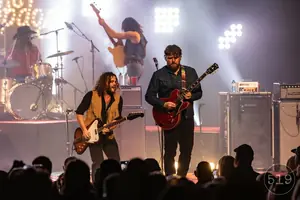
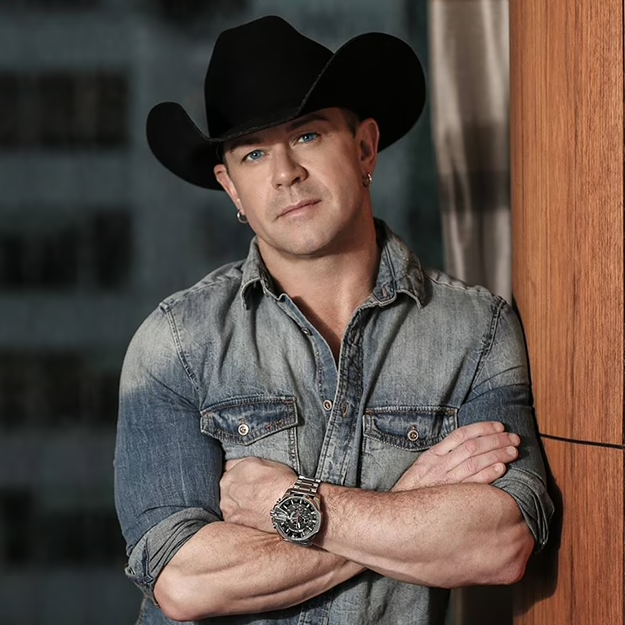

Standing inside the Chatham Capitol Theatre, you can almost smell the history in the velvet curtains and the gilded proscenium. It is a room built for drama, a restored 1920s movie palace that demands a performer with enough gravity to fill the space. For Aaron Pritchett, the British Columbia native who has spent the better part of two decades defining the harder edges of the Canadian country circuit, this stop feels like a long-overdue reckoning with a crowd he has somehow bypassed for 15 years.
But the wait ends this Saturday, Jan. 27. Pritchett is finally pulling the tour bus into the heart of the 519, bringing a sound that refuses to play nice with the polite, acoustic tropes of the genre. He is a rocker in a Stetson, a man who understands that a country song is often just a power ballad with a little more dirt on its boots.
And that grit is not an accident. It is a byproduct of a childhood spent soaking in the high-gain distortion of the Reagan era. While other kids were studying the phrasing of George Jones, Pritchett was likely dissecting the arena-sized hooks of the hair metal gods.
“I’ve always had more of an edge in my country music,” Pritchett says during a late-afternoon call from the West Coast. “I grew up back in the rock world in the 80’s and 90’s. When I got into country, I really wanted to add those reflections. As I’ve grown and evolved, my music has to change a bit, but that’s the one element that seems to stay and even gets a little heavier at times. I try to rock out as much as possible.”
This sonic philosophy is the engine behind his 2016 effort, *The Score*. It is an eight-track collection that functions less like a traditional LP and more like a manifesto for modern, genre-bending production. It is aggressive. It is polished. It borrows the stuttering rhythms of electronic music and the soaring choruses of 90s pop, yet it never loses its rural soul.
But the standout, at least from a stylistic standpoint, is the track "Lifeline." It is a song that trades the typical hay-bale aesthetics for something far more cinematic and dangerous. It sounds like a desert highway at midnight, full of shadows and unresolved tension.
“Lifeline was a really cool song to record,” Pritchett says, reflecting on the studio sessions that birthed the track. “My producer Scott Cook said that he loved the demo and wanted to turn it into something like a spaghetti western meet Quentin Tarantino. So, we did it and it’s one of my favourite tracks on the album.”
The Tarantino comparison is apt. There is a certain swagger to the arrangement, a sharpness that cuts through the radio-friendly sheen. It is a technical win for Cook and Pritchett, proving that country music can be high-concept without losing its blue-collar accessibility.
And yet, Pritchett is savvy enough to know that you cannot live on high-octane riffs alone. You need the heart. You need the vulnerability that makes a crowd of a thousand people feel like they are the only ones in the room. He finds that balance with "When A Momma’s Boy Meets A Daddy’s Girl," a track that leans into his softer sensibilities.
The song is a calculated risk in a genre that often prizes stoic masculinity above all else. But Pritchett wears the "momma’s boy" label like a badge of honour, grounding his rock star persona in something deeply relatable.
I’m a momma’s boy for sure. I’m very close to my mom even though she lives 9 hours away from me. It still feels like she’s right here with me. When it came down to choosing the one slow song I wanted to have for the album, this was an easy one because it could be a wedding thing or it could turn out to be one of these eternal songs that people always play because it hits so close to the heart.
“I’m a momma’s boy for sure,” Pritchett says. “I’m very close to my mom even though she lives 9 hours away from me. It still feels like she’s right here with me. When it came down to choosing the one slow song I wanted to have for the album, this was an easy one because it could be a wedding thing or it could turn out to be one of these eternal songs that people always play because it hits so close to the heart.”
It is this proximity to the heart that seems to dictate his entire career trajectory these days. In an industry that demands constant visibility and a grueling 365-day hustle, Pritchett has begun to push back. He is no longer interested in the blind pursuit of the next chart position if it comes at the expense of his own front porch.
The music business is a notorious thief of time. It steals birthdays, anniversaries and the quiet moments that actually constitute a life. Pritchett has seen the toll that the road takes, and he has made the executive decision to reclaim his calendar.
“I always say that there are many great things about the music industry, but the worst part is that you lose time away from your family,” Pritchett says. “There were times I lost focus with my family and friends and the worst part is you don’t really realize it until later. I noticed the summer is always busy, so I consciously decided not to tour in the summer for the last couple years. Last summer I took three weeks off in July when there are so many opportunities to play.”
For a country artist, skipping the summer festival circuit is akin to a retail worker skipping December. It is the peak season, the time when the cheques are the fattest and the crowds are the largest. But Pritchett is looking at a different kind of bottom line.
“I need to be with my family, I want to enjoy the summer and go camping, take long drives and not have to worry about it being in the winter. And I want to connect and reconnect with my family. These last couple years have been overpoweringly amazing. So that is the thing, I make time now - I just put it in my calendar and say I’m not working those weeks,” he says.
This commitment to family has created a unique ecosystem within his touring camp. His sons are not just spectators to his fame; they are active participants. His oldest, Jordan (known as JP), has already carved out a significant niche as the lead guitarist for the pop-punk outfit Faber Drive and is now navigating his own solo country career.
Seeing father and son share a stage is a rare glimpse into a functional show-business legacy. It is not about competition; it is about a shared language of melody and performance. Another son is deep in the trenches of his own musical development, while the youngest has found his niche behind the lens, capturing his father’s performances via camera-mounted drones.
But despite the shared professional interests, Pritchett is careful to maintain a firewall between the man on the stage and the man at the dinner table. He does not want his children to grow up in the shadow of a persona.
“To them, I’ve always been dad first and foremost,” Pritchett says. “I work really hard at separating my work life from my home life and make sure the two never mix.”
That separation is likely what keeps him sane as he navigates the "craziness" of a life spent in transit. When you have played every hockey arena and community centre from Victoria to St. John’s, the geography starts to blur. The 401 corridor becomes a repetitive loop of service centres and green highway signs.
This brings us to the Chatham mystery. For a man who has spent 15 years on the road, it seems impossible that he hasn't headlined the Capitol Theatre before. But the life of a touring musician is often a fog of soundchecks and late-night load-outs.
“I’ve been through Chatham many times, but I think this might be the first official time I actually get to play there,” Pritchett says. “I certainly remember playing in London and Windsor, but there is a possibility I was in Chatham years and years ago - if I was, it got lost in all the craziness that we were in at that time.”
Whether this is a debut or a return to forgotten ground, the stakes remain high. Chatham audiences are notoriously discerning; they know the difference between a polished act and a genuine performance. Pritchett, with his blend of rock-and-roll swagger and "momma’s boy" sincerity, is uniquely positioned to bridge that gap.
He is a Canadian treasure precisely because he refuses to be just one thing. He is the rocker who loves his mother, the star who stays home for July and the veteran who still finds the "craziness" of the road worth the trip.
The lights will go down at 8 p.m. this Saturday. The guitars will be loud, the stories will be personal and the Chatham Capitol Theatre will finally get its official introduction to one of the most resilient voices in the business. Tickets are still moving through the box office, and if history is any indication, this is one show that will not be forgotten in the haze.