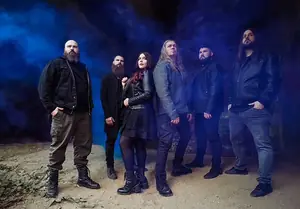


There is a specific kind of domestic grit that comes from five grown men shacking up in a house in Franklin, Tennessee to scream into microphones and bleed over guitar strings. It is a far cry from the sterile, file-sharing assembly lines that define modern rock production. For Asking Alexandria, this retreat to the woods was not just a change of scenery; it was a desperate, necessary exorcism of the "puppet" years.
Watching the band’s trajectory from the third row over the last decade, you could see the fraying edges. But with their latest effort, *See What’s On The Inside*, the original quintet—Ben Bruce, Danny Worsnop, James Cassells, Cameron Liddell and Sam Bettley—has stopped chasing the ghost of their 2008 selves. They have arrived at a place of clarity that only comes after you have clocked a billion streams and realized that numbers do not actually keep you warm at night.
I sat down with guitarist Ben Bruce over a Zoom call to dissect this new chapter. He looked relaxed, a man who had finally put down a heavy weight. When I asked him about the impending release, he leaned into the frame with a smirk.
"There’s a new album coming. No one told me. No, I’m kidding," Bruce says. "See What’s On The Inside, it’s a special album for us for more reasons than just one but we really utilized this time to reconnect as a group and rebound just as friends and musicians. I think the result See What’s On The Inside, it’s apparent how much fun we had and how much passion will be put into this record as soon as you turn it on. It sounds unlike anything else you’ve ever done before."
The industry usually demands a "more of the same but louder" approach from legacy acts. Asking Alexandria ignored that. For the first time in more than 10 years, they were in the same room, breathing the same recycled air and fighting over the same riffs. It is a technical shift that fundamentally alters the DNA of the audio.
"Basically, we wanted to recapture that feeling we had when we started the band," Bruce explains. "We were so excited when we were kids to be in a band together. We weren’t signed, there was nothing, it was just five friends, making music, listening to our favourite bands and making music like our favourite bands and somewhere along the way once you start getting bigger, and you are signed and more people start directing you in a certain way, you kind of get lost a little bit and things become blurry and you’re kind of like a puppet almost. You’re moving around and just doing things that you’re told to do."
That "puppet" comment is a sharp jab at the label-driven mechanics of the mid-2010s. The band felt the squeeze of the "album-tour-album" cycle that treats artists like livestock. And the pandemic, for all its horror, provided the one thing a global rock band never has: a pause button.
"This time off, allowed us to reminisce on why we started this band and how much fun we had when we were kids," Bruce says. "We just wanted to get that back. Over the years, you don’t have time really to sit down all together in the studio and create a record like you used to, because it’s okay to record, go on tour, give me another record and go on tour because we live in such a fast paced world now. With this one, we were like no, we want to reconnect and we went away into the middle of nowhere just the five of us and we got in a room together for the first time in 10 years to write and create and recapture that sort of energy, and that passion that we had when we were kids starting this band for the first time."
The choice of Franklin, Tennessee was deliberate. It is an area defined by its "expansive nothingness," located just far enough from the Nashville neon to prevent any late-night distractions. There were no "friends down the street" or trendy bistros to lure them away from the work.
"Simply because it was in an area that none of us were familiar with," Bruce says regarding the location. "We threw around a bunch of ideas, and we didn’t want to go anywhere where anyone had any ties, like, 'Oh, I could just pop home' or 'I’ve got a friend down the street' or 'I know this great restaurant over here.' So we wanted no distractions, there was nothing, so Franklin, Tennessee, provided us with that solitude and that just expansive nothingness. But we were also close enough about 45-50 minutes away from Nashville. So when we did need to go into town to get anything music related, like guitar heads, or guitars or drum skins or anything, it was close enough for us to get to, so that we could make the record the best it possibly can be, but not so close that it was going to be a distraction, and we’d be like, 'Oh, well, let’s go out for dinner every night.'"
The resulting record feels lived-in. It has the companionship of *Exile on Main St.* mixed with the stadium-sized ambition of a group that knows how to command a crowd of 50,000. There is an emotional transfer that happens when you stop clicking mouse buttons and start hitting strings.
"I think it was just the energy, we were so excited," Bruce says. "Obviously, emotions were running high, creating together again, but just the fact that we were all there, I could pick up my guitar and play guitar riff. And instead of just laying it down, and then going, that’s the song with everyone being there. There was just energy bouncing around. And so I’d be playing a riff and Cameron would go over and grab his guitar and play with me. But 'Oh, that’s cool. Why don’t you try this.' So the emotions go through the room with just a lot of excitement. It was so much fun, there was so much joy, bouncing around that room."
Danny really, really damaged his voice screaming... I was listening to Danny’s voice and he sounds like he’s in so much pain, even when he’s talking to the crowd, and it made me sad. He was really pushing himself back then to continue doing this. We’re never going to do that to him again. It’s not fair. He has an incredible singing voice, and so we want to showcase that.
One of the most authentic moments on the record happens at the end of the track "Fame." As the song dissolves into a chaotic "rinse," you can hear drummer James Cassells laughing. It is a tiny, technical imperfection that most producers would have scrubbed clean. Asking Alexandria kept it.
"Genuinely you can hear it, and you can feel it in the recordings that we captured," Bruce says. "We didn’t rely on computers, it was just the five of us, very raw recordings, the tones are recreated both on the drums, on the vocals and the guitars. So much so that even at the end, if you listen to a song called 'Fame', where we just all start rinsing at the end of the song, and when it stops, the song ends, you can hear James laughing, his laugh is captured through his drum mic, and we left it there because it just shows just how much fun we were having playing together again."
The technical side of the record benefited from the isolation. They maintained a strict "bubble" during the recording process, ensuring that the only people in the room were the five members, their producer and an engineer. It was a closed circuit.
"Not particularly just because we’d all been staying safe and quarantining anyway," Bruce says when asked about COVID-19 concerns. "All of us started getting vaccinated and that was another reason why we decided to go into the middle of nowhere. We very much kept it a closed session, it was just the five band members, our producer and engineer. There was just a select few people that were allowed in the studio, and we stuck to our group, stuck to our bubble. We were cautious with it, but we stuck together and we went through it together."
Comparing the new album to the Rolling Stones or Metallica is not hyperbole—it is a matter of structure. If the self-titled record was their "Black Album," this is their moment of absolute unity. Bruce agrees with the sentiment.
"Definitely, I think that’s a really awesome comparison and observation to have made as well," he says. "It definitely feels very much like that, and camaraderie is a great, great word for part of the experience of creating this newest album. Yeah, that’s awesome. I love that."
But with this new camaraderie comes a definitive end to the metalcore era. The screams that defined their early career are largely gone, replaced by Danny Worsnop’s soulful, whiskey-soaked croon. For the "purists" who demand 2009-era breakdowns, Bruce has a blunt reality check.
"I think those old records are still there for people to listen to and enjoy. I’m still super proud. We’re all still super proud of those records we created," Bruce says. "But they were created at a time in our lives that we are not in now. And every single one of our records is there for listeners and for us, for a specific reason and time in our lives that we’re going through and just to keep doing the same thing over and over again, would almost be redundant. Also, not to mention, Danny really, really damaged his voice screaming, and a lot of people are like, 'Well, such and such has been screaming for 30 years' and so well that’s excellent for such and such. That’s not the situation we’re in and you can go back in time and watch."
Bruce points to the band’s *Live in Brixton* DVD as a turning point in his perspective on their old sound.
"We released a DVD years ago called Brixton and beyond the thing was called it was live in London at Brixton Academy," Bruce says. "I actually watched parts of it the other day, and I was shocked. I was listening to Danny’s voice and he sounds like he’s in so much pain, even when he’s talking to the crowd and it made me sad. I was like, he was really pushing himself back then to continue doing this. We’re never gonna do that to him again. It’s not fair. He has an incredible singing voice. I’m really proud of how much effort and work he’s put into his singing, and so we want to showcase that."
This transition is a return to their true north: classic rock. The promotional materials for the album cite Metallica, Led Zeppelin and Queen as primary influences. It begs the question: if this is what they love, where did the metalcore come from?
"I think it’s just a product of the times we grew up in you know," Bruce admits. "I mean, obviously, I grew up going to watch Deep Purple or Elton John and Aerosmith and all these classic rock bands. I grew up loving and listened to them and they were all introduced to me from my stepdad. And I loved them but I also discovered my own music as a kid too. And I would listen to bands like Slipknot or Killswitch Engage and early Avenged Sevenfold and stuff like that. So, that was a part of my journey as a young aspiring guitarist and musician. There were a lot of bands that I listened to back then, like Killswitch Engage that influenced me when I was starting this band. So that’s where it came from originally. I think each one of our records is sounded very different to the previous one. And you can hear different inspirations and influences among all of them. Yeah, I think it’s just a product of the time."
The title track, "See What’s On The Inside," serves as a manifesto for this "no-gimmicks" era. It is a literal invitation to peel back the layers of the band’s identity.
"I think a lot of bands struggle with this, but we always struggle, trying to name our albums," Bruce says. "It’s so hard to just find an encompassing word or sentence that describes what the album is. And this is the first time in our career that it wasn’t an issue. Immediately we knew what this album meant to us from what it was and See What’s On The Inside, yes, it’s the title track but really the title of the record is something even more separate than just for the song in it. When we hand in this record to someone, we wanted the music to speak for itself. In its simplest form, we’re allowing that to happen by calling it See What’s On The Inside, and that’s the idea behind the album artwork to peeling back that initial layer and seeing the band name. It’s like this is all of us. This is quite literally the five of us, and our instruments, recorded and captured here on this album."
The lead single, "Alone Again," is perhaps the most potent example of this new energy. It is heavy, but not in the way their early work was. It is heavy in its musicianship. Bruce, a man who grew up worshipping at the altar of Dimebag Darrell and Gary Moore, finally allowed himself to be a guitar hero.
"I love 'Alone Again', and we didn’t know what was going to be the first single obviously, when we went into the writing process, but that was one of the first songs I think it might have been the first song in the studio, we sat down and worked on," Bruce says. "And I remember when we were right in it, and that riff came out that first initial big riff. I was like, 'Man, this is gonna be the first song we released. This is so cool.' It’s got such a good energy. And it shows a little bit of everything that the record has to offer. There was a lot of Metallica, Avenged Sevenfold and Pantera influence in that song on my behalf. It was just so much fun. It was the first time where I sat down with my guitar and everyone’s like, 'Just let it rip, dude. Just let it real do a solo.' We’re not particularly known for doing solos. But, I grew up listening to Dimebag and a lot of blues guitarist like Gary Moore. I love playing lead guitar, and so I was like, whatever I’m gonna let it rip and have fun and I had so much fun doing on that song. It was hard to stop me from doing it on all of them. There’s so many guitar solos and stuff thrown throughout this record and it all stemmed from just how much fun I had playing on 'Alone Again'."
Thematically, the song touches on a recurring Asking Alexandria motif: isolation. Despite the billion streams and the millions of followers, the band often writes about the void.
"It’s just something that not just us as a band or people but I think everyone goes through and it’s funny, we live in such a world where everyone is connected by social media, and that’s Facebook, and everyone is here at your fingertips," Bruce says. "But I feel like, social anxieties and depression and stuff are more prevalent than ever before in history. It just goes to show that even though there’s everyone there, it’s still very common and very easy to feel completely alone. You know, there’s a screen in front of you. It’s not real. These people aren’t real. It’s just something that it crops up in even our lives our daily lives, especially, I’m a father for instance. I go out on the road and I’m desperately lonely when I’m out on the road missing my wife and kids and I think it’s just a recurring thing that people have to deal with throughout life. So, it’s bound to come up in topics when you’re writing songs, especially if you’re writing from the heart."
The mission for this record was simple: to feel something again. To move away from the "mission-critical" business of being a brand and return to the simple joy of being a band.
"Yeah, and it simply was just to really fall in love with and feel like we can create a record that made us feel like we felt when we were kids," Bruce concludes. "That first time you put on Metallica’s self titled record or the first time you hear TNT by AC/DC. The first time you get those feelings, you hear these songs and these records, and you’re like, wow. And you’re stoked. That’s what we wanted to create and that was our mission. It was like, I want to make a record, we want to make a record that we get excited about when we hear it and it makes us feel certain ways. 'Find Myself' makes you feel really sad. And then, 'Alone Again', makes me feel energized and kind of angry at times, and it was just super important for us to capture those emotions and not just play music that sounds away. It needs to make you feel away."
And they have succeeded. This is not a record designed for a playlist; it is a record designed for a house in the middle of nowhere. It is raw, it is loud and it is finally, authentically, Asking Alexandria. They have vowed never to go back to the old way of working.
"Oh, 100% and that was the point in this," Bruce says. "That’s why it was so important that we all sit down and play these pieces, and they’re not constructed, and there’s not a computer making anything like all the sounds are us and the energy is us. It was so important to us and we fell so deeply in love with the band again and with each other again, that we made the decision that we’re not going to go back to doing it any other way. This is how it has to be done, from here on out. So whenever we do a new record, we push pause on everything else. And we’re going to go away together as a five piece and create music like this, because that’s why we started this in the first place was simply for the love. We all had a common love for rock music and metal music and music in general and creating music together, and it’s nice to have been able to rediscover that that passion, and we’re definitely going to hold on to it with both hands.