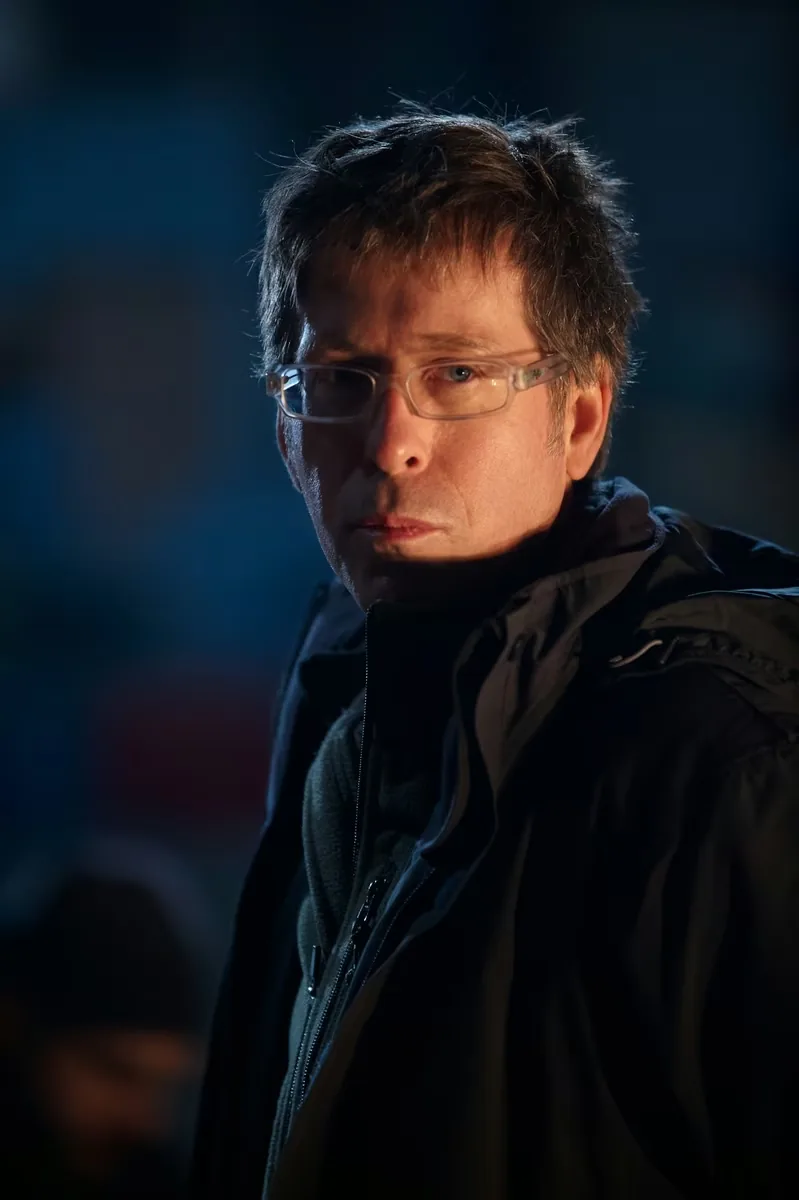

Looking back at these archival tapes from Jun. 11, 2010, is a trip. The industry was in the throes of a 3D obsession, and the Saw franchise, a Halloween institution, was gearing up for what was billed as its grand finale. On the line from Toronto, in the thick of post-production, was Kevin Greutert, the man tasked with landing the plane. He’d started as an editor on the first film and was now directing Saw VII, or Saw 3D as it would become known. The call itself was a sign of the times, a slightly crackly Skype connection because, as he put it, he was having “cell phone trouble.”
Greutert had been there since the beginning, a key architect of the series’ signature frenetic pace. And he was candid about the ride. “I started with Saw One, with James Wan back in 2003, and it was a very small movie at the time,” he says. “So I had no idea that it would go this far and take me this far. So it’s been a great experience.” That understatement hangs in the air. By 2010, Saw wasn’t just a movie; it was a billion-dollar cultural phenomenon, a yearly ritual for horror fans.
But the machine was showing signs of wear. Greutert acknowledged the truth of the situation. The box office numbers had been slipping. When asked about the series’ enduring appeal, he didn't offer a canned PR line. Instead, he gave a surprisingly honest assessment of the secret sauce that was becoming harder to replicate. He knew the formula inside and out.
“I think that when the series is at its best, it has very intricate but intriguing stories and characters on top of the very visceral punch that you get from the trap scenes,” he explains. That was the core of it. The series was never just about gore; it was a puzzle box narrative that rewarded dedicated viewers. And presiding over it all was the icon himself. “You’ve got the character of Jigsaw who is just very original and alluring, I think, for a lot of people. He’s a moralist but also a serial killer.”
This seventh entry had a new weapon, a third dimension. Fresh off the monumental success of Avatar, every studio in Hollywood was scrambling to slap 3D onto their tentpole pictures, and Lionsgate was no different. Greutert was aiming to make the film feel bigger, more spectacular. “We spent more money and built a lot more ambitious sets and really tried to make it Saw on steroids,” he says. A noble goal, but one that came with immense technical baggage.
Greutert’s comments on the 3D process are a fascinating time capsule of a filmmaking trend that often felt more like a mandate than an artistic choice. He’s frank about its limitations. “I don’t know if I necessarily agree with that because it’s a very stylized and arguably a very artificial look, but it is very interesting,” he admits, pushing back against the studio talking point that 3D was “more like real life.” He understood it was a gimmick, a fun one perhaps, but a gimmick nonetheless.
The technical hurdles were significant. He describes a set crawling with extra crew members and cables everywhere. Each camera was really two cameras, demanding precise calibration and a lot more light. The technology fundamentally altered his craft as an editor and director. “We can’t quite edit as rapid-fire as we did in the other Saws because it takes the eye a little bit longer to adjust when it’s focusing on a 3D image,” he notes. It was a trade-off: the immersive depth of 3D came at the cost of the franchise’s signature lightning-fast cuts.
My one real critique, looking back, is that this trade-off was never quite worth it. The 3D in Saw VII feels like an appendage, a funhouse effect that adds little to the narrative tension and actively works against the gritty, low-fi aesthetic that made the original so effective. It was a commercial decision, a way to justify higher ticket prices for a franchise that was, as he noted, seeing diminishing returns. It was an attempt to make it an event.
He’s complex because I think he’s self-deceiving. So when you have a very brilliant person who is living a lie, that’s just very rich territory for storytelling.
And was this event the final chapter? Greutert played it coy, but the writing was on the wall. “It certainly feels like it to me, but you could have said the same thing after Saw III, and then here we are in Saw VII,” he hedges. “It definitely has a great deal of closure to it, and I know one of the titles that they’re kicking around certainly will announce that it is the last one.” History, of course, tells us that no successful horror IP ever truly dies. But at that moment, the plan was to provide a definitive end.
The conversation inevitably turned to the man in the centre of the web, John Kramer. Greutert’s read on Jigsaw is sharp and academic, going beyond the simple monster caricature. “He’s complex because I think he’s self-deceiving,” Greutert analyzes. “So when you have a very brilliant person who is living a lie, that’s just very rich territory for storytelling. And I think he really does feel that he’s helping people, but any psychiatrist could tell you that his main motivation is revenge against a world that isn’t dying along with him.”
That complexity was channelled entirely through one man: Tobin Bell. Greutert is unequivocal about his importance to the franchise’s success. “I really do credit him with the longevity of the series,” he states flatly. “He’s just very intense, and he takes it very seriously and really makes the writers and the directors review what they’re doing and just try not to do anything half-assed. He lives and breathes the Jigsaw character and, you know, just maintains a level of integrity for the whole series.”
Bell’s gravity was the anchor. Without it, the increasingly convoluted timeline and apprentice backstabbing would have collapsed into self-parody far sooner. He gave the series a weight and a strange sort of moral compass that elevated it above its torture-centric reputation.
Another key character in the Saw story is a city: Toronto. Greutert was speaking from his temporary home, where he’d spend nine months of the year bringing these films to life. When asked why the franchise relocated to Canada after the first film, his answer was brutally honest and stripped of any artistic pretense. “Toronto offered great tax breaks, and the crews there, my understanding is they aren’t as expensive as in Los Angeles. So it was an economic decision purely.”
He’s quick to praise the local talent, adding, “They’re great crews. So it’s not like we’re getting a subpar product by making it with Toronto crews.” But the point stands. The franchise’s look and feel were as much a product of Ontario tax policy as they were of James Wan’s original vision. It’s a perfect microcosm of how the film industry actually works, a balance of creative ambition and cold, hard numbers.
This commitment to the bottom line didn't mean they cut corners on the production itself. The world of Saw was painstakingly created year after year. “Throughout the Saw films, just about every single location is built from scratch every year,” he reveals. “Jigsaw’s lair and all the trap scenes, those are always things that we build on a set.” It’s an incredible feat of production design and construction, a dark universe assembled and disassembled on Toronto soundstages.
As the interview wound down, the topic turned to the film’s biggest hook for long-time fans: the return of Dr. Lawrence Gordon, played by Cary Elwes, whose fate was left ambiguous at the end of the very first film. Greutert knew this was the ace up his sleeve. “The Lionsgate website indeed lists him as a cast member,” he teases. “So I probably shouldn’t say too much, but let me just say that the fans will not be let down.”
It was a promise of resolution, a full-circle moment designed to reward the faithful who had stuck with the series through every twist, trap and retcon. He was speaking directly to the people who made the franchise a success, assuring them that their investment would pay off. The convoluted narrative would finally click into place.
Hearing this conversation again, over a decade later, is to hear a filmmaker navigating the immense pressure of ending a beloved saga while simultaneously wrestling with a new technology that threatened to overshadow the story. Greutert comes across not as a horror auteur but as a dedicated craftsman, one who understood the mechanics of the series better than anyone. He knew its strengths, its weaknesses and its audience. He was just trying to give them one last, explosive show.
519 Magazine Archive: We are thrilled to officially unearth the Rockstar Weekly Digital Vault. This isn't just a re-post; it's a high-fidelity restoration of a pivotal era in music journalism. By pairing original print dates with modern retrospectives, we’re bridging the gap between historical rock-and-roll grit and the lightning-fast performance of today’s web. These stories—once locked in physical print and lost URLs—are now back, fully searchable, and optimized for a new generation of fans.
We are thrilled to officially unearth the 519 Magazine Digital Vault. This isn't just a re-post; it's a high-fidelity restoration of a pivotal era in music journalism. By pairing original print dates with modern retrospectives, we're bridging the gap between historical rock-and-roll grit and the lightning-fast performance of today's web. These stories—once locked in physical print and lost URLs—are now back, fully searchable, and optimized for a new generation of fans.