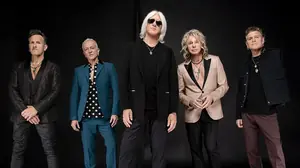

Standing in the damp heat of the Rogers Centre on Aug. 8, there is a specific kind of electricity that only comes from 40,000 people waiting for a snare hit to crack the atmosphere. It is the kind of mid-summer Toronto night where the air feels like wool, but the crowd does not care. They are here for the nostalgia, sure. But Def Leppard is not interested in being a museum piece. While their peers are content to rot on the state fair circuit, the Sheffield boys are out here pushing *Diamond Star Halos*, an album that actually demands your attention.
I caught up with guitarist Phil Collen before the soundcheck. He is lean, tanned and looks like he could outrun a man half his age. We talked about the sheer scale of this trek with Mötley Crüe, Poison and Joan Jett. It is the biggest stadium tour of the year, and for a band that has been through the ringer more than once, the momentum feels earned.
"It’s been on an upward trajectory, even before we got the Rock and Roll Hall of Fame in 2019," Collen says. "With a bit of perseverance, it’s just paying off. And then came the pandemic, it all just exploded after that. The audiences are going nuts on this tour. They’re just obviously been starved of it."
It is a rare thing to see a band of this vintage refuse to coast. Most groups from the 80s hair-metal explosion are happy to play "the hits" until the wheels fall off. But Def Leppard has always had a chip on their shoulder about being "just" a rock band. They want the pop sheen. They want the longevity.
When I asked if they ever considered just hanging it up and living off the royalties of *Hysteria*, Collen bristled at the suggestion. The idea of becoming a legacy act that stops creating is clearly anathema to him.
"Why would we do that?" Collen asks. "I think that if you’re just in a band and you do this thing, it’s all fine and dandy, but that’s not us. We actually aspire to be like The Stones - always putting new music out. They go on tour and they always put new music out - it keeps them relevant. It seems like a bit of a cop out if you don’t do that. I know it’s hard and they just want to hear the older stuff, but we’re really proud of what we do. It’s expression. That to me is the most important part is writing, recording and getting stuff out. I wouldn’t really want to do the other thing. It’s very important for me to be an expressive artist."
That desire for expression is what keeps the fan base rabid. There is a sense of survival baked into the band’s DNA. You can see it in the way they carry themselves on stage. It is not just about the pyrotechnics; it is about the fact that they are still here, standing, while so many of their contemporaries have faded into the "where are they now" files.
"I think there’s an integrity that the band has," Collen notes. "Every family goes through the same thing - births, deaths, marriages, divorces, terrible things happening, but, we’re in a rock band, and we just do it in front of everyone. So it’s kind of nice when it when it pays off, you know?"
The new record, *Diamond Star Halos*, is a massive nod to the glam rock era that birthed them. The title itself is a direct lift from T. Rex’s "Get It On (Bang a Gong)," and the influence of Marc Bolan and David Bowie is all over the tracks. For Collen, this was not about chasing a trend. It was about returning to the source of his own musical awakening.
"It’s more of a homage to an era," he says. "Joe Elliott and I use this phrase to describe the era that we got baptized into music. I was 14 and everything just musically exploded for me and my life changed. When you’re a teenager, and just around that time period, you’re a sponge and you’re looking for an identity. In my case, I saw David Bowie on Top of the Pops. I’d already seen Deep Purple on the Machine Head tour and that blew my mind and made me want to play guitar. Then I saw David Bowie on Top of the Pops and I felt like this guy was writing songs for me personally. And then I joined that tribe, if you like. We always describe that era, that feeling, as hubcap diamond star halos. A lot of friends of mine, had exactly the same moment, like Paul Cook from the Sex Pistols. Same time, same person. A lot of the stuff that was coming out at that time."
The record has been hailed as their best work in decades. And while that sounds like typical PR fluff, the songs actually back it up. There is a looseness here that was missing from some of their more clinical 90s and 2000s outputs. Much of that comes down to the lack of a rigid plan. In the past, they were known for spending years in the studio, obsessing over every snare hit with Mutt Lange. This time, the pandemic forced them to be scrappy.
"Usually, when we do an album, we have a rough idea of what it’s going to be," Collen explains. "When we did Hysteria for example, (producer) Mutt Lang famously said, “Everyone else is making Pyromania Part Two, let’s not do that. Let’s make a rock version of Thriller”. And that’s really what we did with that album - we incorporated all these different things. With this one, we didn’t have a plan. Joe and I started playing with phone ideas and mp3 texting. This stuff came out that really represented that era we just talked about, more than anything else. It just kept going back to that era of when we got into music."
But the result was not a retread. It was a synthesis of everything they have learned over 40 years. They traded files across the ocean, recording in home studios and on laptops. It is a far cry from the multimillion-dollar studio budgets of the 80s, but it allowed for a creative freedom that the band had not felt in years.
"It wasn’t a nostalgic thing, it was more like a light bulb moment," Collen says. "This was such an important time in our lives and we didn’t go out of our way to make a tribute to it, it just kind of happened. We didn’t have to go to a recording studio, which was great. I’ve done all my parts actually sitting on my laptop. And I just plugged the guitar in, did all the vocals, and the rest of them did the same thing. We were sending stuff back and forth. Before we knew it, we had this amazing record."
Seventeen years ago, I wrote a song with my friend, CJ Manson, called This Guitar. It was about this spirit that follows you all through your life. ... We told her we had a song, or a couple of songs, that may suit her. She got back within about an hour and said she could do both of them. She sang all the way through - it wasn’t just a line here and there; she sang the whole song. It just sounded magical.
The biggest surprise on the tracklist is the appearance of bluegrass royalty Alison Krauss. She pops up on "This Guitar" and "Lifeless," adding a layer of vocal sophistication that pushes the band into new territory. It is a collaboration that seems odd on paper, but in practice, it is the record’s secret weapon.
"Seventeen years ago, I wrote a song with my friend, CJ Manson, called This Guitar," Collen says. "It was about this spirit that follows you all through your life. If you’ve ever got anything artistic, like a guitar, or keyboard or painting or poetry or whatever, it’s always your friend, it stays with you. We wrote the song about that. Joe had been a champion of it for years saying “Oh my god, we should do that”. It has a big country vibe but he felt if he sang it, it would take it away from that direction."
The connection finally happened through a bit of rock and roll networking.
"When we started doing this record, he asked about This Guitar again. “Can you just send me a demo and I’ll sing over it?” So I sent the demo and it sounded very different and completely separate to everything else we had," Collen explains. "One day Joe was talking to Robert Plant, who was out on tour with Alison and we’re both huge fans of both of them. She sang a line on a song and all of a sudden, it just throws us straight back into it again. She’s the most amazing singer. If you’ve ever heard her, especially live, it’s like goosebumps all night. We told her we had a song, or a couple of songs, that may suit her. She got back within about an hour and said she could do both of them. She sang all the way through - it wasn’t just a line here and there; she sang the whole song. It just sounded magical."
The result is a sound that defies easy categorization. It is not quite rock, not quite country. It is something more atmospheric.
"Both songs really worked and the whole thing took us into another dimension," Collen says. "It’s beyond country or rock. I am still a huge fan of the Eagles and they really created the original rock/country hybrid, which they actually don’t get enough credit for. And the reason why they were so good is that they were just massively talented as artists and songwriters and everything else. If our songs are anything like that, we’ll take it."
I asked if they had to rework the tracks once Krauss agreed to sing. Surprisingly, they kept the core of the original demos, including some clever fakes on the instrumentation.
"The original This Guitar had some kind of pedal steel that CJ Benson actually faked on the keyboard," Collen says. "Ronan McHugh, our producer, engineer and out-front guy, actually copied CJs parts on a keyboard and pedal steel – we wanted keep that kind of integrity intact because it was about every version of a guitar – slide, pedal steel, acoustic, electric - we wanted to keep all of that in the game with that song."
The song "Lifeless" followed a similar path of evolution.
"The song Lifeless initially sounded a bit like when The Stones used to go a bit country fide," Collen notes. "When I started writing, I thought if I crossed that with a YouTube type vibe, it could create something different. And then obviously, when Allison came on it just, it made it into something entirely different altogether. That’s the great thing about art, you never know where it’s going. It can go off on a tangent, and when someone does such a beautiful thing to it, we’ve learned to just follow it."
This is not the band's first flirtation with Nashville. They previously collaborated with Tim McGraw on "Nine Lives," a move that baffled some of their harder-edged fans but made total sense for a band that has always prioritized melody.
"It wasn’t like Def Leppard were gonna go country," Collen says. "We’d heard through Rick Allen’s brother who would work with him, that he was a fan. I met him for the first time backstage at the Hollywood Bowl and literally, I said, “I’ve got an idea for a song. If you ever want to do it”. I said “It kind of starts with this guitar riff”, and we pretty much wrote the guts of song in the hallway within about 90 seconds. Obviously we expanded on it and I loved the way that turned out."
And then there is the weird stuff. If you are a deep-cut collector, you remember the B-side to "Armageddon It" featuring Stumpus Maximus and the Good Ol' Boys. It was a bizarre, drunken country parody that somehow became a legitimate hit in the Mediterranean.
"We were doing the Hysteria album, and we were just goofing around," Collen laughs. "I think Joe was on the piano and Melvin who was Steve Clarke’s guitar tech. We were just making fun of it and just doing this thing always changing the key and he sang “Please release me.” We kept changing it until he couldn’t hit the notes and tapes rolling - and it actually was a real tape back then. The funniest thing of all, is that it became a hit in Greece. I think it was top 10. The single was other way round there - that was the A side."
But back to the new stuff. "Kick" is the song that arguably saved the record from being too experimental. It is a straight-ahead glam stomp that sounds like it was written in 1974. Collen wrote it with Dave Bassett, and it almost did not end up on a Def Leppard record at all.
"I had an idea for almost a Gary Glitter/Joan Jett style you know that sexy T Rex. kind of groove," Collen says. "He totally understands the hubcap diamond star halo line. In fact, before we actually even had the title, I said it’s Hubcap Diamond Star Halo and he actually repeated the next line of the of that song, so I knew that we were onto something; I knew he was in the in the groove and the right kind of headspace synergy wise and everything. We got just very excited about writing the song. It wasn’t going to be for Def Leppard, I was actually thinking of a female artist because we were thinking it kind of sounds like Joan Jett and there’s a lot of younger artists that are coming out who aspire to be like Joan Jett. I played it for Joe and he said, “Are you nuts? This is a Def Leppard song, we have to do this for Def Leppard”. So, there you go. It never got to a female artist, but as soon as Joe brought his voice to it, he was right."
Then there is "Fire It Up," written with Sam Hollander. It has a rhythmic bounce that feels modern but retains that classic Leppard vocal stacking.
"Sam Hollander. I don’t know if you’ve heard High Hopes from Panic at the Disco - he wrote that and all this great stuff, but he also used to be a rapper in New York," Collen says. "What’s brilliant about Fire It Up, is that it’s got this hip hop kind of meter in the verse, so kind of like Pour Some Sugar On Me – “Love is like a bomb, baby, c’mon get it on”. The lyrics are just brilliant and I think Sam is just an extraordinary writer, he just kind of gets an idea and goes with it like he’s been channeled or something."
The recording of that track had its own weird, cinematic energy.
"We got to a studio in LA where Ed Wood filmed Plan 9 from Outer Space," Collen recalls. "It’s one of the big movies from the 50s and this was one of the rooms that they actually used to film it. That was pretty cool. It’s like Bela Lugosi had been in there and all of this stuff. We recorded this riff and he just started free writing and all of a sudden, we had the song done in less than an hour, and we recorded the demo."
Much of the band’s sonic consistency over the last 15 years is thanks to Ronan McHugh. He has been their go-to guy since the *Yeah!* covers album in 2006, and he has effectively become the sixth member of the band.
"He’s the best live sound engineer anyone’s ever heard," Collen says. "Everyone says his mixes don’t sound real. His live sound sounds like a record. He knows our voices really intimately and he records us all the time. So when we get out on tour, if someone’s got a sore throat or something, he adjusts it accordingly. He knows the guitar playing down to a fine art and he’s just been learning and taking all these ideas in as he goes. We learned all that from Mutt Lang. I think Ronin has taken that role on and he’s actually absorbed a lot of that stuff, so he’s a member of the band as far as I’m concerned."
Finally, I had to ask about the physique. Collen is 64, but he looks like he spends eight hours a day in a gym. In an industry where most guys his age are struggling to fit into their leather pants, Phil is out there shirtless, looking like a statue.
"Well, thank you," he says with a grin. "I’m a vegan although that has nothing to do with that. That was the result of me working out and eating the right amounts. During the pandemic, I got to my ideal look and weight, almost like a Marvel superhero, but I’m not that right now. I limited my food and I was working at just the right balance. It’s a little bit harder on tour, but it’s mainly a food thing. You can work out furiously, but even with a workout, I never go too far to injure myself. You can really do too much heavy weights and there are certain exercises that are bad for your body, especially as you as you age. I won’t be swinging kettlebells and stuff like that. I do martial arts, I always do kickboxing drills and training more to just keep my hips and knees and everything so I don’t feel like a 64 year old man. And it’s the same with the food - keep it constant. It’s leafy greens, crazy loads of fruit, and I do get protein powder to in my bowls or shakes. I allow myself some junk food every now and again as well."
As he walked off to join the rest of the band for their final checks, it was clear that Def Leppard is not just surviving; they are thriving. They have figured out how to balance the demands of a stadium-sized legacy with the creative hunger of a new band. And in 2022, that is a rare feat indeed.