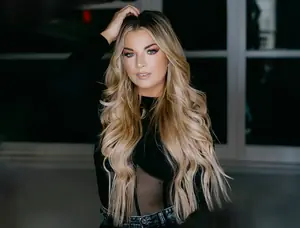
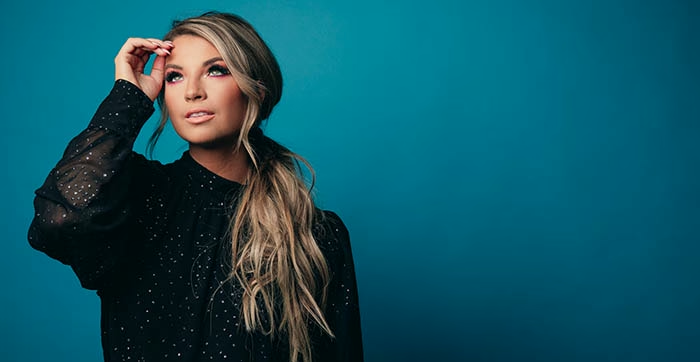
Looking at the flat, expansive horizon of Saskatchewan, you realize why Jess Moskaluke is obsessed with the concept of home. There is a certain grit required to survive the prairies, a resilience that the Langenburg native has translated into a decade-long career in the often-fickle Canadian country music scene. Holding the physical pressing of her latest effort, *The Demos*, you feel the weight of a project born out of necessity rather than a polished corporate schedule. It is a record that smells of local dust and digital ambition.
Moskaluke has spent ten years as the powerhouse vocalist the industry couldn't ignore. She has the JUNO Awards and the CCMA trophies gathering dust on her mantle, yet one specific milestone remained elusive. In an industry where the airplay charts often look like a boys' club, she finally broke the glass ceiling. In a year where most artists were lucky to keep their lights on, she notched her first No. 1 single with "Country Girls". It was a historic moment, marking her as the first woman and the first solo act from her home province to ever sit at the top of the mountain.
But she is not slowing down to admire the view. On Feb. 19, Moskaluke is dropping *The Demos*, an 11-track collection that acts as a post-mortem of her creative process. It features the hits like "Country Girls" and "Halfway Home" alongside her current radio offering, "Mapdot". The project is a raw, virtual collaboration with her long-time producer Corey Crowder, pulling back the curtain on how a song actually breathes before the studio gloss is applied.
When we sat down to talk about the logistics of creating in a vacuum, Moskaluke was candid about the pivot. The traditional Nashville-to-Canada pipeline was severed by border closures and lockdowns.
"It’s been very different, and to be totally honest with you, that’s why this album happened," Moskaluke says. "The reason this album is called The Demos is because of the pandemic, essentially. I couldn’t travel to Nashville or anywhere to write, and I couldn’t really get into a studio because we were all forced to be home. This past year actually gave me a way to record songs that I had already written and always wanted to release, but I never really had the opportunity for whatever reason. There’s a lot of different factors that go into why I may fall in love with a song and not choose to release it at a certain time. Maybe it’s just not what the world needed to hear at that point, or maybe it just wasn’t the sound we were looking for."
The decision to release demos is a risky one. Usually, these are the skeletons in an artist's closet—unpolished, vocal-heavy and sometimes technically flawed. But for Moskaluke, the lack of a traditional studio environment became a creative asset. She saw an opportunity to educate her audience on the labour that goes into a hit.
"That said, I finally had a reason to put a lot of these songs that I’ve always wanted to release out into the world," she says. "We took the demos of a lot of the songs that I had already partially recorded and we kind of just refreshed and cleaned them up. It’s really going to give fans a kind of interesting take on the whole process. We even included a few of the actual demos to really give people a glimpse behind the scenes at everything that goes into producing a finished track."
The result is a record that functions as a "before and after" gallery. It is a bold move in a genre that usually demands perfection. If there is a critique to be made, it is that the repetition of tracks might feel redundant to the casual listener, but for the die-hard fans, it is a masterclass in songcraft.
"So, there are two versions of a couple of the songs on the record — kind of a before and after, just to kind of get a little insight on the whole process," she explains. "It’s been kind of fun, and something I’ve actually wanted to do for a long time. A lot of the time when we’re writing a song, like Country Girl for example, the demo sounds almost exactly like the actual song we released to radio. Other times it’s fun to listen to a song and go back to the demo, knowing how it started was so different."
When you dig into the tracklist, "Mapdot" stands out as the emotional centre of the project. It is an anthem for the small-town kids who were told they had to leave to be someone. Moskaluke rejects that narrative. She lives where she wants, and she writes what she knows.
For me, a No. 1 was a goal that I had wanted for so long, since being a part of the country music family, and it seems like something that was always so far out of reach. Frankly, it seemed like a silly goal that I had in mind. ...Sometimes it’s very challenging for Canadians to get a No. 1 at all, let alone a female. It really just means to me that Canadian country music needs to continue to be supported, and really getting the chance to feel that support is the best feeling in the world.
"Well, Mapdot would be that was one of the most personal songs I’ve ever written," she says. "But I mean, for a lot of different reasons, so many of these songs mean different things to me. For Leave Each Other Alone, I was super excited about recording with Travis Collins, who is the Australian artist that’s featured on that song. It was an amazing duet, and as you’ll hear on the demo version, it wasn’t always meant to be a duet."
The collaboration with Collins is a highlight, but it was a session with Nashville royalty that really had her sweating. Writing "Drive His Truck" put her in the room with RaeLynn and Sarah Buxton, a songwriter Moskaluke has idolized since she first picked up a microphone.
"It was kind of cool to watch that come to life," she admits. "Drive His Truck is a song I wrote with my producer, as well as RaeLynn and Sarah Buxton, both of whom are extremely talented singer/songwriters. I’ve actually been a huge fan of Sarah Buxton for my whole life, so when Corey told me we were going to write with Sarah that day I was like, freaking out and hyperventilating. She also offered to do background vocals on the song and she just knocked it out of the park. I’m so pumped that song took on a whole new life because of Sarah."
But we have to go back to "Mapdot". It is more than just a track; it is a manifesto. In a world of digital nomads and big-city dreams, Moskaluke is planting her flag in the dirt of Langenburg. The song is a love letter to the postal codes that most people just drive through.
"Mapdot is a song I had wanted to write for a long time, both literally and figuratively," she says. "I had the title sitting in my notes folder, where I keep all my song ideas on my phone, for a very long time. It had never really struck a chord with any of my co-writers as a good song idea, I guess, so we kind of tabled it and it just sat there. I had always wanted to write about where I came from, because people had always told me I would have to move to Nashville or Toronto or Vancouver in order to be a successful musician, and I’ve never felt that way. I figured, I travel for a living, so why can’t I live where I want? Where I’m happy? So, I wrote the song to tell everybody about where I come from, because I really don’t think anyone fully understood. Really, it’s kind of a love song to my hometown."
The music video for the track reinforces this authenticity. There are no hired actors or Hollywood backlots here. It is a documentary of her actual life, filmed by local talent.
"Some of my best friends are in that video with some of their families," she says. "It was really important to me to have all real people in this video, it was also shot by crew based out of Saskatchewan, which was also really important. I also think that because we’ve all been forced to be home for so long, the song really comes at a great time. I hope it encourages people to shift their focus, and instead of seeing being home as a chore, I kind of hope they can learn to appreciate their communities and their small towns."
The album also explores the dizzying speed of relationships. "Too Much Too Soon" is a song that captures that frantic, terrifying moment when you realize you are falling faster than you planned. It is a sentiment Moskaluke knows well from her own marriage.
"Too Much Too Soon I wrote a long time ago, gosh, maybe two years ago," she says. "It was actually about one of the other writers’ experience in a relationship that we kind of thought was fun. And it was the same sort of experience I had when I first met my husband. You think, this is all going too well, too fast. Sometimes it seems too good to be true. Is that OK? It seems like it should be wrong, but it’s not. No Place Like You was written ironically at the height of when I was touring, and just kind of talking about missing my husband, but not. We chose to take kind of a more positive spin on it. Like, oh my gosh, I miss you so much — this sucks — but know what, wherever you are is where I want to be right now."
And then there is the elephant in the room: the No. 1 spot. When "Country Girls" hit the top in March 2020, the industry was shocked—not because she didn't deserve it, but because they assumed she had already been there. She has platinum records and gold singles, but the actual peak of the chart was a new experience.
"Yeah, that was kind of the reaction I didn’t really expect from people, to be honest with you," she says. "I kind of just thought everyone would know it was my first. Honestly, I learned there is no more flattering response to for some many people to question whether it was true. So many people were listing off songs they thought had made it there, which to me means those other songs had really resonated with fans despite where they may or may not land on the chart. That was a pretty cool feeling. In such a potentially discouraging year, the timing was fantastic — it was really truly flattering, and it felt good to see how many people were on the bandwagon and were supporters. It was such a cool experience."
For Moskaluke, the No. 1 wasn't just a personal victory. It was a data point for the viability of Canadian country music on the global stage. It proved that a girl from Saskatchewan could dominate the airwaves without changing her zip code.
"For me, a No. 1 was a goal that I had wanted for so long, since being a part of the country music family, and it seems like something that was always so far out of reach," she says. "Frankly, it seemed like a silly goal that I had in mind. Sometimes it’s very challenging for Canadians to get a No. 1 at all, let alone a female. It really just means to me that Canadian country music needs to continue to be supported, and really getting the chance to feel that support is the best feeling in the world."
The last year has been a grind for everyone in the arts. Moskaluke was literally on the road when the world shut down. The sudden shift from the roar of a crowd to the silence of a living room was a jarring transition.
"It’s definitely been a challenge," she admits. "In the beginning, when the pandemic started, I was actually on tour. I was two or three days into this tour that I was on with a bunch of my friends and we all went home and at that time you’re thinking, OK, so we’ll have about a month at home, whatever, we’ll get rested up, we’ll practice, and we’ll be with our families and then we’ll hit the road again. Here we are, almost a year later, and we’re still home. So, that provides a bit of a challenge for everybody, not just musicians, but I have tried to say, OK, here are all these things that were put on the backburner . . . what can I do next?"
But she isn't interested in just sitting around and waiting for the world to reopen. She is restless. She has spent her downtime clearing out the creative cupboards and preparing for the next chapter.
"People had always asked me for years, what do you like to do in your spare time? And I would just laugh," she says. "Now, everyone’s focus is a little bit different. In the beginning, I really just wanted to record and get some time with my family, but now I’m done resting. I want to pick it up, so let’s release a bit of a different kind of album and have a whole new adventure.
Get Tickets