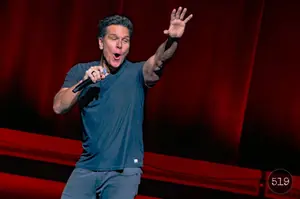


I’m sitting in a plush velvet seat at the Fallsview Casino Resort in Niagara Falls, looking at a stage that is about to be occupied by a man who has made a career out of being a professional anomaly. We are talking about Dan Whitney. But you know him as Larry the Cable Guy. He is bringing his specific brand of Southern-fried observation to the venue on Apr. 3. It is a fascinating study in character endurance. Most comics burn out their personas in five years. Whitney has been wearing that sleeveless flannel for decades.
In a recent sit-down with 519 Magazine, the man behind the "Get 'er done" mantra was surprisingly candid about the artifice of his empire. He admits he knows nothing about cable television. It is the ultimate irony of modern comedy. The most famous cable guy in North America couldn't fix a signal if his life depended on it.
When you look at the landscape of stand-up, most performers try to find their "authentic" voice. Whitney did the opposite. He built a fortress. I asked him where this icon actually originated.
"It was a creation in my head, just a combination of people I grew up with," Larry says. "I grew up in the country. When I used to do a bunch of characters on stage, I loved all the character creation and this got popular by default. I never intended to do it on stage, but it just evolved into what it is. But I called the radio station for the first time pretending to be a cable installer. They asked me what my name is, and I threw out Larry, and they go, 'Oh, its Larry the Cable Guy?' I said, 'Yeah.' And it just kind of stuck."
It is a classic case of the tail wagging the dog. The radio bit became the brand. The brand became the career. But the transition from a voice on a phone to a headliner in a theatre required a leap of faith. It wasn't a calculated corporate strategy. It was a happy accident in Florida.
"Then I had a friend of mine, about a year and a half later, bill me as Dan Whitney, AKA Larry the Cable Guy from 95YNS in Tampa, the radio station, and it sold out two shows in 20 minutes," he explains. "I went off the stage and people started yelling out my phrases and all that and signing autographs, taking pictures. And a light bulb kind of went off in my head and said, 'Boy, I’ll tell you what. I should just do this on stage. It’s fun to do. I love writing for it. It’s funny.' So it all happened by just trial and error. I mean, I didn’t intend on doing it on stage. It was all theatre of the mind really. But it’s fun. I enjoy it."
There is a historical precedent for this. Whitney isn't the first to hide behind a mask. He views himself as part of a lineage of character actors who found a niche and dug in deep.
"Throughout the years there’s been comedians that have done characters," he notes. "Mine’s probably one of the longest running ones. I always liked Jim Barney. He did it for a long time, and Father Guido started to do it. I enjoy it. It’s just something fun to do and the crowds love it. I love it. I’m a country kid, so it’s just a retrospect of people that I knew and grew up with."
The "Cable Guy" moniker is a total misnomer, though. He’s about as qualified to wire a house as I am to fly a shuttle. His technical expertise peaked in the era of analogue piracy.
"I don’t know anything about cable," he admits with a laugh. "The only thing I knew about cable is when they first came out and you had that little black box and you could take an index card and fold it in half and slide it in the top of that box and you could get HBO."
Comedy usually requires a foundation of real-world misery. Whitney has a resume that reads like a list of rejected reality show pitches. Before he was selling out arenas, he was selling things nobody wanted.
"Well, let’s see. What’d I do?" he asks, reflecting on his pre-fame labour. "I used to do stripper grams for the blind. I sold Princess Diana antenna balls. Both of these were dead-end jobs for me. Can you imagine if I’m door-to-door selling Princess Diana antenna balls? I make myself laugh sometimes."
But beneath the absurdity, there is a genuine connection to the land. This isn't just a city boy playing dress-up. He grew up in the dirt of Nebraska. His aspirations were rooted in the livestock trade.
"When I grew up, I wanted to drive a big rig," he says. "I wanted to drive a Peterbilt Potbelly hog truck and haul cattle and hogs to market. And I wanted to be a cattle auctioneer. That’s what I wanted to do when I was growing up. I grew up next to a sale barn, livestock barn, and my whole life revolved around livestock. So it was my first job working at the cattle barn when I was just a kid. I raised pigs. We had a pig farm there in Nebraska."
His work history is a sprawling map of the American service industry. It is the kind of background that provides endless fuel for a one-liner comic.
"But my other jobs, I did pretty much everything," he continues. "I cut lawns. I was on a lawn crew. I worked at a Laundromat when I was in college. I cleaned office buildings. I was a bellhop at Hyatt Regency. Geez, what else did I do? Worked at Wendy’s, which was my first job I ever had coming from a pig farm. I didn’t have a very good work ethic. I quit because I couldn’t go to a football game. Me and the other employee and the cook, Leo, wanted to go to the local high school football game so we just quit Wendy’s and went to the game. Probably not a good idea. Let’s see, what else did we do? I think that’s it. I think that’s pretty much every job I ever had. Oh, I was the assistant manager of the Radio Shack in Georgia when I went to college at the South DeKalb Mall in Decatur, Georgia. Then I started doing stand-up. So it’s just a good conglomeration of all kinds of things that I did."
As the man changed, the character had to shift. You can't tell the same jokes as a father of two that you told as a single guy in a dive bar. The edges have softened. Larry has become more accessible, perhaps by necessity.
"When I came up with it, it was just myself," Larry explains. "I wasn’t married. I didn’t have kids. So it was just whatever. I made up stories about ex-girlfriends and ex-wives. Then I got married and there are a lot of jokes between you and your wife so I wanted to incorporate some of those. My act was rough as far as who could come to the show. And then I had kids, and I wanted my kids to be able to see stuff so it mellowed out a little bit. It wasn’t as harsh. Jokes that I thought were funny when I was single and an idiot weren’t as funny anymore because I had a family. You just grow. The character kind of grew with me as a person. I still kept it what it’s supposed to be, but the character didn’t do things that I didn’t want him to say. So I would say it grew a little... I mean, the jokes are still there. I think the jokes are just as funny as they used to be. More people can enjoy them, let’s put it that way."
I asked John Lasseter, 'How do I play Mater? How do you want him played? Is he a quick talker?' He basically just kind of looked at me and said, 'Well, no, he’s you. Just be yourself. Be you. You’re Mater. However you play Mater is Mater because you are the voice of Mater.' It worked out brilliantly. It was awesome. It was probably one of the coolest things I ever did.
Then there is the question of the voice. Is it a costume or a skin? Whitney treats the accent like a dial. He can turn it up for the crowds or turn it off for the grocery store. It is linguistic code-switching at its most profitable.
"Yeah. When I get with my buddies, I just talk like that," he says of the Southern drawl. "I mean, I lived in the South for 34 years, so I just picked it up. I hung out with all the crackers down there. So it comes and goes. Just depends on where I’m at, you know? But I have a little bit of an accent just from living down there for so long. If I’m not hanging out with anybody that has a little twinge of an accent and I’m away from my friends for a long time, I start to lose it. So I can talk normal."
It is an environmental reflex. He compares it to the way people absorb their surroundings, whether they are in the Midwest or the English countryside.
"Like my buddy, Brad, called the other day, 'Honey, what’s going on up there?' You know? He talks like that," Whitney says. "So that’s how I just started to talk, and then I hung up and my wife goes, 'You know, you talked with a Southern accent the entire time you’re on the phone.' I said, 'I did?' She goes, 'Yeah.' I mean, I don’t even realize it. It just depends who I’m talking to, just kind of shows up. My wife, she’s from Wisconsin. She lives in Nebraska. She doesn’t have a Wisconsin accent, but the minute we go back for vacation and she’s hanging around her sisters and her parents, saying 'Oh.' She’s talking like that, going to the boots. So she takes up that accent. That’s how it is. Look at Madonna. Remember when she moved to England? All the sudden she’d have an English accent."
But don't expect him to slip out of character when the house lights go down. He knows what he's being paid for. The professionalism is high. He views Larry as a job, and he is a very good employee.
"Oh, yeah. When I did my show Only in America, I went in and out of accent all the time," he notes. "People always say that every time you see me I’m always in character. But I’m not in character. I’m only in character when I’m on television. Well, when I give my shows and stuff, when I’m ironed people say, 'Hey, Claus, Larry the Cable Guy is coming to do a show,' obviously I’m going to be doing my show like they know it. But when I’m just hanging around the house or hanging around with my family, just when I’m at the store, I’m not in character. Any time I’m paid to be Larry the Cable Guy, I’ll be Larry the Cable Guy. I mean if it’s funny and it makes you laugh and you like the jokes, just enjoy it. What’s the big deal?"
There is a defensiveness there about the South. He bristles at the idea that the accent equates to a lack of intellect. For Whitney, the persona is a celebration of a specific culture, not a mockery of it.
"Exactly," he says. "It’s just different regions of the country, it doesn’t matter what you talk like. There’s just as many intelligent people in the South as there is in the Northeast. Just as many intelligent people in the South as in the Midwest. It’s dumb. It’s stupid. I do that because it’s how I grew up. Foxworthy and I used to riff off each other and we’d put our accent on thick. It’s fun. We enjoyed it. Makes us laugh."
Speaking of Jeff Foxworthy, the history between the two is legendary. They were the pillars of the Blue Collar Comedy Tour, a phenomenon that reshaped the industry. Foxworthy recently told a story about Whitney leaving him naked in a hotel hallway. Whitney doesn't even try to top it.
"Well, I can’t top that story," he says. "But that’s probably the crème de la crème of the story. That’s the number one story. I’ll never beat that story."
That tour was a moment in time. It was the "Redneck Rat Pack" era. It forged bonds that didn't exist before the buses started rolling.
"It created the friendship," he says of the tour. "Jeff and I have been friends forever. He’s one of my best buddies. Jeff and I have been friends since like 1986-87. I never met Bill Engvall in my life. I met Ron White maybe twice and briefly. So when the tour started that was the first time that I hung out with everybody. Jeff and I were already buddies. And we all got to be really good friends. So no, we’re all good friends. That was a real special tour. Nobody will ever do that. That was like four comics that were doing things that no other foursome will ever do in comedy. It was fun to be a part of that history when they called us the redneck rat pack. I mean, it was just really cool. We’ll always have that special bond of those shows, and we’ll always be friends."
When he isn't on stage, Whitney is a massive music fan. Specifically, he is an REO Speedwagon devotee. It is a bit of a tragedy that he will miss them in Niagara Falls, as they are scheduled to play the same venue just months after his show.
"It’s really funny. Whenever we’re on the road and we see each others’ names, we’ll take a picture and send it to each other," he says. "Just following somebody or something like that. Yeah, they’re awesome. They play my golf tournament. Whenever we’re close and I’m there, I always go on stage and air guitar. It looks like I’m playing air guitar, but I’m not. I’m air guitaring Roll with the Changes, but people think I’m really playing. It’s just a blast. I have a good time with those guys. They should be in the Rock and Roll Hall of Fame, that’s for sure."
His love for the band is visceral. It was his gateway into the world of live rock.
"That's good rock and roll. I don't know what drew you to it," he tells me. "REO Speedwagon was the first rock concert, by the way, that I ever saw. I had never been to a rock concert before, so I think I was 22 years old when I first saw them live. Other than that the only concert I'd ever been to was Buck Owens and the Buckaroos and Crystal Gayle. But Speedwagon, they’ve got good tunes. They're a good, solid American rock band. They're an iconic rock band and they have some of the best guitar solos in their music of any rock and roll group. Those arena bands back in the day, they should all be in the Hall of Fame. I know Journey just made it, but those are the basic food groups of rock and roll. Journey, Styx, Foreigner, REO Speedwagon, The Cars."
Despite his fame, Whitney still gets starstruck. But it isn't by the modern A-list. He is moved by the icons of his childhood.
"No, not really," he says when asked about fanboy moments. "I get more fanboy-ish over stuff when I grew up when I was a kid. I mean, REO's great. I love hanging out with them and it's awesome. But now I see them a lot and now we're friends. But I always fanboyed over just iconic stuff when I was a kid growing up and stuff that I remember, like when I first met Tony Orlando. I grew up and he was on TV. I was 10 years old when he was big. And he's still out there and he's still doing it. He came to my show once and I couldn't believe it. Tony Orlando came to my show. And I remembered watching Tony Orlando and Dawn variety show on TV when I was a kid. So when I got my first three Christmas specials, of course, I called Tony Orlando and asked him if he wanted to by my co-host because I thought that would be so cool. I grew up watching him as a kid and now he's my co-host on my show, be awesome. So I get that. I love Tony to death. Now he's like my adopted brother. He's so awesome. But stuff like that, like when I did my roast and Maureen McCormack was on there, Marsha Brady, I just couldn't believe that Marsha Brady was there. I mean, that stuff that you grew up as a kid, you know?"
Of course, the biggest shadow in his career is cast by a rusty tow truck. Mater, the heart of Disney's *Cars* franchise, changed everything. It took Larry from the comedy club to the nursery. When he first met John Lasseter, he was out of his depth.
"Yeah, it was pretty neat. Mater was a lot of fun. It was awesome," he says. "When I went on that first day I was nervous, and I asked John Lasseter, 'How do I play Mater? How do you want him played? Is he a quick talker?' He basically just kind of looked at me and said, 'Well, no, he’s you. Just be yourself. Be you. You’re Mater. However you play Mater is Mater because you are the voice of Mater.'"
That permission to be himself—or at least, to be Larry—opened the floodgates.
"It made me feel comfortable so I just basically did Mater like I would do Mater," he explains. "It worked out brilliantly. It was awesome. It was probably one of the coolest things I ever did. You have all these huge A-list celebrities that still haven’t done a Pixar movie and they would love to do one because they got kids or whatever, grandkids, and they never have done it. Not only did I get to do one, I got to do three of them, and I got to voice an entire theme park."
He even takes the voice on vacation. On the Disney Fantasy cruise ship, he famously took over the intercom.
"You know, it's funny," he recalls. "That was the inaugural launch of the Disney Fantasy, and I did two shows in the showroom, and John Lasseter actually thought it'd be fun if I went up and I made a ship's announcement as Mater. I was on the boat that day because John Lasseter asked me to go up and make that announcement. So I went up and I grabbed the microphone and just did a bunch of Mater’s stuff. It was a good time. I actually talk about that in my show. There's a funny, little twist to that that I do in my shows about that."
But the core of his work remains the stand-up. And stand-up is a numbers game. For a one-liner comedian, the math is brutal. You can't hide behind a long story. You need a punchline every 10 seconds.
"Well, yeah, always keeping your act fresh is always the difficult part because you're constantly writing and adding things," he says. "There's a comedy club that I'll go up to called the Funny Boat in Omaha. I go up and I try some stuff out, but most of my trying out stuff is at the actual show. It takes forever to get a new hour of material when you do one-liners. So when you finally get them all together, then you do an album if they want you to do an album and then you're like, 'Oh, man. Took me forever to get those. Now I got to write a whole new hour because now it's all on an album.' So yeah, it's a long process, but now I have a ton of material that I've never used that didn't work, but could work if you reworked it now that your time's gone by. So there's always stuff that I can pull out and try and rework and see if it works again. But yeah, the writing process of one-liners takes a while. Once you get it, though, you're glad that you put the time in because it's funny. But if you're just a storyteller comedian or you're doing a bit about Lima beans or something."
He compares his grind to that of Foxworthy. The difference in efficiency is staggering.
"Jeff called me up the other day, he goes, 'Hey, I've got this new bit about...' whatever it is," Whitney says. "And then when I see him do the bit on stage, it's seven minutes. Like that story about me in the hotel with him, that's like a seven, ten minute story. So I mean, if he needs a new album of material, that one story took 10-20 minutes. It'll take me a month to write 35-40 one-liners and out of those 40 one-liners, probably only 10 of them are worthy of being tried out on stage. Five of those are funny, so in a month I've got five new jokes and that's almost a minute and 10 seconds."
Despite the pressure, he doesn't fear the "cancel culture" or the idea of crossing a line. He trusts his internal compass and his connection to his audience.
"No. Humor's humor. I kind of know what I can do and what I can't do," he says firmly. "My fans expect a certain thing and I don’t think I really go too far. Can you though? You could if you weren't paying attention. But if you read your crowd and I can pretty much read my crowd and kind of tell what I can or cannot do."
As he looks toward the rest of 2020, the sleeveless shirt might be coming off more often. He is a man who has won the game and is now just playing for the love of it.
"Just raising the kids and hanging out with my family," he says of his current priorities. "As far as comedy goes, I love it. It's not my number one priority. My number one priority is my family. I've had a great career. My fans are awesome. Look, any time I do a show, I give 110% and I always try and come up. Even though I got a new album that I just did that's coming out in April, I still always like writing. I love what I do. I love making people laugh. So my goal for this year is just to show up at my shows and give everybody a good night out."
And that is exactly what the crowd at Fallsview is going to get. A professional. A character. And a man who knows exactly how much an index card is worth when you're trying to steal HBO.
Get Tickets