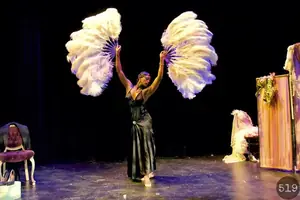

The velvet at the Olde Walkerville Theatre usually feels like a relic of a bygone Windsor, but this week the air in the room is shifting. It is getting heavier. It is getting louder. The historic venue is currently shedding its local playhouse skin to become a vintage burlesque house, a necessary backdrop for the touring theatrical production of *Josephine, A Burlesque Cabaret Dream Play*. The show lands in the city for four performances from June 28 to 30.
And it isn’t just a history lesson. This is an exorcism of sorts, led by dancer and actress Tymisha Harris. The production is a jagged, beautiful collision of cabaret, theatre and dance. It aims to reconstruct the fractured legacy of Josephine Baker, the first African-American international superstar and a woman who spent the 20th Century breaking every rule she could find.
Harris comes to the role with a resume that screams commercial polish. She has put in time as an Assistant Choreographer and dancer for NSYNC, done the Hollywood hustle in the *Bring It On* franchise and weathered the road in the national tour of *Rock of Ages*. But sitting in the theatre, you realize this role is different. It is personal. She didn’t just take the job; she fell for the woman behind the banana skirt.
“Josephine was in love with being in love and it’s not a bad thing,” Harris tells 519 Magazine. “She adopted 12 kids and was always trying to get back to America. She was looked down upon, spat upon, called a Communist, her Visa revoked and all these different things, but when the civil rights movement actually did get started, Martin Luther King called and asked her to be a part of it. She was banned at the beginning, called this and that, but they brought her back because it was the right thing to do. I think we all need to hear her story.”
The narrative weight of that story is staggering. Baker was born in St. Louis in 1906, a time and place that offered a Black woman very little besides a life of service or silence. She found moderate success in the United States, but she had to cross the Atlantic to find her crown. By the early 20s, she was the toast of France.
But let’s be clear about the stakes. In the 30s, Baker was starring alongside white romantic leads in major films. This wasn't just rare; it was dangerous. She navigated multiple interracial marriages and homosexual relationships with a nonchalance that would terrify the modern social media moralist. She was performing in men’s clothing decades before the term “drag” became a household staple.
France offered her the oxygen of freedom, a reprieve from the racial oppression that defined her American upbringing. Yet, the play suggests a lingering ache. She never stopped wanting her home to love her back.
She was African-American and she was the first international superstar. She rose to the same hype that Beyonce has now... I admire that fearlessness and her guts to go for it. I think her story is amazing because it shows us that if we continue on the same path, we might not be headed in that right direction.
“She was African-American and she was the first international superstar,” Harris explains. “She rose to the same hype that Beyonce has now with three films starring a black woman – that’s three films right next to very prominent French actors. I admire that fearlessness and her guts to go for it. I think her story is amazing because it shows us that if we continue on the same path, we might not be headed in that right direction or we’re not going to change our direction. Hopefully the story opens people’s hearts, minds and thoughts about what they are saying about somebody.”
The staging is brilliant in its simplicity. The play exists within an imaginary boudoir, a space where Baker can drop the persona and speak to the audience with a casual, almost startling intimacy. It is a confessional. She recounts the escape from St. Louis, the embrace of Paris and the eventual, stinging rejection of the United States.
It isn't all sequins and jazz, though. The script digs into her work as a spy for the French Resistance. It is a historical fact that often gets buried under her stage credits, but the play brings it to the fore, detailing how she carried secret information hidden in her undergarments.
Harris manages to find the balance between the myth and the human. Her performance is a mix of sass, sweetness, sexiness and humor. But there is a technical hurdle here: the show is unapologetically adult. It carries a heavy anti-racism sentiment, but it also features nudity that might make the more conservative Windsor theatre-goers blink.
“She loved herself, she loved her body and she wasn’t afraid to show it off,” Harris adds. “She had beautiful skin and she put it out there for everyone to see. We don’t have to be prudes at this show – she certainly wasn’t. We’re not born clothed. But anybody can look for themselves whether they’re comfortable or not and maybe this will start to change body images of what people see. I figured out I could make my light shine in my own skin whether I’m fully clothed or naked. I’ve been in and out of costumes before and I’m dancing in just bananas in this show, so either way that power has transcended through those costumes or lack of costumes.”
That power is what makes the show work. Baker wasn't just a dancer; she was a woman who claimed her own sexuality in an era that wanted to commodify or crush it. She was sexually active and entirely indifferent to the boundaries of race, colour, creed or orientation.
“Oh yeah, she was into all sorts of things,” Harris says. “She was very sexually fluid. That was also just part of life in the Roaring 20s. She embodied the time and ran with it. I think that’s what enhances some of her sexuality on stage – she was so sexually open and free and powerful that she was not hindered by anyone else. She didn’t bother to worry about anybody else and about being a prude. That created a nice little grey area. It wasn’t just on the stage, she actually lived it.”
The "grey area" is where the play finds its teeth. It refuses to sanitize Baker for a modern audience. Living in that space for 90 minutes is an exhausting ask for a performer. Harris admits that the weight of the role requires a certain level of spiritual permission.
“I definitely call for her to come and I ask ‘How did you do this Josephine?’, and she answers ‘like this’ and I’m like Okay. I do try my best to make folks understand her right to do the things she did and the grace that she had when she performed. She had an unforgettable smile with her eyes and when she smiled, you felt comforted by it.”
The production itself has been a slow burn. It started as a work in progress back in 2016 before evolving into a full North American tour in 2017. It has picked up accolades at Fringe festivals across the continent, largely due to the chemistry between Harris and her co-creator and director, Michael Marinaccio. The book and music by Tod Kimbro provide the skeleton, but Harris provides the soul.
If there is a critique to be made, it is that the "dream play" format occasionally feels too ethereal for a story so grounded in the dirt and blood of the civil rights movement. But perhaps that is the point. Baker lived a life that felt like a dream because the reality of 1920s America was a nightmare.