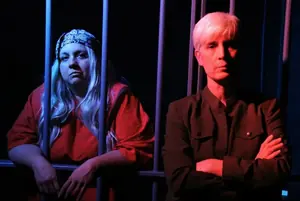

Sitting in a dimly lit theatre in Halifax, you can almost smell the diesel fumes and damp sawdust wafting off the screen. Taylor Olson is a name that carries a certain weight in the Maritimes, though most casual observers probably only recognize him as Larry from the gritty, low-budget chaos of *Trailer Park Boys: Jail*. But Olson is far more than a bit player in Sunnyvale’s orbit. He is a filmmaker with a jagged, honest edge, and his feature debut, *Bone Cage*, is a far cry from backwoods slapstick.
The film is a visceral adaptation of Catherine Banks’ acclaimed play. It follows Jamie, a young man operating a massive wood processor, caught in a soul-crushing cycle of destroying the very environment he feels a desperate need to protect. It is a story about the friction between labour and conscience.
When I ask Olson why this specific story served as his jumping-off point into feature filmmaking, his answer is rooted in DNA and grease.
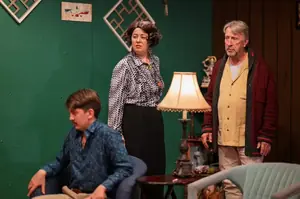
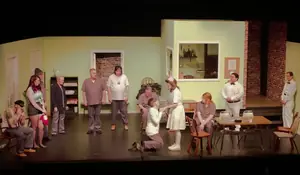
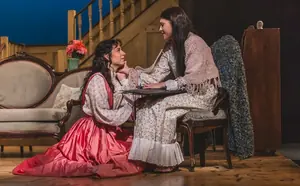
"I read the play in university, it feels like forever ago, and I fell in love with it," Olson says. "I think Catherine’s a brilliant writer, and my family’s worked in the logging industry for generations. My dad’s a heavy-duty mechanic. My grandfather on one side worked a wood processor, just like Jamie, and the other one ran a boom boat business. So it was something I really understood in a world that I knew. Then luckily, I did the stage version here in Halifax in 2017. This is the second day of rehearsal, I just thought it’d make a great film. The poetry of her writing was so beautiful. And I could see that translating to visual images that I’d seen before and clear cuts or in selective logging woodlot. It just felt right."
But moving from the stage to the screen is a minefield. You risk losing the intimacy of the theatre or, worse, making something that feels like "filmed theatre"—static and suffocating. Olson knew the stakes. He wasn't just moving actors around a room; he was expanding a world.
"It is quite difficult," he admits. "That was one of the things I learned about the adaptation process. Luckily, I had Catherine as my script editor every step of the way. The play has about 15 scenes, and then you end up with 107 scenes in the film. What we really wanted to do was make it its own thing. It’s coming from Catherine’s play, keep the heart of it, but find the story that I want to tell and find my own voice through it. Through that, change the medium. So it was a lot of hard work but it was totally worth it."
Maintaining that relationship with Banks was vital for Olson. In an industry where directors often treat writers like disposable blueprints, Olson took a more collaborative, almost protective stance. He didn't want to strip the soul out of the source material.
"Catherine’s great," Olson explains. "She’s really insightful and knows this world so well. She wrote about real places of real people that she knew, and she built off of these real situations. She was an incredible resource and adapting the playbooks. I could go to her and say, I had this question about this character, what’s underneath this? What’s the backstory for that, and she would say, 'Oh, it’s this, this and this,' and then I can build off of that and make my own version of it. Even in the casting process, I wanted her to feel very involved, because I’ve heard of so many stories of people having their work taken and adapted and stripped from them. And it’s something completely different. And I didn’t want that to happen to her because I really respect her. So even in the casting process, I had her input and at the end of the day, it was my decision, but I really wanted her to feel good about the choices we were making."
Taking on a feature for the first time is a Herculean task. Most directors would be content just surviving the production, but Olson decided to direct and star. It sounds like a recipe for a breakdown, but he speaks about the process with the kind of clarity you only get from someone who has spent hours staring at a shot list in the middle of a clear-cut forest.
"Thanks. Oh, man, it was so fun," Olson says. "It was honestly a really joyful experience. It was a great challenge, there were days that it was difficult, but overall, we get to tell a story that we’re passionate about, and we get to go and make a movie, something not many people have the privilege to do. So that was a blast. The thing that I learned, moving from shorts to features is, at the end of the day, it’s all filmmaking, but there is a larger scope. It’s more prep, and in that prep, you’re digging deeper and deeper, because you have a lot more room to play with. And so we did a ton of crap when we came into the film, memorize the shot list from beginning to end, the cuts were planned and we knew every piece of it just so that we could try to be there and be present with the actors and the crew on the day."
Having already played the role on stage gave Olson a head start. He wasn't discovering Jamie on the day; he was refining him. The theatre run acted as a laboratory for the character's psyche.
"Yes, absolutely. It was huge," Olson says. "I’ve done the stage version, so I knew the play so well, I knew it inside and out by the time we finished the run on stage. And that really gave insight to how I wanted to shape the characters in the film. The heart of them are the same, but there’s little nuances that I was going to pull from my life here. And this person I know here, and it was a huge foundation to then be able to add specific small details."
Jamie is a complicated figure, a man trapped by the expectations of his environment. He is the embodiment of a specific kind of rural struggle, where your livelihood is tied to the destruction of your home. It’s a paradox that Olson felt in his bones.
He’s taken on this armor of performative masculinity and now it’s welded itself to him, and he can’t get it off. But underneath all of that, he’s actually quite a sensitive, and caring person who’s slowly changed over time, because of this armor of essentially toxic masculinity.
"Jamie was the thing, even reading the play, although it was the world altogether and the images," Olson notes. "I’d seen these clear cuts before, it was really him and his character paradox that really excited me. He’s a hard case, he’s sort of tough guy and really, what’s happened is to survive in this community. He’s taken on this armor of performative masculinity and now it’s welded itself to him, and he can’t get it off. But underneath all of that, he’s actually quite a sensitive and caring person who’s slowly changed over time, because of this armor of essentially toxic masculinity. That was something I grew up in many communities in BC, around the forestry industry, and I knew a lot of these guys. So there was a lot to pull from, there’s even parts of the character, especially the sensitive side of him who’s working this job that he knows he’s actually working himself out of a job, and knows it’s stripping the environment, a place that he cares about. And it hurts him and I saw a lot of my dad in that and so I was able to pull from all these people."
There is always a risk when a director casts himself. It can look like vanity. But for Olson, it was about efficiency and intimacy. He knew the character better than anyone else could after years of living with the script.
"Yeah. It was something that I went back and forth on, and got advice from people on," Olson says. "At the end of the day, one of my closest mentors said, 'You know the role so much better than anyone else stepping in is going to know it.' In that sense, there’s an advantage, since you’ve done the play, you’ve adapted the script, you know this character so well, why would you hand that off? And I’d already acted in my short films. I’d already acted and directed myself before. So it was something I was familiar with, and in the end, it felt organic for this project."
Directing yourself requires a strange kind of mental gymnastics. You have to be the creator and the tool simultaneously. It requires a level of detachment that most actors struggle to find.
"It’s a good question," Olson says. "I’ve gotten used to it. At first it was a little bit odd, because you can second-guess yourself. But at the end of the day, the thing that wins, if you had to fight between the two, 100% of the time, it’s the side of just making the film as good as it can possibly be. What happens to me when I’m dragging myself is, when I watched the playback, I don’t even recognize it’s me, I’m just watching the character and it’s the story coming across, so I think when you focus on the story, you don’t recognize yourself in it, and it doesn’t bother us as much."
The film lands at a time when environmental anxiety is at an all-time high. But *Bone Cage* doesn't preach. It shows the human cost of industry. It’s about the people who have to do the work, not just the people who protest it.
"We all know that scientists are saying that we have to make these changes now, or it’s too late," Olson says. "The thing that at the end of the day that I always think about is, how do you hold on to hope in these situations? But I think we have to find different ways to and that comes in connection with each other and building community and that’s how we can hold on to hope so that’s my take on it is, we got to act now, and we’ve got to do it together."
Even on set, the production had to reconcile its message with the reality of filmmaking. You can’t make a movie about logging without, well, logging.
"Yeah, absolutely," Olson explains. "In the film, you do see us with the wood processor, cutting a few trees. We were very, very careful to only do a few trees. All the footage that you see in the movies as much footage we had, and actually we double up on it sometimes. We were very careful in that way, we wanted to show how intense and aggressive and violent that wood processor is. But we didn’t want to do more damage than was needed. The same thing when we’re in the clear cut, making sure that there’s no animal habitats and things like that before we shoot. That was all really important to us, as we were making the film for sure."
Olson identifies as a "Come From Away," but his commitment to Nova Scotian storytelling is undeniable. He captures the grit of the province without the romanticized, "postcard" aesthetic often found in Canadian cinema. He wants the truth, even if it’s ugly.
"Yeah, I’m a technically a 'come up from away,' right? That’s what they say out here," Olson says. "I’ve been here since 2010. I feel like Nova Scotia is my home, and I’m Scotian, and I love this place. I really wanted to tell a story, from Catherine’s play, that told the story of these people and rural communities out here and be honest and not pull any punches on what rural living can be like, when you are without necessarily money or education. What does that actually do and how does it hold you back? What does it look like when you have big dreams but you don’t fit in the box of what people are expecting."
Of course, you can't talk about Nova Scotian film without the shadow of the *Trailer Park Boys*. Olson’s time in that world provided a different kind of education. It’s a world of high-speed improv and deep character work, even if it looks like chaos from the outside.
"Yeah, that was a lot of fun," Olson says. "A lot of friends were in that too. I got to know Robb and JP a bit and those two guys are sweethearts, and I did a film this last summer with Robb on Shelley Thompson’s feature debut who played Barb on the *Trailer Park Boys*. So I got to work with him. And that was really neat, because Robb’s a really good actor, and people sometimes might not realize it, but he’s a really good actor."
The fans of the franchise are intense, and for good reason. The show has a longevity that most sitcoms envy. Olson saw firsthand how the "run and gun" style actually functions.
"The thing that fans might not realize is someone like JP is so chill," Olson says. "He’s just the nicest guy ever and makes jokes about the set. It’s a running gun shoot, like fans might think, 'Okay, it looks like it’s all just made up on the spot.' But, you know, they really do just dive in and go for it and find it on the day. And so there’s a lot of improv flying around. You have to be on your toes on a set, which is fun."
Stepping into a world that has been established for two decades could be intimidating for a newcomer, but Olson just looked for the rhythm.
"No, I think you just follow people’s lead, right?" Olson says. "They’ve been doing it for more than 20 something years now. You get a chance to watch what they’re doing to go, 'Okay, alright, I’ll just jump on board and try to fit in,' just try to catch the wave and just surf it and just keep going."
The recognition has started to trickle in. Larry might not be the protagonist, but in the world of the *Trailer Park Boys*, every character is someone’s favourite.
"I’ve got a couple of messages on Instagram or Twitter saying, 'You’re Larry,' so that was kind of neat," Olson says. "That’s never happened before."
Beyond the ego boost, the credit has real-world utility in the industry. It’s a calling card that carries weight in rooms where people are looking for reliability and range.
"That’s a great question. I don’t know," Olson says. "It’s funny when I did go to Toronto for a week to get an agent as an actor there. That was the thing that a lot of the agents were saying 'Oh Okay, he did however many episodes on that.' That did help me land an agent in Toronto. I’m just curious to see, I know they’ve talked about doing more seasons. So hopefully, fingers crossed, that I get to be brought back, I think that’ll help it more."
With *Bone Cage* out in the world, Olson isn't slowing down. He is already deep into the next phase of his career, working with micro-budgets and experimental structures. He is a filmmaker who seems to thrive on the "piecemeal" nature of independent art.
"This summer, I’m starting to shoot my second feature, which is another micro budget, and that’s called *Look at Me*," Olson says. "I’m excited to shoot that and we’re doing it in chunks, like in piecemeal. We’re allowing for physical changes and changes in season and weather so it’s almost like we’re shooting a series of short films in a way that become a feature even though it’s narratively very feature like, and not biology-like. I’m really excited to do that and in the fall, I can’t say where yet but I got a small web series funded to shoot and I’m waiting on funding for my third feature, which is *In the Waiting Room at Telephone*."
Olson is the kind of creator the Canadian industry needs—someone who understands the machinery of both the industry and the literal machines that shape our landscape. He isn't interested in the easy road. He’s interested in the one covered in mud and pine needles.
Get Tickets