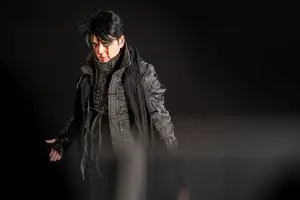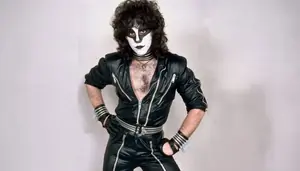

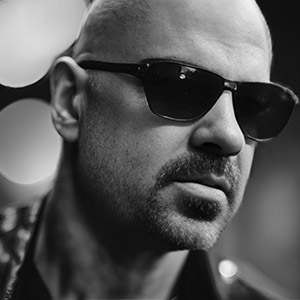
Sitting in a dimly lit corner of a Vegas lounge, the kind of place where the air smells faintly of stale gin and expensive leather, Lizzy Borden looks less like a shock-rock deity and more like a noir protagonist. He has traded the greasepaint for a sharp jacket, but the intensity in his eyes suggests he is still very much in character. We are here to talk about his foray into the digital slaughterhouse of *Die Influencers Die!*, a film currently haunting Amazon Prime. It is a messy, low-budget affair that feels like a fever dream from 1982, featuring adult cinema icons Tabitha Stevens and Katie Morgan.
But Borden didn’t just show up for a paycheck. He became the "unnamed evil tormenter," a role that required him to pivot from the bombast of a heavy metal stage to the claustrophobic tension of a film set. The transition was born out of a chaotic schedule.
"I was on the road over a year ago and was asked to do this," Borden says. "I was like, 'I don’t really have the time. But you know, I’ll see when I come back, if I can do it.' So they had the cast together, and they were doing all the prep work and everything for the movie and when I came back and I missed all the table reads, but I said, 'Yeah, okay, I’ll do it.' I just came in and sporadically put this character together. It all came together really well. It was one of those things that I think if we put too much thought into it, we would have ruined it. But the fact that it was going off the cuff, it kind of worked out really well. It was so much fun to do."
There is an inherent risk in "going off the cuff," especially in a production that relies on tight editing and practical effects. Yet, Borden’s lack of preparation became his greatest asset. He didn't overthink the motivation; he just inhabited the space.
And that naturalism is what makes his performance stand out in a film that could have easily drifted into parody. Borden has spent decades breaking the fourth wall in theatres across the globe. Acting, it seems, was just the next logical step in his evolution.
"I would love to," Borden says when asked about future film roles. "I’ve been in theatrical rock onstage for so long that even though this was my first acting experience, it felt so natural. In fact, for my first scene, I wouldn’t say I was nervous – well, maybe I was a little – but we had a pretty good sized crew, and I didn’t want to waste their time. But I also wanted to be edgy and good, so my first take, he just said, 'Let’s just see how it goes.' We did it, and the director, Gary, starts getting angry and pissed off. I’m like, 'What’s going on?' He goes, 'I didn’t film that, but that was exactly what I’m looking for.' So from then on, he filmed all my practices. It was one of those things that started off good, and it just kept going."
The film itself acts as a biting critique of our current obsession with digital validation. It is a world where "likes" are traded for lives. It is a theme that resonates with Borden, who has watched the music industry shift from physical dominance to the ephemeral nature of social media.
"Oh, definitely," Borden says. "Sometimes influencers are a good thing – they can actually help you through so many different things that you need. People are just saying, 'This is my experience. And this is how I did it.' Even talking about tech, there’s lots of tech things that talk you through everything that never was around before. They point you to the right tech. So there’s lots of good stuff. But there’s also lots of bad stuff, just like with anything. If you’re skeptical, you’re all right. But if you’re not skeptical, and you’re gullible, then that’s when it becomes a huge problem, and I think that’s what this movie deals with. That’s what attracted me to it. That’s why I even said yes to the movie in the first place, because it was exactly what’s happening right now. It’s one of those things where I grew up on splatter flicks from the 60s, 70s, and 80s, and it was always a similar kind of thing. So this was a new thing dealing with what’s happening today."
Holding the physical pressing of his latest record, you can see the appreciation for the tactile. *Die Influencers Die!* taps into that same nostalgia, channelling the grit of 42nd Street grindhouse cinema. It is a specific aesthetic – one that prioritizes ingenuity over a massive budget.
"Oh, definitely," Borden says. "When videos came out, the first video I ever rented was *I Spit on Your Grave*, and it was one of those things where it’s like, that was the first one I pulled off the shelf, when we were renting videos. I just see what was done. And then, you look at a lot of the great movies that were done with no budget and just ingenuity, like *Evil Dead*. All the stuff that they did on that film went on to be landmark things that they actually invented real tech for. But it was done with a piece of two by four and a camera mount, hammered to it. So a lot of things were invented when you don’t have the money. That’s why I love those films, and this film had that flavour to it. It was definitely going to be a low-budget film, right from the get go. No one had any illusions; it was going to turn into something bigger. So that’s good. It stayed right in its wheelhouse and it didn’t try to be more than it was. I love all those films, they put you in an interesting place."
But let’s be clear: low budget does not mean low effort. Borden’s character in the film is a departure from his stage persona. Onstage, Lizzy is a dynamic force, constantly interacting with the crowd. In the movie, he had to maintain a singular, terrifying frequency.
"Well, I’ve always been theatrical," Borden says. "But yeah, I love the character that I played. It was something a little different, because he was on 10 the whole time. Usually, I have a lot of dynamics and I go back and forth – especially on stage where I break that curtain down between the performer, the character and audience. Other performers stay in their acting zone, but I always break the curtain down, because I want to bring the audience in. That’s the only way, otherwise they’re just watching and I want them to be participants. My live show has more dimension while this character was on 10 the whole time. I really had to have that energy for each scene, because he wasn’t subtle. I think that was something I’d like to bring on stage, to see if I can hold that kind of energy at that level, for every scene, every song and not bring dimension into it. So I have been playing around with that thought – that’s old David Bowie, that’s, early Alice Cooper, Gene Simmons and Fee Waybill from The Tubes – they were in character, they stayed in character, they didn’t come out and they didn’t break that curtain down. With this character, it was so different than what I do on stage. But it felt very familiar and really interesting. I actually liked to play that character again, or something similar, because it was so much fun."
The most striking aspect of Borden’s performance is the voice. It isn't a roar; it is a whisper. It is a choice that feels calculated and predatory, reminiscent of the great screen villains who don't need to shout to be heard.
I’ve had so many years of being onstage in character and when you’re backstage - and you’re sick, you got pneumonia, you’re tired, you’re exhausted – you still have to get into character. It’s actually helped me through some of those times. Once I slip into character, he does all the work. And then when I’m done, I can get back to being sick.
"That was one of the things that Gary loved," Borden says. "I just brought it because my favourite people are Christopher Walken, Nicolas Cage, Jack Nicholson and all that stuff, where they’re just at a peak of anger. But they bring it down into a whisper, and it’s like a snake slithering up very slowly. You don’t know when it’s going to strike. It just does. So that’s what I was thinking this character is like. He wants you to hear him, so I brought it down to a whisper, and Gary loved it. So we ended up using it."
The lack of a concrete backstory for the character adds to the unease. He is a phantom, a manipulator who exists only to cause chaos. Borden describes him as a "figment," a catalyst for the violence that unfolds on screen.
"The fact that you don’t know where it comes from – that was the thing that excited me about it too, because you don’t know what his back story is," Borden says. "That’s what was really fun. If I was tied to a back story, then I would have had limitations, but you don’t know about the why, it doesn’t even exist. It’s just a figment of everybody’s imagination – a manipulator just like Othello. Some of these other characters were just whispering in the ear and that’s the way I looked at him. He just had nothing but disdain for everyone he was talking to, and he wanted an outcome. Those are the two limitations that I had. I kind of played off of that. It was fun, but the fact that I wasn’t tied to a back story really helped."
Because Borden missed the initial table reads, his first interactions with the cast happened in real-time, in front of the cameras. This lack of familiarity served the narrative. He didn't want to be their friend; he wanted to be their nightmare.
"I didn’t get to do the table reads, so they were all kind of a group," Borden says. "I was on the road, so I couldn’t do any of that, so there was no bonding. I just met everybody while I was working, which I actually liked, because if I’m too familiar with someone, then I couldn’t bring out that disdain that he’s supposed to have. It would be more like acting and I didn’t want to act. I wanted to be real. So I’m glad I didn’t know anybody. I’ve since met everybody, but originally I only did scenes with a few people, so it was one of those things where I watched some of the other scenes and some of the gore scenes. It was really interesting to watch, and Tabitha was great, especially the scene where she’s on the table and I’m asking her to choose. She didn’t have very much dialogue, but she really did a good job of making me feel like it was real. She was choking and doing all this stuff. So it really was fun. It was fun to play off that."
The scene in question is a standout, a moment of visceral horror where Tabitha Stevens’ character finds her resolve through agony.
"Her revenge is superseding – it’s just her just giving up and I’m the catalyst that makes it happen," Borden says. "I have to talk her into it and she played that really well. She was just spitting up, choking and then realizes that she wants revenge."
Borden’s approach to acting is purely intuitive, much like his song writing. He relies on instinct rather than formal training. He moved to Vegas three years ago, and fate seemed to drop this script into his lap – or rather, his junk mail folder.
"It’s all intuition," Borden says. "I didn’t work with anybody. I knew Gary and Tabitha. We went out to dinner quite a few times over the last year. I just moved to Vegas three years ago and they moved just right after me back here, so we all got together. It was one of those things. I didn’t know them before, but when it came down to showing up on the set, I didn’t get the script even till a few days before the movie because it was in my junk box. I found it and then raced my way through it and we filmed it. I do that with my songs that I have been working on for a while. I have the melody line, but I won’t have the lyrics – especially on the last album, *My Midnight Things*. Some of the stuff you hear me sing is the first time I ever sang it. I just blurted out the lines and I kept it and it’s like that kind of thing you’re never going to get most people. They wear the songs out by the time they sang it, they’ve already sung that song a million times, and for me some of the stuff on there was first take, first time. With acting it was the same thing. The first thing they heard out of my mouth was the bird cage scene and that was the most vile, vicious, and venomous scene. I couldn’t imagine going to acting school or acting class or anything like that. To me, my acting school is watching these amazing movies from all the people that were influential into a style that I would eventually create."
Years of performing while physically compromised – battling pneumonia or exhaustion – have hardened Borden. He knows how to slip into a persona and let the character take the lead.
"I’ve had so many years of being onstage in character and when you’re backstage – and you’re sick, you got pneumonia, you’re tired, you’re exhausted – you still have to get into character," Borden says. "It’s actually helped me through some of those times. Once I slip into character, he does all the work. And then when I’m done, I can get back to being sick. So I’m always giving 100% to the shows because it’s a character. So slipping into this character was very comfortable to do and that’s why I’d love to do more. It doesn’t even have to be horror. I had two days to analyze this character and try to get some dimension out of him, but he was very one dimensional."
The film also serves as a vehicle for his music, specifically the title track from *My Midnight Things*. The choice of song was a point of contention, purely because Borden’s recent output is so consistently strong.
"It was interesting because they wanted to do a video for the movie and I don’t know who came up with the idea of just doing a soundtrack video," Borden says. "We had done one when we were in the movie, *The Decline of Western Civilization*, then we did a cover of 'Born To Be Wild' and they cut that film up and it was really cool. When we decided what to do for this one, I told them to pick any song off the record. I gave it to Tabitha. I said pick any song, she picked a different song. Then I told Gary the same thing, pick any song you want. He picked a different song. Then Brian Slagel from Metal Blade picked a different song. Everyone had a different song, which I looked at as a compliment because I had so many songs that would work perfectly for this film. It was Gary who decided that 'My Midnight Things' was the one that fit really well in this. He was right, it worked. It was fun to film. We went into the same studio that we shot the movie out of here in Vegas. That was comfortable. we had some of the same settings, which was really cool. We also used a green screen, which I hadn’t used much of before, so it was interesting playing off of that not knowing what was going to be behind me. I was really excited to do that. I actually would like to do more of that, because it was really fun. He’s like, 'There’s gonna’ be a moon behind you, play to the moon.'"
Borden’s comfort with a film crew comes from his extensive history with music videos. He understands the mechanics of the frame and the necessity of providing an editor with options.
"I’ve done so many videos, and I think that’s why I’m comfortable with a crew," Borden says. "It’s not weird, because usually when I do a video, it’s usually me, just by myself, I don’t have a band and I don’t just sit there and head bang. I actually have to perform something interesting. We need to have four minutes of stuff to cut too, so I understand the editing side of it. A lot of these videos, you see the whole video in the first 20 seconds. And they just keep rehashing it for four minutes and that’s the one thing I don’t like about videos. It doesn’t have to be a story, but I do want some dimension. I want a beginning, a middle and an end. The same thing with the movie, I really wanted to give the director as much as that as they can go to. If for some reason, they don’t like what they’re seeing, they can go to somewhere else so they could do something else. I did a video 'Long May They Haunt Us' with another director. I had to sit in a chair, the whole video. Its like, how can I make that interesting – four minutes sitting in a chair. The first scene the director was very unhappy. I told him 'I can do a lot of things, but you got to let me play'. Once I started playing, he loved it. We had more than enough options of me sitting in a chair for four minutes. Make something out of it. I see it from an editing point of view, and that kind of works similarly between the movie and the kind of videos."
The technical side of the film also brought him back into contact with Ralis Kahn, a master of special effects who has long been a part of the Borden orbit.
"I was lucky enough to work with Ralis Kahn, who is a master special effects guy," Borden says. "He actually makes all my masks for the stage show. He did a mold of my face, and that’s how he makes all my masks. His wife, Katie, makes some of my costumes, so I’ve already been down this road. In fact, some of the people that worked on the film were students of Ralis’. I actually brought a lot of stuff to the set of what we could possibly use, but between Gary and me, we realized this character is very stripped down, so I didn’t use any of it. But as far as the stage show, yeah, it’s pulling me in a different direction. If this pandemic ever goes away and we can get back on the road, I’m rethinking what I want to do theatrically when we can get back out there and it largely has to do with how this character has been already received. People are loving the character and I’m trying to see if I do that on stage. Can I bring him on there in more of a stripped down way? Or maybe I’ll do a little bit of both, I haven’t decided. I came in to the set already prepared, I did my own makeup, and I was ready to go. But they wanted to do more with my hair – something that fit the character more. The makeup artist just took all this goo, this gel, and dumped it on my head, and it made the character. That’s what it needed. She must have put a gallon of that stuff in there. It’s those little tiny touches to help sell it and help create it. There were multiple people involved in creating this character, so it really worked. But that gel was the last piece of the puzzle. And it’s something I wouldn’t have done. It was something I wouldn’t have thought of. So yeah, I got a lot out of working with everybody."
While the film is a new chapter, Borden is also looking back at his musical legacy with a new "Best Of" collection. It is a necessary update for the streaming era, focusing on the material that has defined his career since the turn of the millennium.
"We did one in the 90s that represented everything from the 80s, and that was great," Borden says. "But you know, the 80s were a long, long time ago. At least half or more of my set is not from the 80s. So I wanted to represent the last three albums, because we do songs off of those records, and they encompass maybe three quarters of my set. I’m looking at Spotify and all those things, and I’m realizing my biggest streaming record is *Best Of Volume One*. So that’s what really gave me the idea. These songs are on albums that people may not even know exist. So we remastered them and picked the best four songs from each album. We did two cover songs and put out this thing and now when people go to stream Lizzy Borden, they have the one representing the 80s, and one representing post 80s. I think that’s what most people do, when they go to stream, they go after the best stuff, or 'The Greatest Hits'. I want them to be able to do that too. I think it’s the best way to get new fans is to give them three or four songs off of each record to represent that. If you like that, then you can go back to the album. If I do another three albums, I’ll do a volume three."
The collection includes covers of Blue Öyster Cult and The Ramones, two bands that have clearly left a mark on Borden’s artistic DNA.
"Well, two of my favourite songs are from two of my favourite artists," Borden says. "I keep contemplating doing cover albums, because all my favourite artists would be able to pick a song, each one would just be mind blowing. But we wanted to bring it down to two songs for this. I had done 'Summer of Love' for the *Deal with the Devil* from Blue Öyster Cult, but I wanted to do 'Burn for You'. I thought it was a better fit for *Deal with the Devil*, but the producers, Elliot and Joey Scott decided no. I always had a nagging feeling I wanted to do 'Burn for You'. I wanted to stick to the script too, because I’m such a huge fan of Blue Öyster Cult. It’s such a great song, great riff, great vocals, and great lyrics. All the ingredients are there for a great song. As far as 'Pet Semetery', I’ve always loved that song. I’m a big Ramones fan, so I could have done any Ramones song, but it’s all been done to death by everybody else. I hadn’t heard too many people doing 'Pet Semetery' and that was their biggest hit. We played a show at The Whisky at Halloween and we just threw it in there, two days before the show, and winged it. The audience loved it. They went crazy over it. So I knew it was good. I’m really happy with it. I can see it staying in the set for a while because it’s such a fun song to do."
Whether he is stalking influencers on screen or commanding a stage at The Whisky, Lizzy Borden remains a master of the theatrical. *Die Influencers Die!* might be a low-budget splatter flick, but with Borden at the centre, it has the gravity of a classic. He isn't just playing a part; he is building a world. And in that world, the whisper is always louder than the scream.