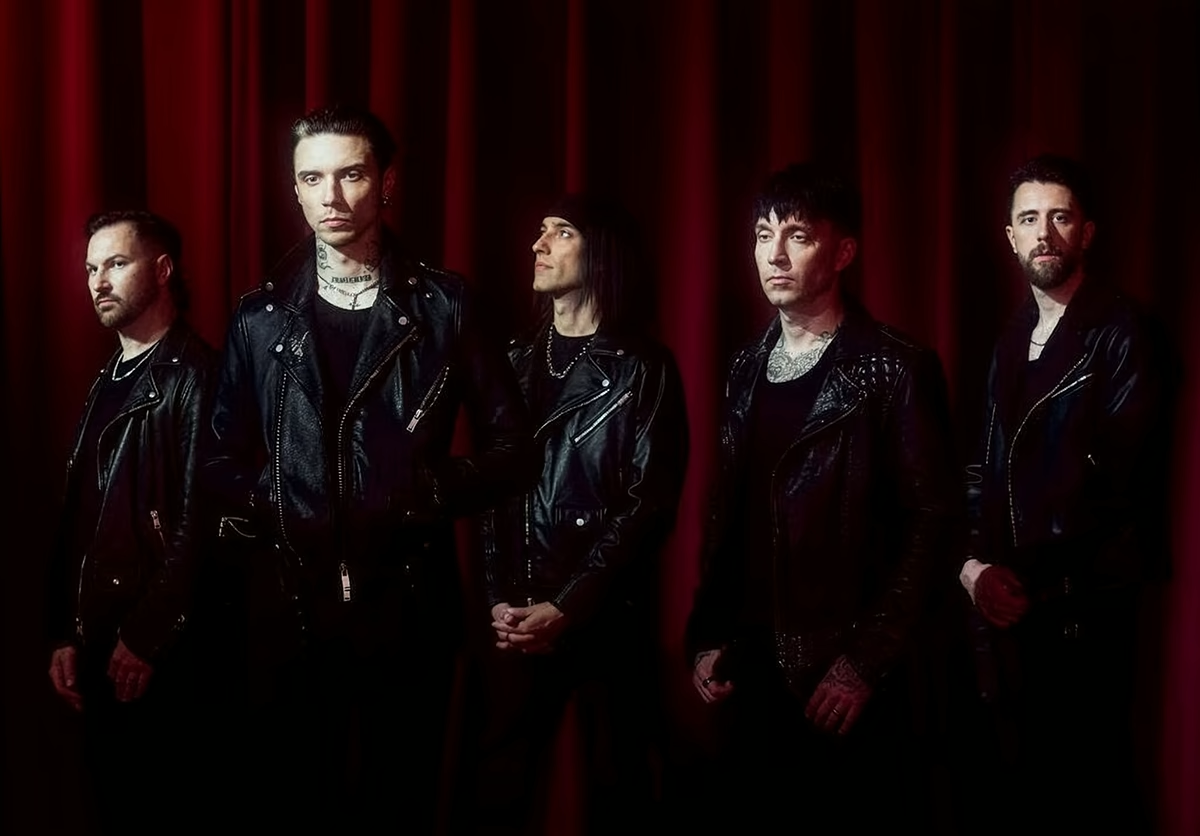
The organ hits before anything else does. No countdown, no false start — just a cold, chapel-dark swell that bleeds into a soliloquy, and then Black Veil Brides' Vindicate is off, running hard on two decades of accumulated score-settling. The band's seventh full-length, out May 8 via Spinefarm, is the record frontman Andy Biersack has been circling his entire career without quite saying so out loud. It's about revenge. Or more precisely, what revenge costs and what it produces, and why some people cannot seem to put it down even when they know they should.
Biersack was calling in from Tampa, 89 degrees, running behind schedule because every interview that morning had gone long and set off a chain reaction. He apologized immediately and meant it. Then he started talking about his hockey pads.
He was five or six when his father first wrote "be a warrior" on the inside of them. The message was directional — don't let them get to you, show them they're wrong — and it embedded. "I was kind of a weird kid who didn't have a lot of friends, and I got made fun of and whatever else. And so then it's: well, fuck them. Don't let them win," he says. "And then I start a band, and that band is reviled by the metal world at first. And so then it's: fuck them. Don't let them win. So it's been this constant theme throughout my life, and it is a huge positive, and it also can be very distracting and isolating and odd, to be this person who's so focused on getting back at your detractors."
That tension — productive fury versus self-consuming obsession — is the whole album. Biersack was careful to build Vindicate around it structurally, not just lyrically. The title track positions the narrator outward, aimed at somebody else. "Sorrow" turns the same weapon inward, on past behaviour and personal failure. "Eschaton," the closing track, pulls back far enough to see the whole thing clearly and finds it a little absurd. "The song 'Eschaton' is about the sort of foolishness of revenge and how lonely it can be to be that way," he explains. "I wanted all of these songs to have some way of relating back to that idea."
He is also, usefully, precise about his terms. Revenge and vindication are not synonyms and he does not treat them as such. "Revenge is somebody does something to you and then you directly get back at them and you win. Well, if someone says Black Veil Brides sucks and then we win an award for being the greatest band of all time, I didn't actually get revenge on that person," he says. "I just succeeded in my own right. So the higher concept is the idea of vindication — this idea that you will be able to show your worth, and to yourself more than anything else." The distinction matters because it shifts the record's emotional centre of gravity from petty score-settling to something considerably more durable.
Vindicate is also the first BVB record produced entirely in-house, Biersack and guitarist Jake Pitts at the helm. Biersack is under no illusions about how that reads from the outside. "When you hear a band is producing their own record, that in a lot of ways is almost like shorthand for 'this record is going to suck,'" he says flatly. "And I understood that that was the hill we were up against. And I think because of that cliché, we took it so much more seriously and insisted that we were very honest about the quality of things. I was gonna do a million vocal takes until it was right. We were gonna spend a whole day on drum tones until it was right." The result is a record that carries its self-production not as slackness but as authority — the drum room breathes differently here, the low end sits with a deliberateness that an outside producer might have second-guessed into mediocrity.
The ambition showed up in the tracking sessions as well. A full orchestra appears across the record. A gospel choir runs through several songs. And then things got cut. There was a timpani at one point that Biersack was convinced the band needed. "Actually, that doesn't — we don't need that," he recalls deciding. The editorial muscle required to make that call without an external producer to either push back or rubber-stamp it is real, and it's visible in how clean the arrangements are given how much was clearly on the table. Pitts and Biersack made the decisions and moved. "You can make moves with a lot more expediency if you're the decision maker than if you were somebody who has to go to the boss that you've hired to come in and be the director."
He credits Bob Rock, John Feldmann and Erik Ron — the producers Black Veil Brides have worked with across their catalogue — for making this possible. Not by proxy, but by education. "The great benefit of working with those legendary people is that we learned so much from all of them that we felt like we were ready to kinda take over." There was even a version of Vindicate where Ron was going to produce. Biersack called him during preproduction and told him directly: "This is absolutely nothing to do with you. You're the best producer that we know and somebody we would be honoured to work with. We wanna do this ourselves. We wanna see if we can do this ourselves." Ron, apparently, understood. The working relationship stays intact. The album got made by the band.
As much as my parents raised me, Gene Simmons and Paul Stanley raised me — in the way that I conduct myself, in the way that I speak, in the way that I view the industry, in the way that I view branding.
Where Vindicate is most vulnerable is also where it's most human. With no outside voice in the room, there are moments — particularly in the record's densely layered mid-section — where the orchestral arrangements and choir stacks press against the vocal performances rather than framing them. The songs themselves hold up. The mix occasionally asks you to work slightly harder than you should have to. That said, "Hallelujah" and the previously released "Bleeders" land with genuine force, and "Certainty" is the kind of chorus-first rock song BVB have always been capable of but don't always prioritize.
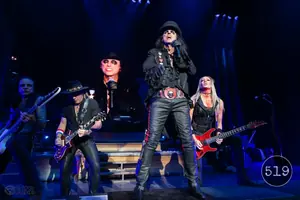
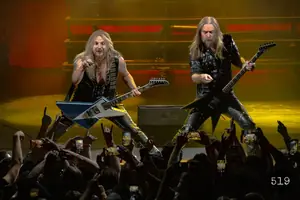
The upcoming tour, Biersack says, is going back to something physical. Something you can feel in the room rather than watch on a screen. "The things that excited me when I was a kid watching the Danzig 'Mother' video — he's got the big-ass logo on the drum kit and the giant stack of amplifiers," he says. "I think in this day and age, we see so much, and we've done it a million times — everything is an LED wall, everything is digital. I want this show to feel as much as it can like a tactile rock concert experience." For Canadian dates on this run, that means a band operating at 35 with the instincts of kids who grew up believing the stage is still sacred ground.
Ticket numbers, he mentions, are already past anything the band has done as headliners in several markets. He catches himself immediately. "I don't want to sound like Gene Simmons, braggadocious here," he says, laughing — which is a sentence only a man who has memorized every Gene Simmons interview since childhood could produce without irony.
And that brings us to the wall.
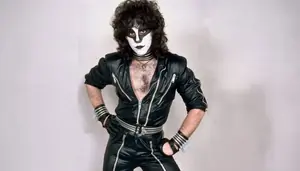
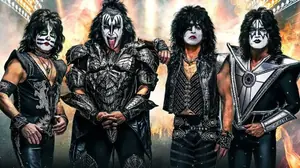
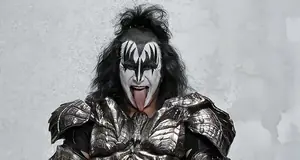
Behind Biersack during the call, visible over his shoulder, is a wall of action figures. Roughly half of them are Gene Simmons. The other fixtures include Danzig, who also came up in conversation, because of course he did. Kiss is not an influence Biersack references casually. It is formative infrastructure. "There is no me in that way without the importance of Kiss," he says. "Being three years old and stumbling across my dad's collection of 1977 Kiss trading cards in a shoebox in our old house and going: what the fuck is this?" From there: the Kiss Unplugged Halloween special at four, the Grammys makeup reunion at five, VHS tapes and face paint and comic books through all of it. "As much as my parents raised me, Gene Simmons and Paul Stanley raised me — in the way that I conduct myself, in the way that I speak, in the way that I view the industry, in the way that I view branding." He's read their books cover to cover "a hundred times." His word, not hyperbole.
And the first time he ever sang on any stage, anywhere, was at the Kiss Expo in Indianapolis. He was eight. Eric Singer was hosting a karaoke competition. Biersack got up and sang "Deuce." Singer told him he was a rock star in the making.
"That is a little bit of my origin story," he says.
He has not forgotten. The BVB Army — the devoted, makeup-wearing, convention-organizing, podcast-producing fanbase that mirrors the Kiss Army in almost every structural way — was not Biersack's idea, technically. "I would not have picked BVB Army if I could have chosen, because of the Kiss Army," he says. "You're not gonna out-brand the most notorious fan club name of all time." But the fans chose it and he has honoured it. You can't choose a nickname. And in Mexico City there is apparently a yearly convention where fans screen Black Veil Brides music videos like films and arrive in full costume makeup. Biersack, who watched Kiss VHS tapes on repeat as a child, understands exactly what that is.
Kiss has threaded itself through his friendships too. Michael Brandvold, who runs the Three Sides of the Coin KISS podcast, is someone Biersack counts as a friend. So is Tommy Sommers, a co-host on the same show. Chris Jericho — another Kiss obsessive — became a close friend through that shared fixation. "Kiss is a massive part of my life," he says simply. The connective tissue of a fandom that followed him from childhood right into the industry.
"Maybe I set myself up to be this character in the metal scene because I loved Kiss so much," he says, "that I just ended up becoming them for a different era."
That's not a boast. It's a diagnosis. And it explains the record, the tour, the chip, the warrior inscription, the whole project — a man who decided very young that the only acceptable response to being told you don't belong is to build a larger room.
Vindicate drops May 8. Album eight is already in riffs-and-ideas. "Right now, I feel like we're on fire," Biersack says. "And we just wanna keep going."