
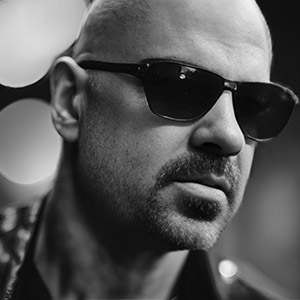
Sitting across from Ronni Le Tekrø via a grainy video link feels less like an interview and more like a dispatch from a remote lunar outpost. The man is a Norwegian enigma, a guitarist whose "machine gun" technique defined a specific era of European metal with TNT, yet he remains refreshingly untethered from the industry's polished expectations. He is currently hunkered down in the woods, surrounded by the ghosts of his past and the eccentricities of his present.
His latest solo effort, *Bigfoot TV*, is a strange, magnetic record. It is the sound of a man who spent the lockdowns of the last few years looking for truth in the most unreliable places—specifically, the fringes of reality television. It is not a shred album, though the technique is there. It is a psychedelic, personal, and occasionally bizarre reflection of a life lived in the spotlight and the shadows.
We started with the title, which sounds like a late-night fever dream. But for Le Tekrø, it was a literal byproduct of isolation.
"Ever since Corona hit us, it was a lot of television for me to dig into. Eventually, I started watching stuff like Expedition Unknown, Hunting Hitler, the Treasure on Oak Island, Finding Bigfoot and all those TV series—the ones where you’re never going to get the answer. When I started writing it, it was a concept album, but I ended up writing lyrics pretty much about myself. Then I realized that my life has been kind of like Bigfoot TV, an unsolved mystery," he says.
There is a certain irony in a world-class musician finding kinship with Bigfoot hunters. Both are chasing something elusive, something that might not even want to be found. But the metaphor holds. Le Tekrø’s career has always been a bit of an anomaly, a blend of high-octane heavy metal and avant-garde sensibilities that shouldn't work together.
The visual component of the record is just as jarring. The cover art does not feature a guitar or a leather jacket. Instead, it is a dense, physical piece of art that demands a second look.
"Bigfoot TV was made by conceptual artist Elmer Laahne. What he does, he kind of mounts up that TV and they get detailed plastic figures into it. So, it’s a mix between some data, animated stuff and the real photography. I think he pretty much described the title very well with the thing. Then again, if you look at Amused To Death with the Roger Waters, you see an ape in front of the TV, so it’s kind of an extension of his ideas in a way. I’m a big fan of that type of conceptual thinking," Le Tekrø explains.
It is a refreshing departure from the AI-generated sludge that passes for album art these days. There is a weight to it. And much like the music inside, it feels like a physical object from a different dimension.
But why now? Le Tekrø has always been prolific, yet his solo work often feels like it is fighting for oxygen against the legacy of TNT. He is quick to point out that his timing has historically been, well, cursed.
"It was the perfect time because it seems every time I release an album, if it was with TNT or my solo, there’s always a fucking war going on or some fucking lunatic in an election. Trump fucked up the last TNT album—he got all the attention. The Gulf War got us twice. TNT had an album out every time that shit broke loose. So, in a sense, there’s a war with each album. What could I expect with a band name like TNT? It’s obvious…" he says.
It is a cynical, hilarious take on the industry. But there is truth in it. The noise of the world often drowns out the nuance of the art. By releasing *Bigfoot TV* now, he is leaning into the chaos rather than trying to outrun it.
When I came to Long Island the first time and smelled the North American territory, it had a totally different smell - that’s what I remember most. I fell in love immediately with the smell. It’s like I had been there before. It reminded me of something. It was really weird. ...It was really nice because I got to see middle class America and met the average American, which had the same dreams that I had.
The musical shift on this record is also notable. This isn't the polished, radio-ready metal of *Tell No Tales*. It is grittier, weirder, and far more experimental.
"I think I’m allowed to go further with my solo stuff. The TNT guys don’t necessarily like my influences and vice versa. I’m a big fan of stoner progress, if I dare say. I don’t expect the TNT guys to like or use those songs that I present on this album. This is not TNT material. This is beyond in a way, and it’s very personal lyrically. Saying that, if you look at the lyrics Tony (Harnell) wrote, I think a lot of that stuff is very personal for him too, the way he wrote the emotions that are in the lyrics," he notes.
And that is the crux of the solo artist’s dilemma: how much of yourself do you hold back for the brand? For Le Tekrø, the answer is clearly "nothing."
One of the standout tracks, "A Handful Of Time," possesses a haunting, almost pastoral quality. It feels disconnected from the rest of the rock world, leaning instead into something ancient and European.
"It’s strange that you say that, because that’s obviously inspired by elements of folk and if you listen back, you’ll hear Russian folk music. I wrote it about friends that I lost the last couple of years, really close friends. I mean, I lost three or four of them in just two years. A Handful Of Time is just a reminder. If you listened to the lyrics, the first verse I sing about my dead friends, then the second verse I sing about my friends that are alive. We’ve got just a handful of time, especially at my age, being 58. I realize that I’ve got a handful of time," he says.
The track is a sobering memento mori. It serves as a reminder that even the fastest guitar players in the world cannot outrun the clock. At 58, Le Tekrø is reflective, looking back at a life that took him from the cold fjords of Norway to the sweaty clubs of North America.
Speaking of America, the track "Life On Long Island" serves as a love letter to a very specific time and place. It is an autobiographical deep dive into the years when TNT was trying to conquer the U.S. market from a base in New York.
"This is a good question. When I came to Long Island the first time and smelled the North American territory, it had a totally different smell—that’s what I remember most. I fell in love immediately with the smell. It’s like I had been there before. It reminded me of something. It was really weird. TNT got based out of New York in the Long Island area, so, I moved in with the assistant of the band, Bob and his mother Mary. They lived in Bay Shore. Instead of renting hotel rooms, I just moved in with the family and I stayed there for seven years or something like that. It was really nice because I got to see middle class America and met the average American, which had the same dreams that I had," he recalls.
It is a charming image: a Norwegian guitar god living in a suburban house in Bay Shore, eating home-cooked meals with Mary and Bob. It grounded him in a way the touring lifestyle never could.
But then, we move from the suburbs to the feline. The video for "Moving Like A Cat" is a bizarre, endearing collection of fan-submitted pet footage. It is the kind of thing that could easily feel gimmicky, but with Ronni, it feels sincere.
"Hey, if you play the song, I’m sure one will pop up. At the end of the song, I sampled my own cats. I have to say that cats have given me a lot of pleasure. They’re really affectionate, but not overly affectionate. They can have their own life and they don’t need that much comfort. They’re mystical with the way they communicate, and sometimes if I’m hurting somewhere, you probably had that too, the cat comes and lays on the spot where it’s actually hurt. I love cats, but I’ve only had one at a time. I could have more because I live out in the forest. It started with a riff that somehow felt like a cat. That’s how the topic came about because one thing inspires another," he says.
The idea of a riff "feeling like a cat" is exactly the kind of eccentric musicality that makes Le Tekrø a critic's darling. He isn't thinking about scales or theory; he is thinking about the movement and the mystery of an animal.
And then there is the voice. Ronni handles the vocals on *Bigfoot TV*, and while he isn't trying to emulate the glass-shattering tenors of his past collaborators, he has found a pocket that works. It is a weathered, honest sound.
"As a guitar player, you easily get labeled ‘the guitarist singer’, that’s what they call it, you got the guitarists voice. If you’re looking back, a lot of those guys didn’t have the best voice on the planet, they just kind of soothed their guitar playing. And I would say Joe Walsh, Ace Frehley, there’s so many of those guys that are not technically incredible in my ears, but they have a character. I’m inspired by David Bowie, a lot of the lower register stuff and mid-range stuff. While TNT is obviously written in a higher key, I can’t sing that. I had to sing in a key that works with my voice," he admits.
It is a smart move. There is nothing more tragic than a legacy rocker trying to hit notes that left the building in 1989. By leaning into a Bowie-esque baritone, he gives the songs a weight that screams maturity rather than desperation.
He is also keenly aware of the physical toll that the "high-key" era has taken on his peers. Watching a singer struggle to transpose a classic hit down three steps is a painful experience for any fan.
"A lot of singers can have difficulties. To play it live, they’ve got to transpose the music and, of course, it’s not going to sound the same. That’s TNT as an example. I think that’s happening to a lot of bands, the bands from the 70s and 80s. The best bands are the ones that just went with the gut—AC/DC and those guys—they don’t fuck around with keys, they just go and do it," he says.
*Bigfoot TV* is exactly that: a "go with the gut" record. It is messy, it is weird, and it is entirely Ronni Le Tekrø. It doesn't care about the charts or the wars or the lunatics in the elections. It only cares about the unsolved mysteries of the forest and the handful of time we have left to explore them.
For those looking to catch a glimpse of the man behind the machine gun guitar, visit ronniletekro.com. Just don't expect any easy answers.