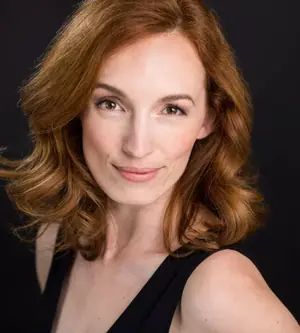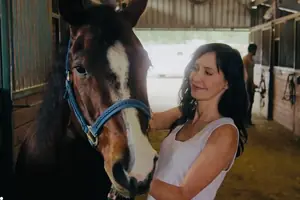

Sitting across from Valerie Jane Parker in a dimly lit corner of a downtown lounge, you don’t see the terror-stricken Corrine from the *Wrong Turn* reboot. You see a performer who has spent the last few years quietly colonizing the horror genre with a precision that most "scream queens" lack. Her latest turn in *The Voices* finds her navigating a claustrophobic psychological space that would break a lesser actor.
Parker is currently the go-to for directors looking to anchor high-concept dread in something human. In *The Voices*, she plays Lilly, a blind mother-to-be who finds herself in a metaphysical tug-of-war. The stakes? The very soul of her unborn child. It is a premise that could easily slide into B-movie camp, but Parker treats the material with a gravity that demands attention.
When we start talking about the mechanics of the film, she cuts straight to the narrative bone. It is clear she isn't just a hired hand; she is an architect of the character’s internal misery.
“It is a supernatural thriller,” Parker says. “I play Lilly, and she is a pregnant woman who gets the terrifying news that she basically needs to choose the soul of her unborn baby before the first heartbeat. And that if she doesn’t, the other side is going to choose for her and it will not be good. So that’s it in a nutshell.”
The concept of the "first heartbeat" deadline adds a ticking clock to a genre that often meanders. But it’s the choice of soul that provides the real meat. In a market saturated with jump scares, *The Voices* attempts to interrogate the anxieties of motherhood through a supernatural lens.
I asked her what specifically drew her to a project that requires such a heavy emotional lift. Parker is quick to cite the lineage of the genre. She knows her history, and she knows that for a horror film to work in the current climate, it needs to rhyme with the classics while offering a fresh puncture wound.
“I thought it was a clever script,” she says. “I think with the horror genre, what you want is both something reminiscent of stories that have come before because we love to play on a theme. So I liked that there were elements of it that reminded me of *Rosemary’s Baby* and *The Sixth Sense*. But you also want a new take on a story, and I felt the script was a great merging of that. It was a clever take on an idea that hasn’t been done before, but has enough callbacks to other films that you love and that genre.”
But there is a deeper, almost sociological reason for her involvement. We are still feeling the aftershocks of a global shutdown that turned every home into a self-contained thriller. Parker recognized that the audience's appetite for pure nihilism has shifted.
“At the end of the day, what attracted me to the role was that it’s a horror film with a little bit of hope, which I know sounds strange, but after the bad year we just had in 2020, hopefully we are coming to the end of this pandemic,” she explains. “I think everybody wants the fun of a horror movie, but we need something uplifting at the end of the day too, and this movie kind of does both. You get scared, but then when it’s over, you’re like, ‘Oh, I feel a little hopeful,’ and I liked that. I felt like that was unusual for a horror script.”
The technical challenge of the role cannot be overstated. Playing blind is a notorious trap for actors—it often results in a series of glassy-eyed clichés that pull the viewer out of the story. Parker, however, went into a period of self-imposed sensory deprivation to find Lilly’s centre.
“Lilly was a really delightful character to get to play,” she says. “Early in the film, she goes through a traumatic accident where she loses both her mother and her vision. And the challenge of getting to play somebody who can’t see was really interesting to prepare for. I spent about a month watching documentaries on blindness, I got a cane and would practice around my house with blackout glasses—it’s very difficult to do.”
If there’s any message that they could take from it, it would be that it’s your world, and you may get what you want, and we really do all have that power within us. If your world sucks, you can recover. It’s okay. Everyone’s world sucks sometimes, you just have to rebuild it.
But the research wasn't just academic. Parker sought out a lived experience, grounding her performance in the mundane realities of visual impairment rather than just the theatricality of it. This is where the performance finds its grit.
“I actually worked one on one with a good friend of mine, Bobby, who is blind, and he let me shadow him at his job for several days,” she says. “We would spend time together and just talk about what he goes through every day. We would go get coffee together and the different challenges of that you don’t think about. It was a fun physical element to bring to it that really made me appreciate all my other senses so much more. It was actually a gift, getting to prepare for the role in that way, because it just made me so much more appreciative of life. I realized that you don’t have to be able to see beauty with your eyes to be able to experience it everywhere, and that was a really cool thing. She has a beautiful, undaunted spirit. She’s a fighter and I love getting to play characters like that.”
There is a risk of voyeurism when an able-bodied actor takes on such a role. I pressed her on what she actually took away from the experience beyond the technical "acting" of it all. Parker’s response suggests a shift in her own perspective on human interaction.
“The thing I like about acting period is that it humanizes everyone,” she says. “Like you play characters that are different from you and play characters that have personality quirks that you may not mesh with in real life. This was a physical version of that. It just makes you more empathetic to the world around you. Maybe have one on one conversations with Bobby being like, ‘When I go out with my blind glasses and people are avoiding me, how does that feel?’ And he’s like, ‘Oh, yeah, it’s the worst. People either want to baby you or they want to avoid you.’ It just let me get out of my skin, experience a challenge that somebody else goes through and taught me how I can walk through that with empathy as a human being in my day to day life.”
This leads into a broader conversation about the social stigma of disability. Having spent time working with the CNIB, I know the divide between public perception and reality is a chasm. Parker seems to have bridged that gap during production.
“Absolutely,” she says when asked if the role changed her. “It made me feel empowered to help. I know that sounds weird, but I think so often when we see somebody that we would label as disabled, it makes us uncomfortable. And instead of having an open dialogue with them, we have to pretend like there’s nothing going on there, which isn’t helpful. Or you do the opposite and you over baby them, which is frustrating when you’re a grown human. So I feel like it gave me an opportunity to open up that dialogue, and to learn how to treat others in my own life who are struggling with that.”
On set, the immersion was so complete that it began to bleed into the cast’s perception of her. There is a certain irony in an actor being so convincing that their colleagues forget the artifice.
“They would forget that I could see,” she says with a slight grin. “But part of that was because in order to do that role correctly, you just stop focusing your eyes on anything. I know that sounds strange, but you just kind of let your vision constantly glaze over. So between takes it was just easier to not pop into it. Plus, you get used to listening to people instead of having to watch them with your eyes—you listen with your ears. But because of that, yeah, they would. They’d be trying to guide me to the car afterwards and things like that. This was their way to help, so they kept forgetting and going along with it.”
Parker’s trajectory is fascinating. Between *Wrong Turn* and *The Voices*, she is carving out a niche in a genre that is often dismissed by the "serious" acting crowd. But she sees the value in the shadows.
“I do. I love it,” she says. “You know, horror movies are modern day morality tales and a lot of people don’t think of them like that. They think of them as maybe a cheaper art form or trashy, but they’re not. They’re accessible. They tell a thematic story and they always have a purpose to them. They’re entertaining and people love that. I’ve been a horror fan for a while now and especially the way modern horror is going. We’re moving away from a lot of the horror/porn like gory slashers, to smarter, more psychological thrills, and I love it.”
And yet, there is the personal irony. Parker is the daughter of two pastors. In many religious circles, horror is seen as the enemy, a gateway to the very darkness Parker now inhabits for a living.
“We did not grow up watching horror,” she admits. “One of my first horror movies was *Rosemary’s Baby* and my friend was like, ‘Oh, you gotta check out this movie on TV.’ We’d never seen it. My mother comes running into the living room screaming. We’d watched only 30 minutes and she said, ‘What is this, turn it off, turn it off,’ so I had to warm them up to it. That being said, they’re so supportive. They have been the biggest fans of it. Now I actually have them watching horror movies. I had to explain to them that it’s not just about a cheap thrill. I finally won them over, but that took a few years.”
Winning over her parents was one thing; winning over the *Wrong Turn* fan base was another. When the remake was announced, the collective groan from horror purists was audible. But the film defied expectations, trading in the hillbilly-cannibal tropes for something more politically charged and visceral.
“You could tell a little bit, but I knew for sure when I got to the set,” she says of the film’s quality. “This is wildly different. Mike Nelson, our director, is so smart and clever, and he just likes to play. He was changing the script daily just constantly looking to add a big twist to it. He has no fear of playing around with it, and as soon as that energy hits you knew it was going to be good. I was so grateful, because it could have just been another reboot—and that would have been fine—but he made it his own thing. He did a really interesting take on it and I loved it.”
The experience on *The Voices* was a different beast entirely. Where Nelson was a chaotic tinkerer, Nathaniel Nuon was a master of the storyboard. It is a contrast in directorial styles that highlights Parker’s versatility.
“In *The Voices*, yes. With *The Voices* Nathaniel Nuon, both wrote and directed the film, and he is organized, he had everything plotted out from day one. There’s not a shot that he hadn’t thought about. Normally when you’re going into a situation like that, there is less room to work around, but he’s also such a lovely, flexible human, that anytime we got to a scene where I was like, ‘Hey, I don’t know if Lilly would do that, I think she would do X, Y and Z.’ He let me play with it every time and that was a real gift. So he let me bring a lot to it. Lilly was supposed to be in her glasses in every scene and I was like, I think we’re gonna’ lose a lot if you don’t let me change it up and he trusted me and I’m really grateful for that.”
Parker’s insistence on removing the glasses is a savvy move. In horror, the eyes are the primary conduit for the audience’s fear. By showing Lilly’s eyes, Parker allowed the viewer to see the vacancy and the struggle, rather than hiding behind a prop. It’s a technical choice that pays off in the third act.
As our time wraps up, she reflects on what she wants the audience to carry out of the theatre—or their living rooms. It isn't just about the jump scares or the supernatural lore. It is about the resilience of the human spirit when the lights go out.
“I hope they’ll be entertained,” Parker says. “I hope they’ll like me. I hope that at the end of the day, it makes them think and it leaves them with a little bit of hope. If there’s any message that they could take from it, it would be that it’s your world, and you may get what you want, and we really do all have that power within us. If your world sucks, you can recover. It’s okay. Everyone’s world sucks sometimes, you just have to rebuild it.