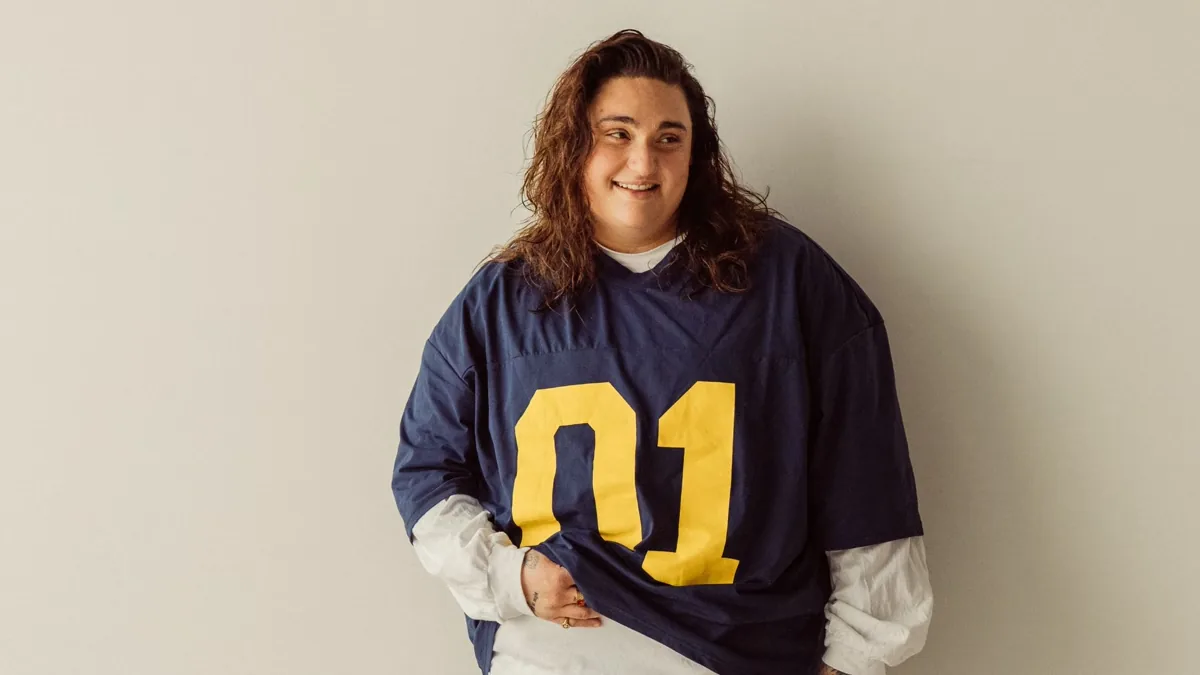
Looking at the raw transcripts from our June 2022 conversation with Jamie Fine is to witness an artist at a critical junction. The recent memory of playing massive venues like Caesars Windsor on the Marianas Trench tour was still fresh. That moment was the commercial peak for Elijah Woods x Jamie Fine, a duo that had captured a specific slice of the Canadian pop consciousness. But the foundation was already cracking.
Fine was in Toronto that week, not Ottawa, a subtle but significant detail. She was already on the move professionally and personally. The transition from a hit-making duo to a solo artist is one of the most treacherous paths in the music business. Most don't make it. The wreckage is legendary. And Fine knew it.
When asked if the duo was headed for a legendary crash, she is blunt. “Yep,” she says. “I mean, I think that, yeah, one of the most beautiful things, you know, about the decision-making was that, you know, it was a respect thing and it was an ability to, you know, walk away and make it completely before things got really, really hostile.” It was a pre-emptive strike against the kind of burnout and acrimony that has defined so many band breakups. A healthy decision, she calls it. And a necessary one.
The catalyst for this public processing was the song 'Sell Out'. It wasn't a post-mortem; it was the surgical tool. “It was a song that needed to come out of us to, you know, break down all the walls, unfilter everything, and just put it out there and see how it sounded,” Fine explains. “It was actually a song that helped me let go rather than, like, I let go and I wanna write a song about it.” This is a crucial distinction. The art wasn't reflecting the life; it was actively shaping it, forcing a confrontation that had been simmering for far too long.
And so began the daunting task of starting over. Or was it? “I think it’s a little bit of both if I’m being honest, and I think both excite me a lot,” she admits. The excitement stemmed from a newfound narrative freedom. The biggest difference between then and now is the liberation from compromise. “I had to, you know, modify the stories to fit two people. Right? As a brand, I don’t have to do that anymore. I get to tell my story as is. I don’t have to filter them with anything.”
That unfiltered storytelling arrived with brutal force on her solo debut for Universal, 'Confessions'. The track is a gut-punch of raw emotion born from a period of intense personal loss. It was a confluence of grief: a close friend passed away, people walked out of her life, and she walked away from others. She had stored it all away somewhere safe, not to ignore but to survive.
The dam finally broke in a studio in Morin-Heights, Quebec. She was with producer Richard Bynon, ready to pack it in after a long writing session. “He starts playing these piano chords and I’m like, ‘You’re such an asshole because now I wanna write to this’,” she recalls. “So, you know, I just started bawling and it was like the perfect time for everything to come out of me.” The song became the vessel for processing everything she had compartmentalized.
Confessions was this, I'm devastated. I wanna cry about this. On my own is I'm fine. I'm gonna be fine. I wanna dance it out, not cry about it.
Within that torrent of emotion was a specific visceral loss: her childhood home. The “house with the red bricks and the black garage” wasn't just a lyric; it was a landmark in her personal history. “It was my old family house, and it was the house I grew up in,” she says. Its sale in 2020 was more than a real estate transaction. It was an anchor being pulled up.
The devastation was profound. “I had a very intense connection to that place,” Fine says. The timing was cruel; she was just a couple of years away from being able to buy it herself. The loss of that physical space became a tipping point. “That was the catalyst to so many things happening,” she confesses. “That house sold, and it was like downhill from there, a tumble. When I tell you I tumbled.”
But grief, as she notes, is not linear. The follow-up single 'On My Own' offers the other side of the coin. It’s the sonic opposite of 'Confessions'—a pulsing, beat-driven track designed for dancing, not crying. Yet it tells the same story. “It’s the perfect juxtaposition,” she explains. “Confessions was this, ‘I’m devastated. I wanna cry about this.’ ‘On My Own’ is ‘I’m fine. I’m gonna be fine. I wanna dance it out, not cry about it.’” It’s a sophisticated artistic choice showcasing two different but equally valid coping mechanisms for the same trauma.
This deliberate single-focused strategy reflects the market realities of 2022. The album was a distant thought. “We are living in a singles world right now very much. I think we have quite short attention spans,” Fine notes, a candid assessment of the streaming era. The goal was to build a new foundation, one single at a time, re-establishing her voice and expanding her audience before dropping a full-length project.
To do this, she began forging new creative partnerships with writers like Good Grief, Mick Schultz, and Jutes. The pandemic had forced a period of draining Zoom sessions, but as the world reopened, so did the collaborative energy. In a strange way, the global shutdown was a personal blessing. “This pandemic was a blessing in disguise for me,” she says. “It forced me to slow down, and it forced me to confront my unhappiness... I needed that because I wasn’t doing it on my own.”
That confrontation extended to all facets of her identity. Our conversation took place during Pride Month, prompting a discussion about her role in the 2SLGBTQ+ community. Her perspective is refreshingly nuanced and deeply personal, rejecting simplistic labels. “I’m not proud of myself because I’m gay. I’m not proud of myself because I love women,” she states emphatically. “I’m proud of myself because I try to be kind and loyal, and I try to be strong as much as I can and honest.”
For Fine, Pride is about the strength to be authentically oneself beyond sexual orientation. It’s a fight for equality that she believes must be inclusive. “You can’t fight oppression with oppression,” she argues. “You can’t say I wanna be equal, but you can’t be part of my group.” It’s a mature take on a movement that continues to evolve and grow.
On a lighter note, this period also saw her find a new personal equilibrium. Her partner Victoria slid into her DMs and got her attention. Fine, who describes herself as a picky non-serial dater who is very okay with being alone, found an equal. “To be able to have a really equal partner like that is something I’m not used to, but it’s the best feeling in the world,” she says. A feeling that, despite her claim of not being good at writing love songs, was beginning to seep into her work.
Ultimately, the Jamie Fine of 2022 was an artist in the process of rebuilding from the inside out. Her tattoos tell the story. One behind her ear reads “live passionately.” It’s a reminder, she says, to embrace the entire spectrum of experience. “I had to learn to fall in love with the lows just as much,” she explains. It’s about seeking excitement from the highs but appreciating the lessons from the lows. It’s all passion.
This was the sound of an artist not just finding her voice but learning to love all its colours, from the mournful cries of 'Confessions' to the defiant celebrations of 'On My Own'. It was a reintroduction. And it was just the beginning.
519 Magazine Archive: We are thrilled to officially unearth the 519 Magazine Digital Vault. This isn't just a re-post; it's a high-fidelity restoration of a pivotal era in music journalism. By pairing original print dates with modern retrospectives, we’re bridging the gap between historical rock-and-roll grit and the lightning-fast performance of today’s web. These stories—once locked in physical print and lost URLs—are now back, fully searchable, and optimized for a new generation of fans.
We are thrilled to officially unearth the 519 Magazine Digital Vault. This isn't just a re-post; it's a high-fidelity restoration of a pivotal era in music journalism. By pairing original print dates with modern retrospectives, we're bridging the gap between historical rock-and-roll grit and the lightning-fast performance of today's web. These stories—once locked in physical print and lost URLs—are now back, fully searchable, and optimized for a new generation of fans.