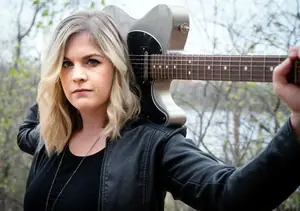

Hollie Rogers is the kind of songwriter who makes you realize how much filler usually clutters the indie circuit. She is a star in waiting, armed with a vocal range that hits like a heavyweight and a lyrical sensibility that feels dangerously lived-in. While the U.K. has been keeping her as something of a local secret, that shelf life is expiring. The world stage is calling, and Rogers is finally answering with a project that demands your attention.
The upcoming album, *Criminal Heart*, is the catalyst for this inevitable breakout. It is a record that refuses to sit still, largely due to a production team that looks more like a genre-collision than a standard studio lineup. James Macmillan, a name synonymous with high-level jazz, sits in the captain’s chair.
When I ask about Macmillan’s role in the new record, Rogers is quick to clarify that this was a collective effort. She says, "Yeah, he’s a co-producer. Basically, James has produced some of the tracks that are on it and the others have been produced by a guy by the name of Stefan Redtenbacher and then I’ve co-produced all the songs with both of them, so it’s a bit of a team effort."
But don't mistake "team effort" for a lack of focus. If you try to pin Rogers down to a single genre, you’re going to fail. There is a folk-pop skeleton here, sure, but the jazz and funk muscle draped over it changes the entire anatomy of the sound. It is a sophisticated blend that feels more like a fusion experiment than a radio-friendly bid.
Rogers acknowledges that Macmillan’s jazz pedigree is only one part of the equation. She tells me, "I think, although James is a jazz musician, himself, I think his production work has spanned so many different genres that he brings a lot of different influences and I’m, as you say, more influenced by folk, pop, Americana, that kind of thing. I think James has bought his own stuff to the table and with the songs that he’s been working on with me, they’ve taken on a bit of a new direction."
And that direction is noticeably grittier. Redtenbacher’s influence adds a rhythmic weight that most folk-adjacent artists are too afraid to touch. It creates a tension that keeps the listener from getting too comfortable.
"It’s a bit more of a fusion of genres than stuff I’ve done before I worked with him," Rogers says. "And then Stefan is very much from a funk background and he brings those kind of funky bass lines to the table so between the three of us it’s there’s a lot going on."
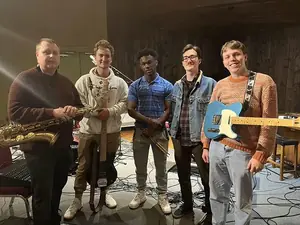
That "lot going on" extends to her live setup. If you’ve seen her on tour, you’ve seen Tom Holder. He’s the double bass player who seems to provide the atmospheric glue for her sets. Watching them interact, there is a shorthand that only comes from years of shared stages.
Rogers laughs when I bring up Holder’s youthful appearance. She says, "Yeah, Tom Holder. He’s so young, he doesn’t look as youthful as he actually is but I’ve been working with Tom since he was about 16 and he’s got so much hair and so much beard that nobody knows he’s only a baby."
The origin story of their partnership is pure serendipity, the kind of "who do you know" moment that defines the British music scene. Rogers was teaching at the time, looking for a very specific sound to round out her performance.
"I needed a cello player gosh, it must be five or six years ago now, and at the time, I was working at a school teaching," she explains. "Someone that I worked with said, 'Oh, you need a cellist I know a double bass player who also plays a bit of cello' and she told me all about him. I said, 'Sounds great!' And then she said, 'And also, he’s just turned 16.' Okay, amazing. Can he actually play and she said, 'Oh, he can play all right.'"
Holder proved to be more than just a session hand. He became a fixture, bringing a textural depth that bridges the gap between orchestral formality and low-end groove.
"He played cello at my last album launch, which was a while ago now, and since then, he’s been on board as my double bassist kind of on a full time basis," Rogers says. "He sort of bows that double bass as well so it’s kind of a middle ground between a cello and a bass, but it means we can get that sound with just the two of us, so it works quite well. It’s great to have that kind of versatility."
It is fascinating to learn that this level of musicality was not a family heirloom. Rogers grew up in Cornwall, a place known more for its rugged coastlines than its conservatory-trained prodigies. She didn't grow up in a house full of instruments.
When I ask if she grew up in Cornwall, she simply confirms, "Yeah, that’s right."
But the musical pedigree? It wasn't in the water. Rogers is a self-made entity, a fact that makes her current polished output even more impressive.
"No, my dad likes to sing but it’s really more of a karaoke time in the car sort of vibe and when he’s drunk at the pub thing rather than anything serious, and my mum, I pay her not to sing," she says with a laugh. "She’s not musical at all but we listened to a lot of music growing up. We listened to quite a varied sort of stuff but I don’t know where it came from, really, because it’s definitely not in the family blood wise."
There is a legendary bit of lore regarding her start on the guitar. Most people start with a cheap acoustic and a dream. Rogers started with the wrong instrument entirely. It is a story that has followed her, and for good reason—it speaks to a level of sheer determination.
I spent several weeks trying to work out why I was struggling so much to follow this little book that I bought to try and teach myself. It was several weeks in that somebody came into the school room that I was trying to teach myself in and told me that it was a bass guitar that I was holding, not an actual guitar.
"Hey, how do you know about that? You’ve done your research," she says when I bring it up. "I did always love to sing. I liked singing from when I was really young and then it would have been when I was about 15 or 16 that I started playing guitar. Not because I had some kind of deep-rooted desire to play but it was literally just about trying to impress boys. I thought all girls with guitars, they look cool, boys like them, I’ll try and learn guitar."
The punchline, of course, is that she wasn't playing a guitar at all. It is a technical error that would have stopped most people in their tracks, but Rogers pushed through the confusion for weeks.
"It quickly turned into a passion after that but yeah, I started to try to teach myself because I couldn’t have any lessons at the time, and I spent several weeks trying to work out why I was struggling so much to follow this little book that I bought to try and teach myself," she explains. "It was several weeks in that somebody came into the school room that I was trying to teach myself in and told me that it was a bass guitar that I was holding, not an actual guitar. So that’s why it wasn’t translating very well. But we got there in the end."
Her path to the stage was not a straight line. She was a drama major, focusing on the technical side of the theatre. This background in lighting and sound is her secret weapon. She isn't just an artist; she’s a technician who understands the mechanics of her own presentation.
"Yeah, absolutely," she says. "I think because I came to the guitar quite late, I’d already chosen my initial options for secondary school exams and I hadn’t chosen music, and I didn’t know how to read music or any of that. So that then meant that I couldn’t take that forward at college level which then meant I couldn’t do it as a degree because I didn’t have that kind of theory, background or knowledge. Drama really was something that I enjoyed and I had a good drama teacher at college and didn’t really know what I wanted to do so I just went with something that I enjoyed, and it meant that I could specialize in the elements of drama that interested me, which wasn’t so much acting or that side of things, it was more the technical stuff, lighting and sound and video creation, and that’s translated really well into my music career that came later. It’s really handy knowing how to use a sound desk, or how to use a microphone to record yourself at home and all that sort of thing so it was quite easily transferable."
The transition from a stable teaching job to the volatility of a full-time music career is where Rogers shows her grit. She spent five years in the trenches of primary school education, teaching everything from history to math, while her own songs were relegated to the 80-hour work week's leftovers.
"That is a really good question because, you know, it’s very difficult financially to sustain yourself on it," she says, reflecting on the leap of faith. "I know that there’s a lot of people at my level, and people more successful than I am who still struggle to sustain themselves exclusively on music without having some kind of side hustle. I guess I’d always thought it could be a career but I had never been brave enough to actually try and do that full time because of the financial risk, I guess. I did five years full-time teaching and not teaching music, just teaching primary school kids all sorts of subjects like history, math, whatever, and music was kind of on the backburner because I was doing 80 hours a week and not really having time for music."
But the pull of the stage was too strong. Four years ago, she packed it in and moved to London. It was a "do or die" year that fortunately didn't end in a return to the classroom.
"But with every year that went by I felt more of a pull to be out there performing my own music and to be writing more and so it would have been about four years ago that I quit the full-time teaching and moved to London and just tried to give it a go," she says. "I thought, I’ll see what happens and if after a year it’s too tough or I’m not enjoying it, or I can’t make it work, then I’ll go back into teaching. It did work and obviously it is tougher in a financial sense but in every other sense, it’s great and I wouldn’t swap it. Obviously, the pandemic has made it harder but that’s the same for everybody and we will eventually get back on our feet and things will return to normal."
One of the standout tracks from her London era is "City of Colour." It’s a piano-driven ballad that reveals another layer of her self-taught talent. In a world of over-produced pop, hearing an artist admit to their technical limitations is incredibly refreshing.
"Yeah, that came later, and to be honest, I still feel like I’m teaching myself," Rogers admits about her piano playing. "I feel very sure on a guitar, it feels really natural and I don’t really have to think about it. On the piano, I very rarely will do that live, occasionally if I’m feeling really brave or I’ve had a bit to drink. It feels like I’m still very much finding my way around the keys and then there are certain keys that I can’t play in. For City of Colour on the video, if you look at my hands, you’ll see I’m playing in C, but on the audio it’s actually in D. That’s because of the magic of the transpose button. But literally, I can’t play that song in the key that it suits my voice best. A musician or pianist would maybe spot that."
The song itself was born from the kind of high-pressure environment that breaks lesser writers. It was written for a competition about London, and Rogers, true to form, left it until the absolute last second.
"Late at night is when it always happens," she says. "For some reason it’s really inconvenient, but usually between 2am and 4am. City of Colour was very last minute written for a competition where the finalists had to write a song about London. There were 10 finalists for a grand finale concert and I’d had weeks and weeks, months probably to do it and I had been trying to do it, but it just hadn’t been coming. On that last day before the concert, I took a walk along the River Thames and I listened to loads of other songs about London and there are so many of them because it’s such an inspiring city, such an inspiring place. Then those songs that I listened to I tried to work into the lyrics of City of Colour so there’s four or five London songs that I referenced in that first verse and second verse where I’m talking about walking along the side of the river. And yeah, it was about two or 3am that night that I finally finished the song ready to perform the next day. And thank goodness I did, because otherwise I’d have been stuck with nothing to play."
This reliance on raw feeling over technical deadlines is what gives her music its soul. She isn't a "brief" writer. She’s an emotional archaeologist.
"100% Yeah, I find it really difficult to write to a brief or to a deadline and that’s probably why I found it so difficult, because it was for a competition and because it had to be about London," she says. "It was only when I actually started to feel those feelings, I talked about in the song that the song was written. Definitely every song that I’m most proud of has come from something I really deeply feel."
That emotional depth is perhaps most evident in "The Coast Road," a tribute to her Cornish roots. It features a verse in the Cornish language, a dying tongue that Rogers went to great lengths to preserve in her work.
"Yeah, I did. So, Cornish, it’s not like Welsh, where a lot of people in Wales speak Welsh and the road signs are in Welsh and the children learn stuff in school in Welsh," she explains. "In Cornwall there are very, very few people who still speak Cornish. It’s not widely spoken at all or used at all and is sort of dying out. I’d written the song in English and I just thought it would be nice to have a verse in Cornish since it was written about my home. I found that the Cornwall Council has a translation service strangely enough and you can send them something you want translated and they will send you back the Cornish."
The dedication to authenticity even required a vocal guide from the council. "They also had to send me a recording of how to pronounce it as well, because when they sent me it written down, I wasn’t sure how I’m supposed to say it," she says. "They did all of that and then I kind of worked it back into the original melody and now when I do it live, I always sing the Cornish verse. I haven’t decided yet whether the Cornish one or the English is going to go on the album. It might be that I’m thinking perhaps for digital release, I do the English, and then for the physical release the Cornish version, but it’s yet to be decided."
Speaking of physical releases, Rogers is leaning into the vinyl revival. A successful Kickstarter campaign ensured that *Criminal Heart* will get the wax treatment it deserves.
"Yes, I am. I’ve already taken some pre-orders for that," she says. "I definitely have to do it now. It was when we did the Kickstarter for the album originally and I met the target quicker than I’d expected doing, so we set a stretch goal of if we reach another target, then we’ll get vinyl made. So that is definitely coming out on vinyl. I’m looking forward to seeing my giant face because I’ve never done a vinyl before."
The album also boasts a collaboration that would make most indie artists green with envy. On the track "Love and Distance," the electric guitar isn't Rogers—it’s the legendary Robben Ford. The story of how that happened is a masterclass in "playing it cool."
"The electric guitar is not me, it is a gentleman named Robben Ford, who you may have heard of," Rogers says. "I went on a songwriting retreat in 2019 and it’s kind of an invite only thing. It’s a mix of people at my level right up to songwriters, and artists who people have heard of, you know, but you don’t know who’s going to be there till you get there. Obviously, I had heard of Robben Ford but I didn’t know what Robben looked like and I was introduced to this guy, just Robben is what he’s introduced to me as. We are put into a room together to do some writing with a guy called Jamie Lawson, who I’d also heard of, and that name rang a bell and someone had told me that he was a big deal. I already knew who Jamie was but we’re sitting with Robben and Robben is asking me about my influence so I’m talking away for about 15 minutes about how much I’ve loved Joni Mitchell for ages. I remember Robben is sitting in the drawing room in this really posh, stately home, and he kind of reclined in his chair with his cup of coffee and he just said very coolly, 'I played with Joni from 75 to 79. She’s a great gal.' And I’m like, 'Oh shit, oh you’re Robben Ford', and then we sat and wrote a song together, the three of us and it was really interesting."
The experience was a turning point for her confidence. "I felt for the first half of the day really sort of afraid to share my ideas almost because I was nervous of what they might think of them or that they wouldn’t be good enough and I can remember sitting down with Jamie at lunch halfway through and having a very honest conversation with him about that and him really putting my mind at rest," she says. "We had been quite stuck up to that point and then in the afternoon it all just kind of happened and that was the song that we ended up with. I was just so pleased that they both agreed to let me put it on my album and to feature on it as well. I think it’s going to be a really exciting moment when I get to release that to the world."
Moving to London was the catalyst for these kinds of high-stakes connections. It wasn't just about the music; it was about the proximity to the fire.
"It’s why I wanted to physically be in London, so that I could just at the drop of a hat, go and meet someone or go to some event or whatever without worrying about how I was going to get there," she says. "I definitely have found that making those connections is sort of like making your own luck to some degree because you’ve got to put yourself in the right places in order for doors to open and things to happen. Nine times out of 10, you don’t meet anyone that you’re going to speak to again, or doors aren’t going to open, but every now and then they do and something like that song will happen. You just can never predict how it’s going to go."
North America is the next logical step. Rogers was slated for a retreat in Arkansas and a stint at Americana Fest in Nashville before the world shut down. But the ambition hasn't faded.
"Oh, I would love to," she says about crossing the Atlantic. "I was supposed to be going over to do a writing retreat in Arkansas, and then going on to Americana Fest in Nashville and that didn’t happen obviously because of COVID, didn’t happen the year after either. But I’m still very hopeful that it will happen one day and when it does, my plan is not just to go to those two places, and then fly home again. If I’m going over, I’m going over so I would like to see more of America and because I’ve never spent any time there really. So yeah, I would love to."
As for the album release, the finish line is in sight. April is the target, pending a few final tweaks in the booth.
"I’m going to say April," she says. "I’m still waiting on two mixes and then as soon as I’ve got those, everything else is ready to go, like the artwork is now ready. Because of all the delays at the studio, and the bookings that they’ve already got, they’re trying to fit me around existing bookings so we’re nearly there."
In the meantime, there is plenty to digest. Four singles are already circulating, providing a roadmap of where Rogers has been and where she’s heading.
"There are four singles out already on Spotify," she notes. "One of the ones that James did came out in February 2020 and it’s going on the album but that was already out, City of Colour. Then there’s Youth, Love, and there’s Strange, so there are four of them out already."
Hollie Rogers isn't just another singer-songwriter with an acoustic guitar and a dream. She’s a technical, emotional, and genre-bending force who has paid her dues in the classroom and on the London pavement. When *Criminal Heart* finally drops, expect the "hidden gem" label to be retired for good.