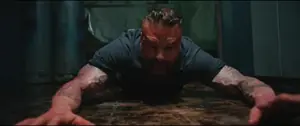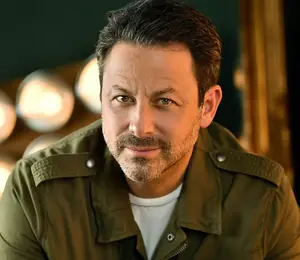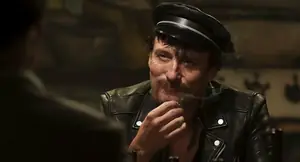

Han Soto is the kind of actor who exists in the margins until he suddenly owns the frame. He might have the oddest name in Hollywood, but the guy has been grinding through the studio system for years, slowly building a resume that reads like a fanboy’s fever dream. This past year, his career didn't just move forward; it accelerated into a different stratosphere. As Pham Minh Thao in the third season of the Netflix hit *Cobra Kai*, Soto played the soldier who kept a young John Kreese caged during the Vietnam War. It was a brutal, pivotal performance that didn't just provide a backstory—it essentially gave the "Cobra Kai" name its venomous origin.
Sitting across from him, you realize the name Han Soto isn't just a handle; it’s a brand he built out of necessity. He wasn't always Han. Earlier credits show a different name, a vestige of a time before he realized that in Hollywood, you have to be memorable or you’re invisible. He explains the pivot with a shrug that suggests it was the most logical move in the world. "I had to figure out what would be something that stuck. It was just one of those moments—my name is translated to John Smith in Vietnamese, so I had to find something that was memorable and sci-fi was kind of where it was at and I’m a Star Wars fan," he says.
The logic holds up. In an industry where "John Smiths" are a dime a dozen, Soto needed a hook. But he didn't just want a gimmick; he wanted something that felt right for the roles he was chasing. "So Han Soto was the closest to Han Solo without being so obvious. So, Soto it was. It had a Japanese feel to it because I started learning Japanese for some roles and it stuck. Actually, it started as a joke, quite frankly, and it just stuck and when I landed that role with Harrison Ford, that was it. It cemented my name," he notes.
There is a delicious irony in a man named Han Soto sharing a call sheet with the original Han Solo. On the set of *Ender’s Game*, Soto found himself playing Lieutenant Soto alongside Harrison Ford. It is the kind of meta-narrative that usually only exists in Reddit threads, but for Han, it was a literal "pinch-me" moment on a massive production. He recalls the production being incredibly accommodating of his chosen moniker. "Yeah, the production was awesome. They gave me my name tag and they let me pick my name and I was like, man, why not put my name on that tag. So they were very gracious," he says.
Most actors would be vibrating with anxiety standing next to a legend like Ford, but Soto played it cool, even when the interaction turned into a surreal vetting process. He describes their first meeting with the sort of detail you only get from someone who was truly present in the moment. "It started off amazing. I was sitting in the chair and he came over to introduce himself. That was my first interaction with him. On set with many of the cast members, he came over, he stuck his hand out and said, 'I’m Harrison'. I said, 'Listen, I know who you are' and put my hand out. I said, 'I’m Han', he goes, 'Oh, I know' and then he walks away and he just turns around and goes, 'Han Soto? Really? Great'. He has his crafty thing. He’s eating his crackers and carrots. It was cool. It’s a fun moment. Like, wait, did he? Did he just like, vet me? Or did he just shun me from any compensation? It was awesome," he says.
The *Ender’s Game* set served as a long-form education for Soto. It wasn't just about the role; it was about the mechanics of a massive blockbuster. He spent four or five months soaking in the atmosphere, watching the gears of a high-budget machine turn from the vantage point of "video village". He explains his process of observation. "The longest, I was on set for four or five months. When you’re not filming, I like walking around and watching how things are being done; how productive productions are going and what the producers are doing. I lived at video village just watching everything and it was one big masterclass for me and I got paid for it," he says.
That observational skill paid off when *Cobra Kai* came calling. By the time the audition landed, Soto was already a fan of the show, having binged the first two seasons. The call from his agent wasn't just another job; it was an entry into a franchise that had defined his childhood. He describes the casting process as a mix of professional restraint and private jubilation. "Same thing, I got a call from my agent saying that the casting director at this point already cast me in multiple projects prior. So they said, hey, we got a role for Cobra Kai and I just finished watching seasons one and two and I got kind of giddy because I tried to de-compartmentalize my emotions when I get something in. So I spent a little bit of time doing that and then when I was ready, I just threw myself on tape and most of it was improv and riffing it in Vietnamese, as I speak four different dialects of Vietnamese. So I felt very comfortable in doing so. But yes, I sent the tape in and they moved me on to the next stage and the next thing I get the call saying that I booked the role," he says.
The news triggered a reaction that Soto usually keeps under wraps. It is the human side of the business—the raw joy of a win in a town built on rejection. "I did a crazy happy dance that I didn’t even know I knew how to do. One may never see that ever, but that was in the privacy of my own home," he laughs. It is a lucky thing we are talking while he is in a vehicle, or I might have pressed him to recreate the choreography for the 519 cameras.
The *Cobra Kai* set is notoriously tight-knit, led by the creative trio of Jon Hurwitz, Josh Heald and Hayden Schlossberg. Soto entered this established ecosystem during the flashback sequences, which required a specific kind of focus. He purposely kept his distance from the usual onset banter to maintain the edge required for a character as dark as Pham Minh Thao. "They did a great job making everyone feel at home. I chose to not engage in a lot of banter when I was there, obviously, because I played a very evil character. So that was my choice. But I did have a chance to talk to Jon, Josh and Hayden. Those three alone are a super tight group and I don’t know if you knew this, but they grew up together in college, or they went to college together. So they’re really tight buddies," he says.
The production value for the Vietnam sequences was a step up for the series, featuring some of the most elaborate sets in the show's history. Soto watched as the main cast, who weren't even in the scenes, showed up just to see the scale of what was being built. "Everyone had their own responsibility. Everything was coming together and all three of those guys had their hand on the steering wheel and in the car never really swerved. So it was nice being led by a group of guys like that and as far as the cast is concerned, most of the main cast, they created their bond with the prior seasons. But they did show up to set when this set was being shot, because it was one of the most elaborate sets that they built in all the seasons. So it was cool. They were very cool and just engaged in conversation. I tried to keep the chatter to a minimum just because I was in that headspace, and I wanted to stay in it," he says.
On set with many of the cast members, he came over, he stuck his hand out and said, “I’m Harrison”. I said, “Listen, I know who you are” and put my hand out. I said, “I’m Han”, he goes, “Oh, I know” and then he walks away and he just turns around and goes, “Han Soto? Really? Great”.
The fate of Pham Minh Thao remains one of those lingering questions that keep the *Cobra Kai* Reddit threads spinning. While the flashbacks ended in fire and explosions, the "no body, no death" rule of television applies here. Soto is coy about a potential return to haunt an older John Kreese. "Anything’s possible. But I’ll tell you, ain’t no bomb gonna catch me. No napalm is going to get me… I’m just kidding," he laughs.
The realism of the Vietnam pit was aided by some very real co-stars: snakes. While many actors would have bolted, Soto found the reptiles far more manageable than other vermin he has encountered on set. He points to a harrowing experience on the film *Don’t Look Back* as his baseline for fear. "I like snakes. I’m not scared. I’m scared of rats and the movie I did called Don’t Look Back, I had to play dead with six rats on me. So just imagine your biggest fear and you have to sit still through the whole thing for four different takes. Snakes were not so bad for me. I mean, they seem pretty tame. They had a few boa constrictors there and they had lot of fake ones and then they added in the real ones in the pit, it was amazing. I’ve never seen it. Yeah, it is as deep as one would think," he says.
Playing a character as irredeemable as Pham requires a certain level of psychological architecture. Soto doesn't just show up and say lines; he builds these men from the ground up, often pulling from characters he has developed in his own time. For Pham, he repurposed a militia leader he had been living with for over a year. "The way I study characters is by actually creating them. I come up with characters, certain guys have certain personalities, they have specific cigarettes and different types of food. This particular character I’ve worked on for a year or so, it was on New Year’s in 2019 and he was a diamond militia leader, like in the diamond trade in Sierra Leone. So he was a Vietnamese guy who found his way to Africa and that’s what he did. That’s how he hustled his money. So basically, this guy is evil. The one I worked on had a machete and he ran crews in the mining towns, right? So I plucked him out of the Sierra Leone and threw him in Vietnam and put a gun and took the machete out of his hands. So I’ve already done the work, it’s just a matter of tying a couple pieces together to make this guy who they want me to be," he explains.
The linguistic choices Soto made for the role were equally calculated. By choosing a Southern dialect for a character ostensibly aligned with the North, he added a layer of betrayal to the performance. It was a subtle "F you" to the American prisoners, delivered through the cadence of broken English. "This one is more of a Southern dialect, just because the North Vietnamese Army came into the South, there are a lot of guys in the South who, instead of being captured, they switch sides, right, and this is kind of like the backstory of how I chose to do Pham. He’s a trader, so when he switched sides, he’s like, Oh, it’s kind of nice to be on the side where the power is—this is what it feels like not to run. So that’s why he does what he does, because he’s really just abusing this newfound power that he just got. I mixed a dialect in there with broken English. Just because there’s a hint of sinister in that they like to tease the American soldiers by trying to speak their language. It was like the ultimate finger, 'F you'. But it was almost a playful tease even—it was evil," he says.
Despite being in a show centered on karate, Soto’s own martial arts background remained largely off-camera. He is a practitioner of Wing Chun and spent years training in Kung Fu, though he admits his initial foray into Taekwondo was a short-lived disaster. "I practice Wing Chun in my basement and I started with two weeks of Taekwondo, didn’t like it, and I jumped over to Kung Fu. I did about eight years of Kung Fu when I was about eight years old. I did it all the way till I was 16 and I stopped practicing and then I picked up Wing Chun later in life, it’s more to keep my body conditioned than anything," he says. When asked if he wanted to show off those skills on *Cobra Kai*, his answer is immediate. "100%. I wanted to grab one of the boa constrictors and show them my nunchuck skills," he laughs.
The connection to *The Karate Kid* runs deeper than just a job. For Soto, the original film was a survival guide. Growing up as a target for bullies in middle school, the story of Daniel LaRusso provided a necessary, if slightly fantastical, sense of hope. "Absolutely, I never even dreamed of being a part of this franchise. All the vision boarding and manifestation I do, it never hit me to put this on my vision board and so with that being said, it just kind of came to me. When I was younger, 'Karate Kid' was my roadmap to not being bullied because I was getting bullied in middle school every day for two years—sixth and seventh grade. So I just didn’t know how to deal with that and depression was a thing for me. The movie really showed a false sense of reality, but you can crane kick your bullies and everything’s done right now. That wasn’t the case in real life though. I wasn’t in a position to crane kick anybody, but it did give me hope. That’s what movies do. It helps. It just helps the spirits," he says.
Soto’s career is a collection of "holy shit" moments. He has shared green rooms with the likes of Sir Patrick Stewart and Hugh Jackman while filming *Logan*, an experience that still seems to vibrate with a certain kind of awe. "I remember being in a green room with Sir Patrick Stewart and Hugh Jackman and it was just us three. We’re sitting there without scripts and I looked around, and I went, holy shit. This is amazing. I had great conversation with Hugh and Sir Patrick," he recalls.
Comparing the practical sets of *Cobra Kai* to the digital voids of films like *Ender’s Game*, Soto prefers the tangible. There is a different energy when you aren't pretending the world exists around you. "Ender’s Game was more green screen, blue screen, if you will, and anytime you get to be in the environment and not have to pretend, it is more fun to me. Of course, depending what the green screen is, if you’re in a crazy situation, that could be more fun too. But I don’t know. I’ve never really had the pleasure of always being on a set," he says.
His Marvel debut came in the much-maligned *Fantastic Four*, but for Soto, the experience was about the craft, specifically watching Miles Teller work. "Yeah, that was fun. That was my first Marvel movie, actually and I mean, Miles was amazing. Watching your colleagues act, when you’re not in the scene with them is a masterclass. So, anytime I get the spitballs I’m using scientific formulas and dosages. I love that fast, rapid fire speaking. That was fun," he says.
Then there was *Olympus Has Fallen*, where he found himself as the outlier in a sea of antagonists. "I was the only good Asian character in that movie and I play a doctor. Surprise!! Anton joked with me, he’s like, you are the only good Asian character in this movie. Everyone else is a bad character. So I thought that was funny," he says. It is a sharp critique of the industry’s tendency to lean on lazy tropes, something Soto has spent his career navigating.
Even his stunt work has a legendary edge. On the set of *Looper*, a moment of high intensity resulted in a very expensive crack. "I got on there as a stunt person. I broke the bar that I was throwing my guy on and I think that bar cost $15,000. You can see it, I picked them up really high from his chest and we did an arc and it was just bam and I heard a crack sound and then my next thought was, Oh shit, this is not good," he says. It is a reminder that the "magic" of cinema often comes with a literal price tag.
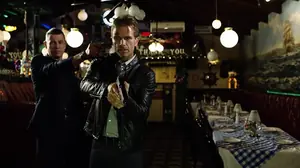
The conversation shifts to the reality of being a minority actor in an industry that often lacks imagination. Soto has seen the "token Asian" roles firsthand—the dry cleaner owners, the broken-English militia men. But he found his power by speaking up, most notably on the set of *Heist* with Robert De Niro. "Oh, yeah. When I first started, I was only getting, 'die American pig die' roles, the militia in the Vietnam War, speak broken English, do martial arts, you own a dry cleaner, you own a corner store. So it got to a point, I think the a-ha moment for me was it was on 'Heist'. The one I did with Robert De Niro. That character was a high roller and it was written as broken English, and I said to the director, 'right after rehearsal, do you mind if I just prepare something, I’ll throw it out on the wall and it sticks it sticks' and he looked at me, he’s like, 'man, I trust you just do what you think is good for Mr. Tao' and I said, 'alright, done' and I did it. I did my English. It’s the cadence of the way I was speaking, it was powerful. I mean, I had to be because I was across De Niro, right? So we did one take, and he came over, and he just grabbed my head. He’s like, yes, that’s it, dude," he says.
That moment with De Niro was a turning point. It taught Soto that the script is a starting point, not a cage. "It made me realize, okay, these rules are written in a way that the writers sometimes don’t understand the culture. But you do have control over it. I think it just takes asking but don’t change the script. I mean, don’t try to speak fluent English in a land where there is no English, but there is a time when you can go, 'Hey, let me try something' and if it works, it works. If it doesn’t, it doesn’t. Don’t ever be scared of asking," he says.
His favorite on-screen moment, however, involves Will Smith and a bit of meta-acting on the set of *Focus*. Smith had a habit of messing with his co-stars by stealing their lines during the final take, a move designed to keep everyone on their toes. "Wow. I have so many. There’s a memorable moment, very noteworthy moment where I was in Focus with Will Smith and what he’d been doing for a week, with his cast mates is once they get the scene in the bag, he’ll come back on the last take and then during the scene, he’ll take their lines and reiterate it back to them and you can see a lot of people were like, what’s going on? Why is he saying my line?" Soto recalls.
When Smith tried it on him, Soto didn't just react; he threw it back with an *I Am Legend* reference that left the superstar impressed. "So anyway, when he did that to me, I knew we already got into camp because I heard the directors say, all right, that’s the one and I figured something was happening and he did it to me and I reenacted his scene in I Am Legend, when he found that dummy when it moved. I even got to the point where I started crying. Tears started rolling down and when the director yelled cut, Will just gave me a hug. I thought that was awesome because he was like, dude, it was so cool. I mean, anytime Will Smith says you did something cool. You’ve kind of done it, right?" he says.
Looking forward, Soto wants to move away from the "muscle" and into the cerebral. He envisions a role that explores the burden of genius, something akin to *Good Will Hunting*. "I like Goodwill Hunting type characters. Like a prodigy, a prodigy kid, super genius. But also play that soft spot in the battle of like, depression, everything that comes with that, too. So I don’t want to just play a smart character and be like, this character knows everything. I want to show how that character battles with the side effects of being a super genius. I might just write that script and produce it," he says. It is a bold ambition, but as he notes, "I think that’s why we produce—to create our own content."
Beyond the screen, Soto is heavily involved in relief and charity work, a passion born from his own humble beginnings. He feels a deep obligation to help those without a voice, particularly children and the elderly. "I did come from humble beginnings and I just like giving kids opportunity to be creative and have almost the same opportunity. Kids should not have access to clean water or the essentials. I just think if you’re in a position that comes across your plate, you have an obligation to do everything you can to help out and I have a really soft spot in my heart for kids and the elderly," he says.
That drive only intensified when he became a father. Issues like sex trafficking are no longer just headlines; they are personal affronts. "I think it got elevated once I had my own child. Especially issues of sex trafficking. I just can't fathom the idea of being a victim of that. So, anytime I see that, I'm all in, just tell me what you need me to do," he says.