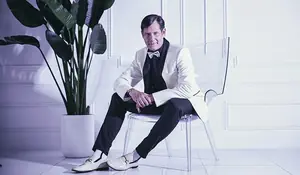

Walking into the Olde Walkerville Theatre feels like stepping into a humid memory of Windsor’s cultural peak. The air has that specific weight—a mix of old velvet, floor wax and the faint, metallic scent of a stage that has seen a century of sweat. It is the kind of room that demands a certain level of vocal gravitas. Russell Drago, a baritone whose voice carries the texture of expensive bourbon, seems almost preordained to stand on this stage.
Drago is a local boy who made good in the Toronto shark tank. He has spent years carving out a reputation in the smoke-filled rooms of the Big Smoke, but the road back to the 519 is often longer than the 401 suggests. It is a homecoming that has been deferred for far too long.
We sat down with Drago in the quiet of the theatre before the lights went down. He is reflective, aware of the weight of playing for the people who knew him before the "velvet-voiced" labels took hold. The logistics of moving a jazz machine of this calibre are not for the faint of heart.
"For as long as I can remember, Windsor has always had a rich and vibrant live music scene," Drago says. "But let’s face it, taking your show on the road presents all kinds of complications and logistical challenges. All the stars have to be aligned. I still have family and friends here; they’ve been so supportive, travelling far and wide to see my shows. I’ve always dreamed of coming home to perform, and I’m just thrilled that this dream is about to materialize."
The choice of venue was not a matter of convenience. In a city where modern, sterile boxes are often the default for touring acts, Drago went looking for soul. He found it in the bones of the Olde Walkerville, a place that breathes history through its plaster.
"The Olde Walkerville Theatre wasn’t the first venue I visited, but I knew the minute I walked in that it was the place," he explains. "I remembered it had been The Tivoli—I’m sure I saw a few films there back in the day. It’s 'old school', which is perfect for my show. Coming home to sing at the Olde Walkerville Theatre is a full-circle moment for me."
There is a technical risk in choosing a room this size. The acoustics can be cavernous if you do not know how to work the microphone. But Drago is not a belter; he is a stylist. He understands the nuance of the "close-up" vocal, a technique that turns a 600-seat house into a private living room.
His reputation precedes him, often wrapped in a specific adjective that has become his professional shadow. It is a branding win, certainly, but it also sets a high bar for every performance. If you promise velvet, you cannot deliver sandpaper.
"My sound was once described in the media as 'velvety smooth'; that description has followed me around," Drago says. "People who’ve talked to me after my shows have told me there’s a warmth and directness that resonates with them; they feel I’m singing 'just to them'. I work hard to prepare for a show. I sing all 25 songs on my setlist from memory."
That last point is no small feat. In an era where teleprompters and lyric sheets are the norm even for seasoned pros, Drago’s commitment to memory is a play for authentic connection. It allows for eye contact. It allows for the band to pivot on a dime without the singer being tethered to a music stand.
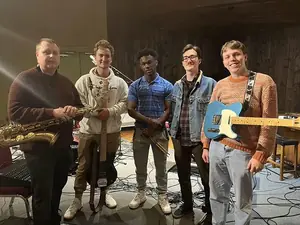
And the band is a heavy-hitting unit. You do not bring a mediocre rhythm section to a town with Windsor’s musical ears. Drago has assembled a group of Toronto’s elite, led by a man who understands the architecture of a jazz standard.
"This is a great segue to talk about my band--some of the most versatile jazz musicians anywhere," Drago notes. "Kevin Barrett is both my Musical Director and guitar god. A multi-genre performer and studio musician, his heart belongs to jazz."
For as long as I can remember, Windsor has always had a rich and vibrant live music scene. ...I’ve always dreamed of coming home to perform, and I’m just thrilled that this dream is about to materialize.
The ensemble depth continues with Louis Simão on keys. Simão is not just a side musician; he is a decorated artist in his own right, bringing a folk-influenced sensibility to the jazz structures that Drago inhabits.
"Louis Simão, my keyboard player, was named 2017 Solo Artist of the Year by the Canadian Folk Music Awards," Drago says. "His jazz sensibility and diverse skills are in demand—as a music educator and as a Canada Council for the Arts juror."
The low end is anchored by Clark Johnston, a man whose resume reads like a history of Canadian jazz excellence. To have played with Peter Appleyard is to have reached the inner sanctum of the genre.
"My bassist Clark Johnston performed with the famed Peter Appleyard and has released three CD’s of original compositions," Drago adds.
Then there is the engine room. Rakesh Tewari on drums is the kind of versatile player who can swing a jazz club on Tuesday and hold down a pop stadium on Friday. His presence on the kit ensures the evening will have more than just "smooth" textures; it will have teeth.
"Rakesh Tewari, my drummer, has shared the stage with Alicia Keys, K’Naan, Rufus Wainwright, KD Lang, Holly Cole and Nelly Furtado, and many others," Drago says.
The chemistry between these five men is the intangible variable of the evening. You can rehearse the charts until the ink fades, but the actual "click" with an audience is a spiritual transaction that cannot be faked.
"We can never predict how we’ll connect with our audience—but believe me, when it happens, we know it and so do they," Drago says. "I have no doubt that Windsor will surprise and delight us."
This performance is bolstered by the momentum of a new recording. Drago recently took his show to the Isabel Bader Centre for the Performing Arts in Kingston, a room known for its pristine, world-class sonics. It was there that he linked up with a legend of the Canadian recording world.
Aaron Holmberg is a name that carries weight. As the former house engineer at The Tragically Hip’s Bathouse Studios, he has been the sonic architect for some of the most important records in this country’s history.
"In March, I performed at the Isabel Bader Centre for the Performing Arts in Kingston—where Aaron is Technical Director," Drago says. "He was house engineer at The Tragically Hip’s iconic Bathouse Studios for years and ran the boards for The Hip, Bruce Cockburn, The Trews, Sam Roberts and Jill Barber."
Capturing a live jazz performance is a high-wire act. In the studio, you have the safety net of the punch-in and the overdub. Live, you are naked. Every missed note and every crack in the vocal is etched into the digital ether forever.
"I hired Aaron to do studio mix of the archival recording the Isabel does for each show," Drago explains. "It’s a gamble--you only have one shot when performing live—there are no second takes. But I thought, 'If I’m not happy, this goes in the sock drawer.' It turned out to be magical--beautiful hall, beautiful audience. My band was right and tight. I felt so good when I walked offstage."
The post-production phase is often where an artist’s ego goes to die. Hearing your own voice without the adrenaline of the stage can be a brutal exercise in self-flagellation.
"A few weeks later, Aaron sent me a rough studio mix," Drago says. "Any artist will tell you we’re our own harshest critics when hearing or watching our own performances."
But jazz is not about perfection; it is about the honesty of the moment. If you polish a live recording too much, you lose the "air" of the room. You lose the reason for recording it in the first place.
"However, your audience may not hear or care about the same things you do," Drago admits.
In the end, the Kingston tapes captured something that Drago knew he couldn't hide in a drawer. It was a document of a band at the peak of their powers, playing in a room that allowed them to breathe.
"I couldn’t have sung any better," Drago says. "Sure, there were a few mis-steps, but the recording lived up to the feeling I’d experienced that night. We’re working hard to ensure that my new CD, Russell Drago Live @ The Isabel will be available on October 17."
The Windsor show on Oct. 17 marks the official homecoming. It is a chance for the city to claim one of its own before he heads back to the Toronto circuit. The evening promises a level of intimacy that is rare for a venue of this vintage.
Doors open at 7 p.m. with the show starting at 8 p.m. For those who want to dissect the setlist or talk shop about the gear, a meet and greet with Russell and his band follows the performance. Don't miss the chance to see a master of the form in his natural habitat.