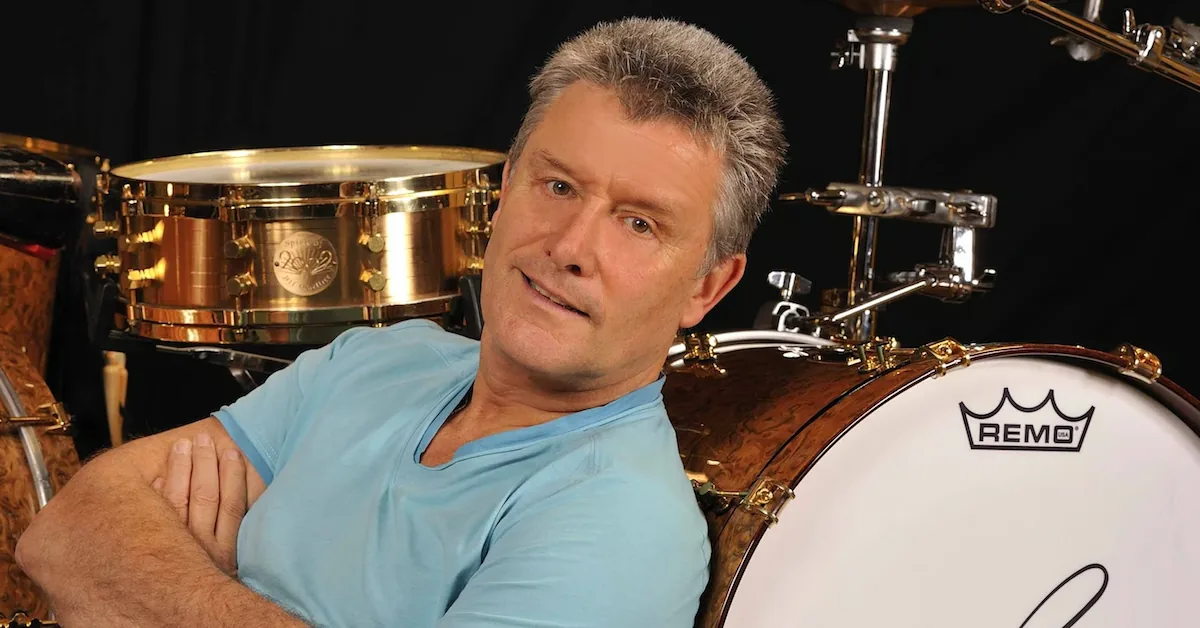
Looking at the raw transcripts from this late 2018 conversation with Carl Palmer is a study in stewardship. By this point the world had lost both Keith Emerson and Greg Lake. The idea of Emerson Lake & Palmer as a living breathing entity was over. What remained was the catalogue the legacy and the last man standing tasked with curating it. This chat caught Palmer in the wake of the release of Fanfare: Emerson Lake & Palmer 1970-1997 a monolithic box set that served as the band’s definitive full stop.
Box sets are a tricky business. They can be cynical cash grabs or they can be lovingly assembled monuments. Palmer was adamant that Fanfare was the latter. It was about creating a complete document a final word on one of progressive rock’s most audacious and commercially potent power trios. And when you look at the contents it’s hard to argue. Vinyl CDs a coffee table book DVDs even an ELP logo badge. It was a completist’s dream.
“That's exactly what we were trying to do,” Palmer says of the exhaustive collection. “We've never done a box set as comprehensive as this one before, and that was the name of the game.” This wasn’t just about re-packaging the hits. It was about sealing the vault. For years fans had speculated about what lost masterpieces might be gathering dust. Palmer shoots that down directly.
The two unreleased live recordings included were it. The final gems. “What you see there, you know, there's two unreleased live recordings. So those are the two gems, as you put it, in there,” he confirms. “At the moment, everything that's of any notoriety, anything that means anything at all to do with the ELP that is, you know, important or hasn't been heard is in that box set.” It’s a definitive statement that closes the book on decades of speculation.
There's a dark but pragmatic humour in how Palmer viewed the finality of the project. He was the surviving member left to quite literally put everything in a box. “We're all gonna end up in a box, aren't we, anyway, at the end of the day. So it was nice to put that in a box,” he states with a stark frankness. The weight of that task is palpable. Both Emerson and Lake knew about the project but their passing left Palmer and manager Stuart Young to see it across the finish line with BMG a label he notes ELP had always wanted to be with.
Part of the process involved remastering the catalogue a move that often elicits eye-rolls from audiophiles. But Palmer’s take is refreshingly devoid of marketing spin. He’s not here to sell you on a sonic revolution. He’s a pragmatist. It was an opportunity to revisit the material and see if improvements could be made. No more no less.
His candid assessment is a blast of fresh air. “Some of it, you know, has turned out really good. Some of it's about the same as what it was before. But, you know, it's always nice to try, especially when you're doing something as complete and final as that.” This is the kind of honesty you rarely get from legacy artists who are often contractually obligated to claim every new version is the definitive one. Palmer simply saw it as due diligence.
And don’t mistake this archival work for wistful nostalgia. He is famously unsentimental about his past recordings. “I don't really listen to the music at all unless I've got to learn a piece,” he admits. “I don't really sit at home and play it on a day to day basis anyway. Never have done.” He’s a craftsman not a curator of his own museum. The work exists to be performed not to be endlessly re-lived.
Everything that's of any notoriety, anything that means anything at all to do with the ELP that is, you know, important or hasn't been heard is in that box set.
At the time of this interview Palmer wasn’t just looking backward. He was actively re-contextualizing the ELP songbook with his power trio Carl Palmer’s ELP Legacy. Flanked by guitarist Paul Bielatowicz and bassist Simon Fitzpatrick the project was a radical reimagining of the keyboard-driven source material. It was a way to honour the compositions of Emerson and Lake without creating a carbon copy a tribute that celebrated the music’s architectural brilliance not just its sonic texture.
He was on the road promoting a live package that doubled as a direct tribute to his fallen bandmates. The CD and DVD featured guest spots from prog royalty like Genesis guitarist Steve Hackett and Vanilla Fudge keyboardist Mark Stein. It was a community coming together to celebrate two of its most important architects. The inclusion of the Center for Contemporary Dance's Ida Choir for a rendition of “Jerusalem” shows the depth and theatricality of the presentation.
This wasn’t a simple bar band tour. Palmer describes a “cinematic approach” using extensive video footage to augment the performances. It was a multimedia experience designed to give the instrumental music a powerful narrative and visual anchor paying respect to the band's history while pushing the arrangements into new territory. The project was less about replication and more about translation.
Beyond the stage Palmer had also carved out a fascinating second act as a visual artist. Through his “Rhythm of Light” collection he uses drumsticks and light to create abstract images from the motion of his playing. It’s a clever and surprisingly effective way of making the invisible art of rhythm into a tangible visual piece. He’s clear that the charitable aspect where proceeds from art events go to local organizations is a core component.
When the conversation turns to his own longevity the pragmatist returns. Does he find it tough to maintain the intense physicality his drumming demands? Of course. “Everybody, you know, gets more aches and pains as they get older. I mean, you just have to accommodate it and deal with it and treat it as best as you can, really.” It’s a simple unvarnished truth.
But he has no intention of stopping. The word ‘retirement’ is poison. He might work less but the drive to perform remains absolute. “How long is a piece of string?” he muses. “All I know is whilst I'm still playing well and I can keep my standard high, then, yes, I'll just carry on.” For a drummer whose entire career has been defined by a high-wire technical standard this is the only metric that matters.
Reflecting on a career of impossible highlights—from Madison Square Garden to Carnegie Hall—he singles out the truly massive events. The show at Montreal's Olympic Stadium on Aug. 26 1977 with over 75,000 fans. The legendary California Jam in 1974 where ELP played to a sea of over 250,000 people. These weren’t just concerts; they were generational markers.
Yet he speaks of them with a sense of seasoned humility. “I've just been blessed and had a lot of moments in my career, which are, you know, are mind blowing to a lot of people and almost become the norm to me, but I'm extremely grateful I was given the opportunity.” It's the perspective of someone who operated at the absolute peak of the industry for so long that the extraordinary became his everyday office.
The final topic is Asia the other prog-rock supergroup that defined a massive part of his career. With the passing of John Wetton in 2017 the band’s future was a significant question mark. Palmer’s answer is guarded and respectful. He confirms they are “looking at it” but that nothing is set in stone.
“I can't really tell you anything that's happening because there is nothing on the table that is actually firmed up,” he says carefully. It’s a non-answer that speaks volumes. It acknowledges the desire to continue but also the immense difficulty of moving forward without a key member. It’s the sound of a man who understands legacy and the importance of getting the next chapter right.
Revisiting the conversation years later Palmer’s role is clearer than ever. He is the engine room the anchor and the guardian. Whether he’s signing off on a definitive box set reinterpreting classic compositions for a new era or carefully considering the future of another legendary band he remains a figure of immense integrity and relentless forward motion.
519 Magazine Archive: We are thrilled to officially unearth the 519 Magazine Digital Vault. This isn't just a re-post; it's a high-fidelity restoration of a pivotal era in music journalism. By pairing original print dates with modern retrospectives, we’re bridging the gap between historical rock-and-roll grit and the lightning-fast performance of today’s web. These stories—once locked in physical print and lost URLs—are now back, fully searchable, and optimized for a new generation of fans.
We are thrilled to officially unearth the 519 Magazine Digital Vault. This isn't just a re-post; it's a high-fidelity restoration of a pivotal era in music journalism. By pairing original print dates with modern retrospectives, we're bridging the gap between historical rock-and-roll grit and the lightning-fast performance of today's web. These stories—once locked in physical print and lost URLs—are now back, fully searchable, and optimized for a new generation of fans.