Five films deep, most franchises are running on fumes and merchandising momentum. Toy Story 5 doesn't feel that way. It's a stellar, genuinely funny entry that finds new ground in a toy box that seemed fully mapped after 2019's near-perfect send-off, and it does it without leaning on nostalgia as a crutch.
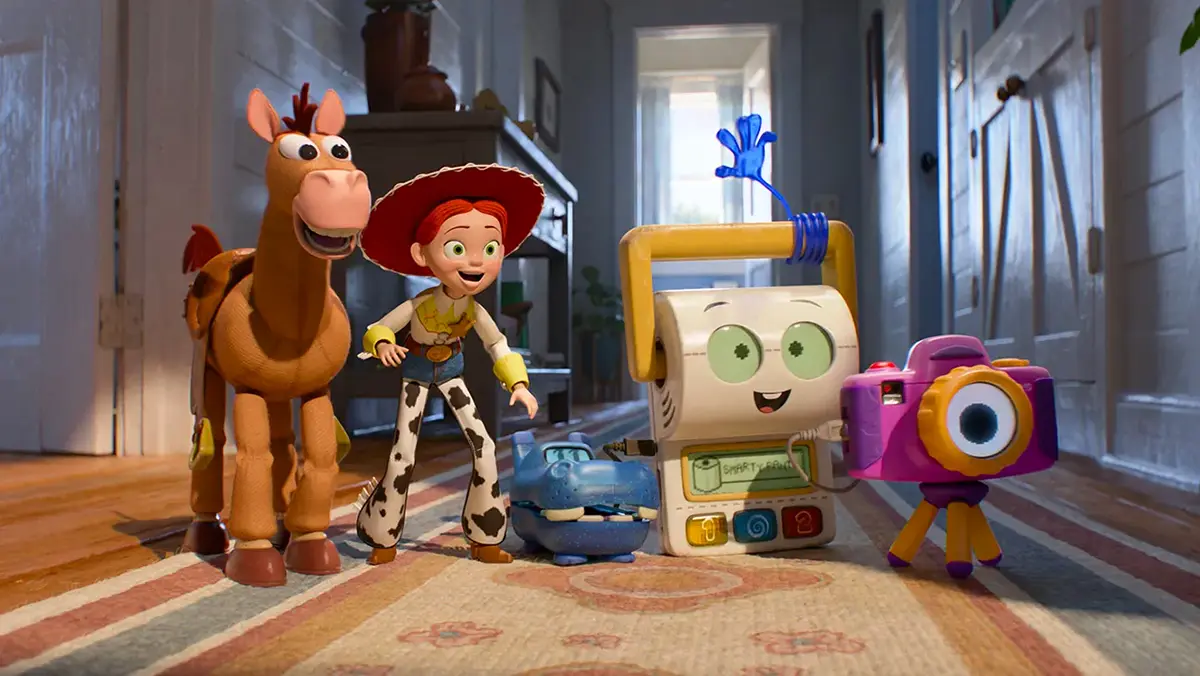
Andrew Stanton, back at the helm alongside co-director Kenna Harris, sets up a premise that's almost embarrassingly obvious in hindsight: toys meet tech. Bonnie gets a tablet named Lilypad, voiced with unsettling corporate cheer by Greta Lee, and suddenly the entire ecosystem of Woody, Buzz, Jessie and the rest is fighting for relevance against a screen that never needs to nap, eat or get put back on a shelf.
That anxiety gives the film real teeth. This isn't a rehash of Toy Story 3's abandonment fears or Toy Story 4's existential wandering. It's something closer to a workplace under threat of automation, wearing a children's-movie costume, and Pixar plays that tension for both laughs and something sharper underneath.
The timing on this couldn't be more pointed. Toy Story 5 lands in a cultural moment thick with lawsuits over social media's grip on kids, and screens multiplying in every corner of a child's life until there's barely room left for anything that doesn't light up. Pixar didn't need to spell out the parallel. It just needed to put Woody's crew up against a device that never tires, never ages out, and never has to earn a kid's attention twice.
What makes the film's angle land is the perspective it's told from. This isn't a lecture aimed at kids about screen time. It's grief, narrated by the toys themselves, the very objects that used to be the thing a child bonded with most personally before a tablet could do it faster and louder. Woody, Buzz and Jessie aren't just losing shelf space to Lilypad. They're watching the specific, physical, imaginative kind of play that built their entire world get replaced by something that doesn't require imagination at all. There's a real sadness under the comedy in that, an awareness that plenty of kids watching this film today will never know the particular joy of a toy the way Bonnie's generation, or ours, did.
It's a heavier thing for an animated sequel to be carrying than the marketing lets on, and it's the best evidence yet that this franchise still has something to say five films in.
And then there's the fifty Buzz Lightyears. A shipment of Hi-Tech Edition figures wake up on a remote island still stuck in toy mode, hunting for Star Command with zero awareness they're not the original. It sounds like it shouldn't work as a bit. It's a hoot from the first frame they show up. Watching an army of identical, sincerely confused Buzzes bicker over which one is the real one is the funniest stretch of comedy this franchise has produced since the Spanish-mode meltdown in Toy Story 3.
Randy Newman, scoring his fifth entry in this series, knows exactly when to lean into warmth and when to pull back and let a scene breathe without music at all. It's the kind of scoring craft that doesn't announce itself, which is precisely why it works.
Where the film stumbles is in its handling of Woody. After four movies built around his voice as the emotional and moral centre of this world, Toy Story 5 sidelines him more than it should. The choice seems intentional, an attempt to let Buzz, Jessie and the newer faces carry more weight. But it leaves a hole in the film's centre that the ensemble, as strong as it is, doesn't fully fill. Fans who've spent five films anchored to Woody's perspective will likely feel that absence before the credits roll.
Tim Allen's Buzz picks up a lot of that slack, and mostly earns it, torn between commanding the growing chaos of his fellow figures and reckoning with what it means when there are suddenly fifty versions of yourself walking around. Joan Cusack's Jessie gets some of the film's best quiet beats, particularly in her scenes squaring off against Lilypad over who actually understands what Bonnie needs.
The newer voices land better than expected. Conan O'Brien's toilet-training tech toy is a strange, specific bit of casting that somehow works. Craig Robinson finds real charm in an upbeat GPS hippo named Atlas. Even Bad Bunny's brief, odd cameo as a sunglasses-wearing pizza slice gets a laugh rather than feeling like stunt casting for its own sake.
Visually, this is some of Pixar's most confident work in years, the tactile plastic-and-fabric texture of the toys contrasted hard against Lilypad's cold, glowing screen-world. The film understands its own metaphor and never overexplains it, trusting the audience, including the younger half of it, to feel the stakes without a lecture attached.
Toy Story 5 was never going to top Toy Story 3's ending, and wisely, it doesn't try. What it does instead is find a genuinely fresh anxiety to hang a beloved cast on, deliver one of the funniest set pieces in the franchise's history, and stumble only in sidelining the character who built this world in the first place. That's a small price for a franchise entry this alive.