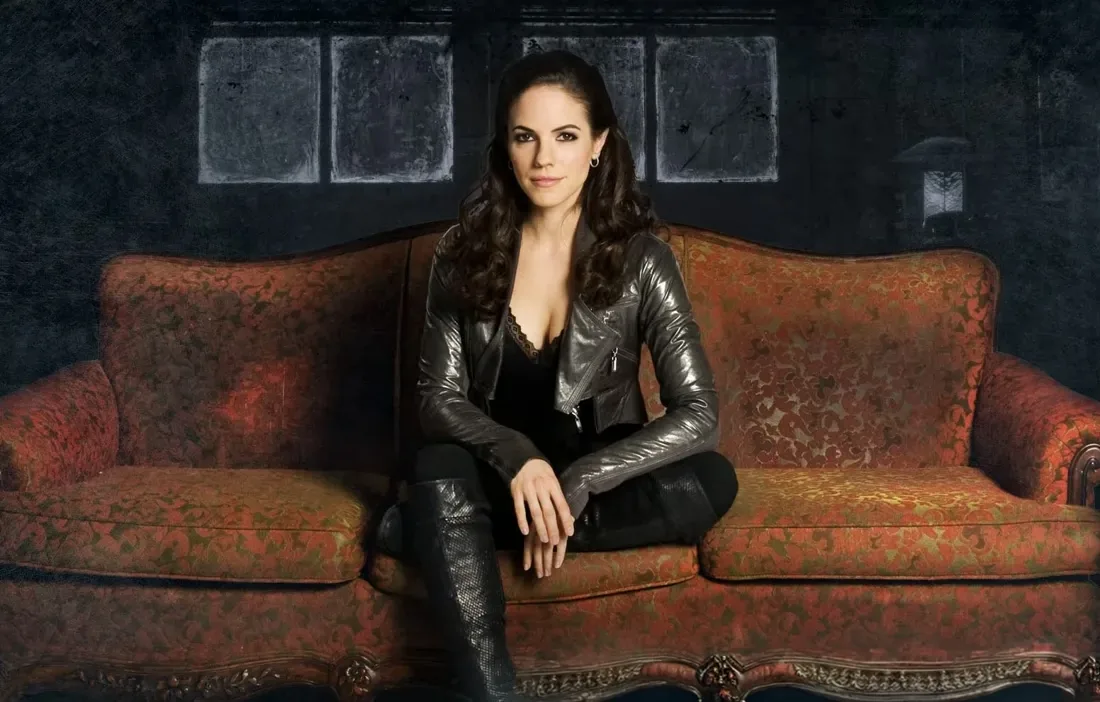
Looking back at these archival tapes from late 2010 is a trip. The digital hiss on the line can’t mask the energy of an actor on the precipice. At the time, Lost Girl had just wrapped its first season on Showcase. It was a plucky Canadian sci-fi series with a wild premise and a cast of relative unknowns. And at its centre was Anna Silk, a Fredericton native navigating the bizarre aftermath of a famous Nicoderm commercial and the sudden responsibility of leading a genre show that would soon cultivate a fiercely loyal global following.
This conversation with Silk, recorded on Nov. 3, 2010, captures that precise moment. She’s thoughtful and grounded, speaking from Los Angeles after a six-month shoot back in Toronto. She’s not yet the icon of Canadian sci-fi she would become. She’s a working actor who made a bold choice in an audition and landed the role of a lifetime.
But before LA and the Fae, there was New Brunswick. We always get a kick out of talent that doesn't hail from the usual Toronto or Vancouver hubs. It adds a different texture. Silk paints a vivid picture of her East Coast upbringing. “I grew up in Fredericton, which is the capital city,” she says. “My mom always said it was like growing up in a park because it's just, you know, trees and a beautiful river in the middle of the city. It was very picturesque and it was a great great place to grow up.”
It’s an idyllic image, but ambition rarely stays put. Her entry into the arts wasn’t a sudden lightning strike but a slow burn, nurtured by her mother’s deep involvement in the local theatre scene. This wasn’t mainstream stuff; it was the kind of formative, interesting work that builds a real foundation. After a typical teenage detour into sports and other things, the acting bug bit hard. The next logical step was Toronto.
Her story there is the classic Canadian actor’s grind. “My first week there, I found an acting school that I really loved and I found a waitressing job, which were both very important,” she recalls. It was a period of bartending waiting tables and trying to crack the code of the industry. Interestingly, her first real break came from another city entirely. While living in Toronto, she found an agent in Montreal and started booking work there, a testament to the cross-province hustle required to build a career in this country.
And then came Deb. Before she was Bo the Succubus, Anna Silk was the face of Nicoderm in a commercial campaign that became a minor cultural phenomenon. She was the woman screaming at people for a cigarette. The role was so memorable, it became her calling card for a while. “That was so much fun,” she says, laughing. “We shot so much material.”
But the real kicker, a detail that reveals so much about branding and public perception, was the mix-up. “I have to say that everybody, and I mean every single person that asked me about the commercial or talks about the commercial always thinks it's for Nicorette. And it was not. It was for Nicoderm,” Silk explains. “So I feel like it was the best money Nicorette never spent.” It’s a perfect, wry observation. She became the face of a product, just not the one people thought.
From there, the television roles started to build. She had a memorable turn on the comedy Billable Hours as a furry, someone sexually excited by animal costumes, and a significant recurring role on the CBC hit Being Erica. Her character, Cassidy, was in a lesbian relationship with the main character’s sister. It was a nuanced and honest portrayal that, in retrospect, feels like a precursor to the themes she would explore so deeply in Lost Girl.
I feel like it was the best money Nicorette never spent. I feel like it sort of got pushed to the wrong product.
The move to Los Angeles seemed like the next logical career step. But it came with a classic Canadian paradox. “When I first got here, Canadian actors seem to find each other down here and everyone said like, ‘Oh, now you'll start doing more work in Canada.’ And I was like, ‘Really?’ And then they were kinda right.” It’s the strange alchemy of the business; sometimes you have to leave home to get hired back home.
Silk also offers a sharp critique of the industry’s underbelly in LA. She speaks of the need to “filter through all the garbage to find good stuff”, referencing a cottage industry built around workshops and classes that prey on aspiring actors. It’s a savvy, clear-eyed assessment from someone who had already paid her dues and wasn’t about to be taken for a ride.
Then Lost Girl came calling. The audition was just another self-tape from LA sent to producers in Toronto. But Silk’s approach was anything but standard. She received the full script, not just audition sides, and saw a character written as a classic femme fatale. She knew instinctively that wasn’t her strength.
“I made a very specific choice to not play her that way,” she says. “I knew that my strength would be more to play her as, you know, really strong and really sexy and really tough, but also really scared because the world that she was going into was so scary and new to her.” This was the choice. This singular decision to infuse Bo with vulnerability is what made the character pop off the page and resonate with the producers. The next day, they wanted a screen test. Soon after, she had the job.
That initial instinct shaped the entire series. Her collaboration with creator Michelle Lovretta was immediate and simpatico, with the character being tailored more to Silk’s personality. The result was an authenticity that bled through the screen. Bo wasn’t just a monster-of-the-week investigator; she was a lost person figuring out her immense, terrifying power. A power that was intrinsically sexual.
“Bo is a sexual creature. I mean, she's, you know, a sex monster, basically,” Silk states plainly. “It's who and what she is.” In 2010, placing a bisexual, sexually voracious succubus at the centre of a primetime show was a bold move. The series never shied away from her sexuality, making it a source of both power and confusion. As an actor, Silk embraced it with a commitment to honesty, figuring out the character’s journey right alongside the audience.
The show quickly developed a passionate fandom, one that famously divided itself into ‘Team Dyson’ and ‘Team Lauren’. Silk mentions hearing about the portmanteau ‘Doccubus’ for the first time, a mashup of ‘Doctor’ and ‘Succubus’ for fans who wanted Bo with Dr. Lauren Lewis. It’s a charming moment, capturing the dawn of a new era of fan engagement that would define genre television for the next decade.
One valid critique of the show’s early days is that, like many genre series of its time, it sometimes struggled to balance its procedural monster-of-the-week format with its overarching mythology and complex character relationships. Yet, the chemistry of the cast, particularly between Silk and Ksenia Solo as her human sidekick Kenzi, always anchored the story in something real and emotionally resonant.
Hearing Silk talk about the show, you sense her genuine surprise and pleasure at its reception. “All of that can maybe indicate that it is going to be special, but you still don't know if it's gonna hit an audience the right way, and I love that it has,” she says. She saw the talent of the writers producers and crew, but the alchemy of a hit is never guaranteed.
The conversation ends on a personal note, with Silk talking about her family’s reaction. Her parents are thrilled. “My mom feels like a local celebrity again in Fredericton,” she shares. “People are always coming up to her and talking about the show.” It’s a wonderfully grounding image: the star of a burgeoning international hit still sending autographed pictures back home for her mom to hand out.
At the time of this interview, a second season was still just a hope. We know now that Lost Girl would run for five seasons, becoming a cornerstone of Canadian genre television and a landmark for LGBTQ+ representation. Listening to this tape, you can hear the foundation being laid. It was in Anna Silk’s intelligent choices her collaborative spirit and her decision to play a monster who was also profoundly human.
519 Magazine Archive: We are thrilled to officially unearth the Rockstar Weekly Digital Vault. This isn't just a re-post; it's a high-fidelity restoration of a pivotal era in music journalism. By pairing original print dates with modern retrospectives, we’re bridging the gap between historical rock-and-roll grit and the lightning-fast performance of today’s web. These stories—once locked in physical print and lost URLs—are now back, fully searchable, and optimized for a new generation of fans.
We are thrilled to officially unearth the 519 Magazine Digital Vault. This isn't just a re-post; it's a high-fidelity restoration of a pivotal era in music journalism. By pairing original print dates with modern retrospectives, we're bridging the gap between historical rock-and-roll grit and the lightning-fast performance of today's web. These stories—once locked in physical print and lost URLs—are now back, fully searchable, and optimized for a new generation of fans.