
The bagpipes are screaming. It is a jarring, glorious sound that has no business working in the middle of a Nashville honky-tonk, but Alli Walker makes it feel like the most natural thing in the world. She struts onto the stage with her cowboy boots kicking up a fine layer of dust, looking every bit the Music City fixture despite her Prince Edward Island roots. This is the "bra country" era, a self-coined sub-genre that is currently rattling the cages of traditional country music.
Walker is not interested in playing the quiet, acoustic wallflower. She has carved out a niche that feels like a collision between a PEI kitchen party and a stadium rock show. With her latest single "Dirt On Us" gaining serious traction on the charts and a social media following that is rapidly closing in on 800,000, she is no longer just a Canadian export. She is a legitimate threat to the status quo.
But the road to Nashville was not just a straight line south. It was a calculated move by an artist who understood that to make it, you have to be willing to reinvent the wheel—or at least put some heavy-duty tires on it. Her recent success with "Dirt On Us" is the result of a long-game strategy that began when she first signed her publishing deal.
"This one was one of the first I ever wrote when I was newly signed to a publishing deal here in Nashville at Sony Music Publishing," Walker says about the hit. The track is a masterclass in taking a tired country trope—dirt—and flipping the script. Most country songs use dirt as a badge of honour for a truck or a farm, but Walker uses it as a metaphor for the secrets of a relationship that the rest of the world is trying to pry into.
The song was born from a moment of pure creative friction in a Nashville writing room. "We came up with that on the spot. There’re other concepts of 'dirt on us,' especially in the country world, but there was no concept where it was like small town rumors thinking they know what's up with your relationship, but really it's only the stars and the moon and the truck bed and the boots that know and have the real dirt on us," she explains.
And that is where Walker wins. She understands the small-town psyche. She knows that in places like PEI, everyone thinks they have the inside scoop on your life. By shifting the "dirt" from gossip to the physical elements of a night out, she creates a sense of intimacy that feels earned rather than manufactured.
Her songwriting fuel is often surprisingly domestic. While some artists claim to find inspiration in the high-brow literature of the past, Walker is refreshingly honest about her love for the chaotic energy of reality television. It is a relatable admission that strips away the pretension often found in the Nashville elite.
"After a long day of writing songs or work or shows, I love watching trash TV. So, The Bachelorette, Love Island, Love is Blind. I love all of those silly shows," Walker says. It was this specific habit that led to the creation of her track "Creek," a song that feels like a bridge between her rural upbringing and the glossy world of modern dating.
The specific spark for "Creek" came from a contestant on Love Island named Rob. He was the quintessential country boy dropped into a world of neon lights and fast-moving city girls. Walker saw the narrative potential in that clash of cultures immediately.
"My husband and I were watching Love Island one day, and a guy on a previous season called, his name is Rob. He actually said this to a girl. He was, like, a very country guy, and he was talking to a girl that was really city, and he was like, 'I'd love to get you in the creek.' Meaning, like, make her more country and show him what he's all about," she recounts.
This ability to translate "trash TV" into a country anthem is part of why she calls her music "bra country." It is a direct, tongue-in-cheek response to the "bro country" movement that has dominated the airwaves for the last decade. If the boys can sing about trucks and beer from their perspective, Walker is going to do it from hers, with twice the charisma.
"I am very much like a girl version of bro country. I call my music bra country, so I love all my Morgan and the Hardy and Luke Bryan, Luke Combs," she says. It is a smart piece of branding. It tells the listener exactly what to expect: high-energy, loud, unapologetic music that does not apologize for its pop-rock sensibilities.
But branding only gets you so far. You need the viral moments to back it up. Walker found hers at a Nashville Predators game, an environment where the intersection of sports and music is a high-stakes game of attention. She was playing the arena during the intermissions, a gig that is often a thankless task of providing background noise for people buying overpriced hot dogs.
"I was playing at the arena, like, during the periods, so, like, the cameras that you would watch at home, you wouldn't see me. It's just for the arena. And I was like, I mentioned catfish in Creek. The second line of the chorus is 'catch you like a catfish.' So, we're like, maybe we can do something for social media for me with the catfish," Walker says.
What happened next was a lesson in the power of the "right place, right time" philosophy of modern marketing. She ended up drinking a beer through a catfish, a tradition that is as disgusting as it is legendary in Nashville hockey circles. She expected a small social media clip. She got a national television moment.
"I didn't realize that they were actually going to get, like, the full, you know, ESPN TSN four snack crew in to take this video. But they, like, cut from commercial early, watched me drink this beer, and then it went viral immediately," she says. It was the kind of authenticity that cannot be faked. It showed a side of Walker that was willing to get messy for the sake of the bit, and the internet loved her for it.
That same lack of pretension carries over into her obsession with trucks. In the country world, trucks are a cliché, but for Walker, they are a piece of her heritage. She is not posing in front of a rented vehicle for a music video; she is a "truck girl" through and through.
"I love big trucks. I've always been a truck girl. Like, my dream. I've never had a dream car, like a Porsche or something. I always just wanted a ram truck because my dad loved rams growing up," she says. This genuine affection led to "I Like Big Trucks," a song that takes the DNA of Sir Mix-a-Lot and injects it with a heavy dose of diesel.
You could post one thing one day and it just pops off and your whole world can change and you can see the streams go up and you get a whole new fan base, which is really cool.
The song is a gamble. Sampling or interpolating a massive hip-hop hit in a country song can often feel desperate. But Walker made sure she did it the right way, securing the necessary permissions to ensure the track had the legs it needed to run.
"We wrote it, and that's been really fun to post online and see the reaction. And we actually got Sir Mix-a-Lot's blessing, and he's technically a songwriter on 'I Like Big Trucks,'" she reveals. It is a technical win that shows her team knows how to navigate the complex legalities of modern music publishing.
Walker’s work ethic is equally disciplined. She does not wait for the muse to strike; she hunts it down with a schedule that would make most corporate executives blush. She treats songwriting like a job, because in the competitive landscape of Nashville, that is exactly what it is.
"I'm writing three to five songs a week, and it's always between the hours of 11:00 a.m. and four," she says. It is a rigid structure that allows for maximum output, ensuring that she always has a surplus of material to choose from when it comes time to record.
And yet, within that structure, there is room for the chaotic spark of a new idea. She is constantly documenting her life, turning every fleeting thought or melody into a digital asset that can be mined for later use.
"I always have titles or concepts in my phone, in the notes, and then I also have, like, voice notes of maybe melodies that I've come up with," she says. This combination of a blue-collar work ethic and a creative's intuition is what makes her so prolific.
Her sound is a reflection of this "more is more" philosophy. She describes her musical identity as a "mod podge," a term that perfectly captures the frantic energy of her influences. She is just as likely to cite a pop-punk icon as she is a country legend.
"I think I am a mod podge of absolutely everything," Walker says, pointing to a list that includes Avril Lavigne, Sum 41, Taylor Swift and Brooks & Dunn. It is a chaotic mix, but in the era of genre-fluid playlists, it is exactly what the audience wants.
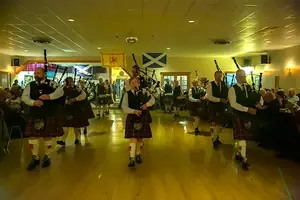
But the real secret weapon in her arsenal is the bagpipes. It is the one element of her sound that no one else in Nashville can replicate. It is a nod to her Celtic heritage that adds a layer of grit and history to her modern country sound.
"I played bagpipes as well. So, I had the Celtic side of things. So, you know, I step dance and highland dance and snare drum and bagpipes," she says. This is not just a gimmick; it is a specialized skill set that she has spent years perfecting. When she brings the bagpipes out on stage, it changes the entire energy of the room.
Since signing with a label in Nashville, her process has expanded. She is no longer just a girl with a guitar and a dream; she is part of a collaborative machine that is designed to elevate her ideas to the highest possible level.
"I wouldn't say it changed. I would say I am just working with different people, so I'm open to a lot more things," she says about her evolution. Nashville is a town built on the co-write, and Walker has embraced that culture with open arms.
"Anyone can write a song on their own, but when you're collaborating with incredible writers, bringing the idea in and knowing who you are helps so much where they can really curate exactly what you want and help bring it to the next level, which is fun," she explains. It is an admission of the power of the collective, a rare bit of humility in an industry often driven by ego.
Her songwriting has also become more pragmatic. She is no longer just writing for herself; she is writing for the person in the back of the bar who has never heard of her. She understands that a live show is a battle for attention, and she is coming armed with high-energy anthems.
"I'm performing so much these days that I have transitioned my songwriting into what works live for me," Walker says. It is a shift from the introspective to the performative, a necessary move for any artist looking to move from the bars to the stadiums.
"It's hard to play all of those ballads, you know, if you're playing at a bar, opening up for an artist, and no one gives a crap who you are. You have to win those people over, and it's hard to win them over if you're just playing a bunch of acoustic ballads. So, I am writing towards, you know, rocking out on stage and having fun," she adds.
But she has not completely abandoned her more "mindful" roots. She views her discography as a timeline of her life, with each project representing a different emotional state. While she is currently in her "rock out" phase, the more conscious side of her writing is still very much alive.
"Every album is almost like a phase of my life," she says. It is a way of compartmentalizing her growth as an artist and a human being, ensuring that she never feels stuck in one particular sound or persona.
"I am writing songs like that all the time still. I just haven't curated a whole album based around it like I did previously. But songwriting in general, it's all about getting your feelings out. So, I'm always writing what's going on," she says. This emotional honesty is the tether that keeps her grounded, even as her career reaches new levels of visibility.
And a huge part of that visibility is due to TikTok. While some artists look down on the platform as a distraction, Walker recognized it as the ultimate tool for connection during a time when the world was shut down.
"During COVID I mean, the only way you could connect with fans was on social media, and that's when TikTok really hit," she says. She is a digital native who understands the nuance of the platform, specifically the way it prioritizes audio over everything else.
"The cool thing about TikTok is people go on there and they listen with sound. I find Instagram or Facebook, people are just scrolling, and they might watch for a second, but there's. They might be at work or on a break, and they can't have sound, but people definitely go on TikTok and listen to sound," she explains. It is a technical observation that has massive implications for how she releases music.
The volatility of the platform is something she finds exciting rather than terrifying. She knows that one 15-second clip can do more for a career than a six-month radio tour used to.
"You could post one thing one day and it just pops off and your whole world can change and you can see the streams go up and you get all a whole new fan base, which is really cool," she says. It is the new "American Dream"—going viral and watching the numbers climb in real-time.
One of those viral moments was "Whiskey's Gone," a track that leaned heavily into her bagpipe-playing roots. It was a risk that paid off, proving that there is an audience for the weird and the wonderful in the country world.
"I played bagpipes in that song and I was like, I don't know what people are going to think of this, putting bagpipes in country music, but people liked it, apparently, which was fun," she says. It was a validation of her unique identity, a sign that she didn't need to blend in to move forward.
Her upbringing in PEI is the foundation of that identity. The island's rich Celtic history gave her the tools she needed to stand out in a town full of people trying to sound like everyone else.
"Because I grew up playing bagpipes and loving Celtic music. That allowed me to write the 'Whiskey's Gone,' which was one of my most viral songs," she says. But the island also gave her something else: the desire to leave.
"I always knew I wanted to live in a bigger city or, like, you know, move away and kind of just have more opportunities than I can get on the island... Being from somewhere so small, it actually did push me to do this and have the fearlessness to move away and do it," she explains. It is a common sentiment among small-town artists who have to go elsewhere to find their voice.
But being a modern artist means the work never stops. The pressure to maintain a digital presence is a constant weight, one that can lead to a specific kind of modern guilt when the content stream runs dry for a few days.
"It's a lot sometimes where it'll be a few days where I haven't posted and I feel guilty because I'm like, oh, my God, I haven't posted anything," she admits. It is a rare moment of vulnerability that highlights the exhausting nature of the 24/7 content cycle.
Yet, she knows it is the price of admission. In a world where the gatekeepers are disappearing, the direct line to the fan is the most valuable asset an artist has.
"To me, social media is just as important as anything, as a tool for marketing, but also just as a tool for connecting with people and creating, like, a true fan base," she says.
Alli Walker is a hybrid. She is a bagpipe-playing, truck-loving, reality-TV-watching, Nashville-signed powerhouse who is rewriting the rules of what a country artist from PEI can be. And she is just getting started. If you want to see the future of "bra country" in person, keep an eye on alliwalker.com for her next move.