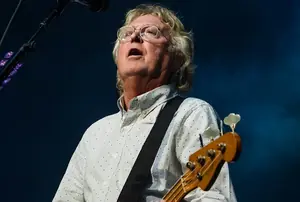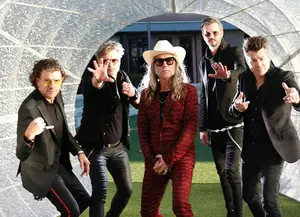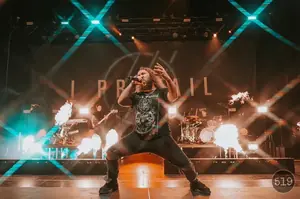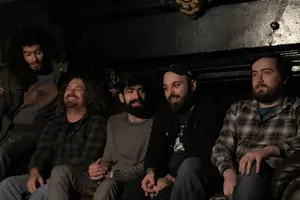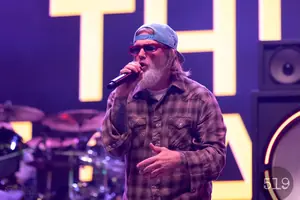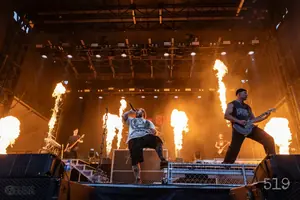

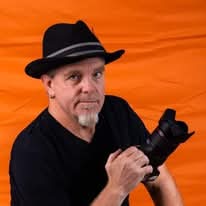
The air inside London Music Hall usually smells like spilled draught and anticipation, but on a Sunday night in May, there is a specific kind of electricity that only follows a band like Badflower. They are the sort of act that feels like they might combust before the encore. Josh Katz, the band’s neurotic, brilliant and hyper-fixated frontman, does not just lead a rock group; he manages a delicate ecosystem of anxiety and high-output creativity.
Watching Katz pace the stage during soundcheck, you see a man who is clearly haunted by his own high standards. This is not the Sunset Strip posturing of the 1980s. It is something much more modern and much more frayed. Badflower spent a decade grinding through the circuit, playing the Key Club and The Troubadour before John Varvatos flew them to New York in early 2016 and signed them on the spot. Since then, they have racked up two number one singles and a gold record for "Ghost," a song so raw it practically bleeds through the speakers.
But the momentum of a debut like *Ok, I’m Sick* creates a terrifying shadow. Now, they are touring behind *This is How The World Ends*, an album that trades some of the debut’s visceral angst for a broader, more cynical look at a crumbling society. I caught up with Katz before the May 8 show to talk about the chaos of the road and the peculiar way he keeps his demons at bay.
The band is currently deep in the trenches of a Canadian run. When I ask about the energy they’ve been receiving south of the border, Katz admits the momentum caught them off guard.
"For the US part of this they started small and we weren't sure what the tour was going to be like, but by the end of it, it's just been chaos. We're playing a mixture of cities that for the most part we haven't played before so that was kind of like the name of the game with this tour, hit a bunch of spots that we've never had, and we weren't entirely sure how it was going to turn out and it's been really great," says Katz.
And that uncertainty is amplified when they cross the border. For a band with their level of radio play in the States, their footprint in Canada is surprisingly light. It is a strange gap in an otherwise rapid ascent.
"We played one day, one show in Toronto with Shinedown, that's it," he notes, sounding almost surprised by the brevity of their northern history.
So, what does a Badflower show look like for a crowd that has mostly only known them through a Spotify algorithm? Katz is honest about the fact that even he does not know the answer. There is a volatile quality to their performance that defies a standard rehearsed set.
"I mean, we're definitely playing some Badflower songs, a handful those. Honestly I don't know. We have our set. It's going to be the same that we've been doing over here but because it's in a brand new territory and we have no idea what to expect from the audience I think I would say the same about us. I don't think anyone including ourselves knows what to expect from us for these shows," Katz says.
The pressure of the "sophomore jinx" is a cliché for a reason. Most bands stumble when they have to follow up a massive debut, especially when that debut is anchored by a hit as culturally resonant as "Ghost." But Badflower’s second effort arrived in a world that had fundamentally broken since their first outing.
"It concerns me, but here's the thing though. It's so hard to tell because the pandemic happened and everything changed and the way that people consume art changed, right? It feels like the first album being released on this new planet that we're all living in or something like that. That's kind of how it feels. It's hard to gauge but the shows are going great and people are loving the new songs and the only way that we can gauge it is audience reactions when we play the songs live and they've been amazing," Katz explains.
Katz is not a songwriter who hides behind metaphors. He is direct, often uncomfortably so. While his peers are writing vague anthems about "the road," Katz is dissecting social issues and personal failures. But he insists this is not a calculated choice to be the "serious" rock band. It is just a byproduct of his environment.
"Oh, yeah, I mean, yes to the second part of that but in real life if I fall in love, and that's what's going on in my life, probably only going to write love songs. I don't really choose to write specific topics that are more hard hitting than others, it's just whatever it feels like that's around me, and during the pandemic, aside from just the fact that we are all living this brand new life where we're stuck at home, we're all on the internet and social issues are being shot at us. It's all we're dealing with, what we're seeing, we're scrolling through stuff so there's a lot of that on this album for that reason. It's not because it's something that I'm necessarily passionate about, it's just because this is what I'm observing from the world," he says.
The album title, *This is How The World Ends*, suggests a grand, apocalyptic concept. But in typical Katz fashion, the reality is much more incidental. It is a title born of a single moment rather than a manifesto.
"No, not at all. This is How the World Ends is a lyric from a song that actually doesn't really apply to any of that stuff. It just felt like a really fitting title considering the times and everything else happening. I wish there was like a super deep meaning and reason behind it, it was just a lyric. The lyric means a lot to the song but it doesn't as an album title, but it feels right for this album," Katz admits.
One of the standouts on the new record is "Don't Hate Me." The video is a jarring, stylized piece of work, and the song itself features a breakdown that feels entirely foreign to the band’s established sound. It is a song about the desperation of people-pleasing, taken to a pathological level.
"It's kind of the opposite. It's not meant to be inspiring, like, be yourself. It’s that concept I think most people have experienced where if you want someone to like you, whether a romantic sense or non romantic sense, doesn't matter, when you want someone to like you, a lot of people tend to change and shift their personalities slightly to suit more what they think that person might like and some people do that in a more extreme way. That song is kind of just a reflection of that behavior in the most extreme version," Katz explains.
And the musical shift in that track was not an accident. It was a meta-commentary on the theme of the song itself.
"We thought it was a fun concept to literally change the sound of our band, like that bridge section when it breaks down, we don't typically sound like that or do things like that. But then writing this whole rant bit over it, explaining that the singer, myself as the character in the song, is changing everything including the sound of the band to make this person like them. We just loved that concept so that's what that is," he says.
This level of self-awareness is what makes Badflower fascinating, but it is also what makes performing a minefield for Katz. He has been remarkably transparent about his struggles with mental health. For him, the stage was not always a sanctuary; for a long time, it was a trigger.
"It used to, right before Ghost came out from our first album. That's what I'm sick was about, was performing and the band was starting to do well and the crowds were getting bigger and we're getting all these opportunities and every dream that I had as a kid was coming true and yet I hated playing shows. I felt like I was suffering on stage and I felt like I didn't deserve it so really the whole thing was really strange and scary for me because I didn't understand being so miserable having everything that I always wanted and I didn't know what to do from there. What do I do now? There's nothing else like this. All of my eggs have been in this basket since I was a kid. What do I do? I it was terrible I mean, I started getting panic attacks again after my teens because of performing. So it only happened on stage and I'd have to medicate myself before getting on stage and I did that for years, up until the last like year and a half? And for no reason at all I'm good now. I'll probably be bad again and I don't know when, but for right now, it's great," Katz says.
Despite the internal friction, the payoff of seeing these songs land with an audience is what keeps the engine running. There is a specific alchemy that happens when a private, lonely thought is amplified through a PA system.
Every dream that I had as a kid was coming true and yet I hated playing shows. I felt like I was suffering on stage and I felt like I didn't deserve it... I didn't understand being so miserable having everything that I always wanted.
"There's so many. I mean, because we're on tour now, I'm going to say playing the shows. Sometimes I think about where I was when a certain song was being written or conceptualized and it's just in a room somewhere super lonely by myself, giddy excited about some lyric or some idea. And then to be on stage in front of 1000 people who are screaming that idea back at you, it's pretty wild. It becomes normalized pretty quick because every night it happens and you're like, Okay, this is just what I do. But the first couple times that happens, it's crazy," he admits.
But the most surprising thing about Josh Katz is not his lyrics; it is his DMX programming. He has found a way to weaponize his workaholism to keep his anxiety at bay. He does not just sing; he is the band’s lighting designer, a job usually reserved for a touring professional with a dedicated console.
"Yeah, well, that's one of those things I believe has curbed my anxiety which is weird, but when I add pressure to my life, creative pressure, typically not like, oh, I have to write all these but when I have to do something creative or else something doesn't work, my mind is busy on that thing and I'm constantly stimulated by it. I also just really enjoy doing so many things other than just performing and writing. And so I get to do all of that and I am a workaholic and I do take on way too much stuff but it kind of keeps me sane so I'm going to keep doing it as long as I can," Katz says.
His pre-show ritual is not about whiskey and vocal warm-ups. It is about fixtures and visualizers.
"I do all of our stage lighting. I pre program all of our lighting and I built our fixtures and so when I get to a venue, the first thing I do is I set up and I start working on the venue's lights. Then I have like a 10 minute sound check and then I go right back to the lights, and then we do our VIP meet and greet and then I'm backstage on the laptop with a visualizer finishing the show, and right before I go on stage, I hand off the laptop and then I play the show," he explains.
This frantic pace is a survival mechanism. If Katz has five minutes of downtime, the intrusive thoughts start to win. By making himself indispensable to the technical production, he forces his brain to stay in the present.
"There's really no moment for me to just sit around and think about whether or not I'm going to have a panic attack on stage. I used to have so much time to just sit and my mind would start racing and I start getting nervous. And now because I'm so busy, and if I don't complete this, there might be a moment in the show where our band is playing in pitch black and that's a problem, so it's important, I have to complete this job. As much as it drives my label and management team crazy because I'm so busy, they're like, we just want you to do an interview or do one thing. I'm like, I can't guys, I can't, but it keeps me sane and I love it," he says.
It is a DIY ethos that has scaled with the band’s success. What started with hardware store hacks has evolved into a sophisticated automated show.
"Yeah, it was just fun. I started small, like a lot of other bands who before they can afford an LD, you get floodlights from Home Depot, just basic, and you figure out how to sync it up. It started from stuff like that and then it just progressed and now we'll you know, we'll do massive theaters or whatever and all the lights are automated to my show that I programmed earlier in the day," says Katz.
That same impatience and need for control defined their early label experiences. Before landing at Big Machine, the band was caught in the gears of the major label machine, waiting for legal clearances that felt like they were taking a lifetime.
"That was before Big Machine and we were on an indie label. We've been on a few labels. We were on an indie label and Republic was going to sign us and that took forever, the legal process took months and so yeah, we were just working on our EP in the background. By the time we actually signed and were done, they came to us to have the conversation about where we wanted to record what we wanted to talk about, we just turned it in," Katz recalls.
Now, under the Big Machine banner—a label historically known for country giants like Taylor Swift—Badflower has found an unlikely sanctuary.
"I have experience now, we've been on a few labels and they give us the most creative control of any label that we've certainly ever been on," Katz says.
The band was a bit of an anomaly on the roster initially, acting as the vanguard for a new rock direction for the label.
"I think they had Cheap Trick before us, but I think we were one of the first new up and coming rock bands. Now they've signed a few and their roster’s filling up. It's getting cool," he notes.
And then there is "Promise Me," a track that has become a tear-jerker for fans of all ages. It is a song about the terror of aging, but not just the physical decay. It is about the emotional jadedness that comes with survival. When I ask if he is afraid of growing old, Katz does not hesitate.
"Yeah, yes I am," he says.
But he digs deeper into what that fear actually entails. It is the fear of losing the ability to feel things deeply.
"I kind of have that fear too, I understand that, but I have both. The overall concept is just that, it's just my fear of getting older. But it's not just fear of getting older. It's like fear of food not tasting as good, things that used to be really fun not feeling as fun anymore because you've done it a million times; breakups not hurting as bad. We start to take things for granted. I especially noticed that because I'm living such a dream life and so many of these amazing experiences that I have don't feel as amazing as I would like them to because I'm getting used to them and I'm just older and I'm jaded. And so that song is about trying not to be and yeah, I think with a little love story wrapped around it as a neat little bow," Katz explains.
The video for the track features children playing out a lifelong romance, a sweet contrast to the song’s heavy existential dread.
"Thanks. It was a blast to make that," Katz says.
To combat the jadedness of the industry, Katz has retreated to a farm near Nashville. It is a move toward seclusion and animal rescue, fueled by a transition to veganism that he shares with many in the creative community.
"Yeah, I want to rescue animals. Since I've become vegan that’s something that I've wanted to do. So yeah, having the land was just the first step. I also like just being alone and secluded and I don't like people very much. I grew up in LA so I needed the opposite of that, and now I have it and I love it," he says.
He thinks there is a link between the sensitivity required to write music and the empathy required to go plant-based.
"I don't know why a bunch of artsy types gravitate towards it. I think probably because we're extra sensitive. Musicians are like super tapped into their emotions, and maybe that helps them tap into the emotions of others, including animals because animals do have emotions let's not forget," Katz posits.
For Katz, the change was not a fad; it was a matter of integrity.
"So I had watched a bunch of documentaries and at some point I watched one by accident or somebody recommended it to me and it stung a little bit in my soul to know what I was doing but I continued eating meat. And then I watched another and another and then I was hooked on watching them and learning everything that I could. It got to a point where I was lying to myself if I continued to eat and live the way that I was. I was being dishonest with what I actually believed because something changed. I haven't touched it ever since it's been well, I don't know how many years a lot of years," he says.
Despite his self-proclaimed dislike of people, Katz has managed to forge some high-profile connections. One of the band’s most vocal supporters is *The Big Bang Theory* star Johnny Galecki.
"It just kind of happened randomly through mutual friends. He showed up to a show at the Viper Room, which apparently is closing down so R.I.P. the Viper Room. He showed up to a show and he was a fan of the music, I guess. Like really early on, like back Temper days, before Ok, I'm sick came out and we hung out. At this point he's like my brother, we're family," Katz says.
And Galecki is not just a fan standing in the wings. He occasionally joins the fray.
"He does yeah. He's come up on stage a handful of times," Katz notes.
We touch on "Heroin," a track that stands out in the Badflower discography for being one of the few songs that employs a heavy metaphor rather than the usual blunt-force trauma of Katz’s lyrics.
"That's the one song that has a grand metaphor in it that isn't straight up direct. Yeah, it's just about addiction in general and I kind of like the juxtaposition between the drug and the relationship with this girl because it kind of feels like the same thing. You can say the same lyrics and describe both like that," he explains.
As for the future, the road is currently too consuming for new art. Katz cannot write while he is worrying about lighting cues and soundchecks.
"I do not write on tour, although it's something we've discussed a lot as a band. Like, maybe I should spend less time doing lighting and instead of putting all of my effort there, we should set up some kind of mobile recording thing. So we're talking, we're talking about it. It might be something that we try to do because we're going to be touring so much in the next year," Katz says.
His writing process requires a total departure from reality—a luxury the tour bus does not afford.
"Yeah, that’s what it is and the thing is, the reason I don't think I could tour and write is because my sleep schedule when I'm writing is all over the place. I don't have anything else to do. I don't have anything else to wake up on time for. This is all I have to do. It's like I'm living on another planet when I'm writing. Even if the time is there, I'm the type of writer that if there's a day I wake up and I'm just not feeling it, I'll just stop, I won't force it," he says.
Katz has no interest in the "nine to five" approach to creativity. He is a creature of impulse.
"I know some artists who have windows of time where they're like, Yeah, I wake up and I have various scheduled and at 3pm I start my session and I write from this time to that time and whatever and here's our record, like all under this perfectly crafted little schedule. I'm like, You're out of your mind, I could never do that," he laughs.
But even the most impulsive artists need a nudge. Big Machine provides the necessary friction to get the work across the finish line.
"Basically yeah, but they also light the fire under my ass when I need it. And I complain a whole bunch, but I do need it. They’re like, all right. deadlines coming up and I'm like, What do you mean the deadlines coming up? I need that deadline. If I don't have a deadline I’ll never turn anything in. That's just the way it is," Katz admits.
Badflower brings their beautiful, chaotic mess to London Music Hall on Sunday, May 8. It is a Mother’s Day show that promises to be anything but traditional. If you want to see what happens when a man tries to outrun his own brain with a guitar and a lighting rig, this is the one.