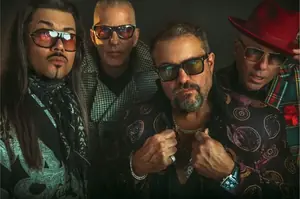

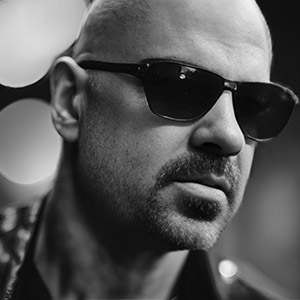
Sitting across from Alex Grossi in a dimly lit corner of a Vegas lounge, you do not see a man resting on his laurels. Grossi has been the six-string engine for Quiet Riot since 2004, a tenure that requires a certain level of psychological fortitude. But today, the conversation is not just about the heavy metal institution. We are talking about Hookers & Blow, the long-running Sunset Strip cover band that has finally, after nearly two decades of debauchery, decided to commit their chaos to tape.
The debut self-titled album from Hookers & Blow (H&B) is a gritty love letter to the records that built the L.A. scene. It is a collection that spans the Stones, Bowie and Zeppelin. It sounds like a party that started in 1984 and forgot to end. For Grossi, the timing was about finding the right partners to handle the mess.
"Well, we decided in 2018 that after we did a tour with The Dead Daisies, and Dizzy Reed’s solo record through Golden Robot, we should give it a shot. They offered us a deal and complete creative control. It took a couple years, but we did it, we’re proud of it. It was the right time, because we finally found the right combination of people. And there’s been a lot of buzz about the band," Grossi says.
There is a cynical school of thought that suggests cover albums are the last refuge of the creatively bankrupt. Grossi pushes back against that with the weight of a guy who has spent thousands of hours in the trenches of the Starwood and the Whisky. This isn't a "best of" filler. It is a curated vibe.
"We promised ourselves we’d never become an original band and put out records. But if you could cover records, you get a pass on it. It was a lot of fun to make, we put a lot of time and a lot of our own money into it. And it sounds phenomenal. So it’s not just a quick cash grab. It’s actually, art for the sake of being art, believe it or not," he says.
The logistics of the record reflect the modern nomadism of the rock industry. The tracks were not birthed in a single, expensive month at Record Plant. Instead, they were stitched together in the shadows of Nevada and the sprawl of California. Grossi’s guitar work oscillates between the precision required for Quiet Riot and the loose, cigarette-stained swagger of H&B.
"It was done in chunks because we did some out here in Las Vegas at The Basement. Drums and guitars were done here. The vocals and keyboards were done in LA, guitars were done back and forth," Grossi explains.
The process was interrupted by the global shutdown, forcing a band built on proximity and shared sweat to embrace the digital ether. It is a testament to their chemistry that the record does not sound like a series of isolated files sent through a server.
"Sometimes I would be in L.A. and then when the pandemic hit, we all had to definitely go virtual, because the studios were closing down. So it was all different kinds of processes, three or four different studios. Thankfully, technology nowadays enables you to do that," Grossi says.
When you look at the tracklist, it is a schizophrenic mix of high-gloss pop and street-level aggression. Picking Eddie Money alongside Body Count is a bold move. It suggests a band that does not care about genre purity, only about whether the song hits hard in a crowded room.
"The Eddie Money song. There was definitely a push for Eddie Money and Body Count songs. Those I thought were really cool together. I wanted to do Godzilla for sure, because we played it live a few times, and it sounded great," Grossi says.
The studio sessions for H&B were evidently more about instinct than over-rehearsal. There is a raw, first-take energy on the Body Count cover that provides the album with its most dangerous edge.
"It’s really a group effort. Everyone had their say and we just made a list and tried a couple in the studio. Some of them we literally learned in the studio, like the Body Count song, we’d never played live. Johnny never even heard it before and we did it on the spot. Each song had a different process," he says.
If you want the thesis statement for Hookers & Blow, you look to the Rolling Stones. "Rocks Off" is the track that defines the mission. It is messy, arrogant and infectious. Dizzy Reed, whose keyboard work remains the gold standard for this brand of rock, was the one who steered them toward the *Exile on Main St.* classic.
"I would say 'Rocks Off' encompasses everything what the band’s about, because it’s got, both lyrically and just a vibe you know. That was Dizzy’s pick and I never even heard the song before. But once when I heard the way we did it, the way it came out, I thought it really is what should be the first single video because it captures the vibe of the band perfectly," Grossi says.
But the album carries a heavy emotional weight that its title might not suggest. The inclusion of Led Zeppelin’s "No Quarter" serves as a haunting farewell to Frankie Banali. The legendary drummer, who passed away on Aug. 20 after a brutal battle with cancer, recorded his parts while facing his own mortality.
I miss Kevin and Frankie every day. ... I was really fortunate to have that education by working closely with those guys, who really did it. Not guys who have one hit in the 90s. I’m talking guys who sold 10 million records. ... I’m glad that I did.
"’Time Of The Season’ is a tough song to cover. But for me personally, ‘No Quarter’ was definitely because we did those separately with Frankie Banali, rest in peace Frankie, on drums. And that process was different because he was in L.A. recording the drums. I did the guitars out here. We never got to play it together, but we played it together in Quiet Riot for so long, it was like second nature, but it was definitely different recording and not having him there with me. He did those songs in one or two takes that are amazing. You’d never know what kind of condition he was in health wise," Grossi says.
The record has inadvertently become a graveyard of rock royalty. Between the time the tracks were selected and the final master was cut, the industry lost several of the giants being honoured.
"No, we picked the songs before Eddie Money died, obviously before Frankie died, before Tom Petty died. We had no idea. Eddie Money knew we were recording the song. I called and texted him for permission. He thought it was great. And then by the time it was done, he was gone. It was really sad," Grossi notes.
The "No Quarter" track remains the standout for anyone with an ear for percussion. Banali’s approach to the Zeppelin classic is a clinic in power and restraint. He wasn't just playing drums; he was fighting for every beat.
"’No Quarter’ gives me chills. It really does. He saw that we were recording and he said, let me know when you want me to go in and we scheduled his chemo treatments where he would be strong enough to play and he went in and banged it out one day," Grossi says.
The void left by Banali is one that cannot be filled by a mere replacement. Quiet Riot was his life’s work, his baby. For Grossi and the rest of the camp, continuing the band is not about the cheque; it is about the legacy.
"No, none of us are. It is cathartic that we’re moving on doing exactly what he wanted, and being successful at it. It’s like he’s still here with us, because we’re keeping his baby going for him," Grossi says.
Grossi’s history with the band goes back even further, to the era of Kevin DuBrow. He is the bridge between the classic metal years and the modern survivalist era. He came into the fold when he was just 25, a kid joining a circus of giants.
"I miss Kevin and Frankie every day. I met Kevin when I was 25, and he brought me into the circle. At first I was his guitar player for his solo project he was doing, when there was no Quiet Riot, and then when they reformed, Kevin and Frankie asked me to be the guitarist," he recalls.
Working with DuBrow and Banali provided a masterclass in the realities of the music business. These were men who had seen the top of the mountain and the bottom of the canyon.
"I miss those guys all the time. I mean, they were hilarious to be around. I was really fortunate to have that education by working closely with those guys, who really did it. Not guys who have one hit in the 90s. I’m talking guys who sold 10 million records. There’s not too many of those guys out there, and if you can work closely with them, and pay attention, you can learn a lot, and I’m glad that I did," Grossi says.
The future of Quiet Riot is surprisingly active. There is new music on the horizon, including a track titled "Rock In Peace" that features the return of bassist Rudy Sarzo.
"Yeah, we’re working on it right now. We just released a song that was debuted on Six Degrees of Sarzo, Rudy Sarzo’s podcast. And he actually played bass on it. It’s called ‘Rock In Peace’. It was on his podcast, and then we’re working on a full length as well," Grossi reveals.
Perhaps most importantly for the fans, Banali’s presence will still be felt on future releases. The drummer was a workhorse, leaving behind a vault of material that the band is now carefully curating.
"Yes, Frankie left behind about two albums worth of drum tracks at least. So he will still be on the albums," Grossi says.
Recording without Frankie’s direct feedback is a surreal experience for Grossi. Banali was known for his sharp ear for arrangements, often acting as the de facto musical director of the group.
"A lot of it was already started when he passed. We were already working on stuff. It is a little strange to not have his feedback, but he was such a musical drummer. And he had such a good instinct when it came to arrangements, which a lot of people don’t realize. He left the blueprints very easy for us. But yeah, you miss them because you don’t have that feedback. You’re just playing to what’s there, but fortunately, I’ve been in the band almost 18 years now. I know how he plays pretty well and it’s nice to hear him even if it’s just through speakers," he says.
Back to the H&B record, the guest list reads like a who’s who of the L.A. underground. The Okai Sisters bring a frantic, Japanese energy to the Blue Öyster Cult cover that elevates it beyond a standard remake.
"They’re Hookers & Blow alumni. Shows that I couldn’t do, they would go out and kill it for me, I believe it was Tsuzumi the bass player for Limp Bizkit and just their family. They’re close friends of ours, and they’re great players. And we always did Godzilla live with them. They would scream in Japanese and break down and they nailed it. And I’m like, you got to put Godzilla on there. I just played rhythm on it, it’s all them, they crushed it. They did great and they’re phenomenal players, they’re friends. Everyone on this record is family," Grossi says.
The album also features contributions from Alistair James and Scott Griffin of L.A. Guns, but the most chaotic addition came during a session at Danny "The Count" Koker’s studio. The Beastie Boys cover "Fight For Your Right" required a specific kind of vocal energy—the kind you only find in a Vegas parking lot.
"Yeah, we had a producer Alistair James plays guitar on a couple tracks. Scott Griffin played on a tracker or two, from L.A. Guns. I think the most interesting guest we have is in the chorus of ‘You Gotta Fight for Your Right To Party’, we have the entire cast of Counting Cars singing the chorus with Danny ‘The Count’ and all those guys," Grossi says.
The mental image of the *Counting Cars* crew being wrangled into a vocal booth is pure H&B. It is the kind of spontaneous, booze-fuelled decision that makes the record feel alive.
"We recorded too at his studio, and we were laying down the lead vocals, and I’m like, we need a gang we need like five drunk dudes. I looked at the parking lot and I see Danny. I go, Hey, Danny come here, we got them all in there. We mic’d them up. It was like eight of them. We recorded four tracks and eight of those guys screaming. And that’s what you hear. That was definitely Danny ‘The Count’ Koker and company. We also had as special guest and Stoney Curtis is the guitar player as well. Yeah, that was a fun night," Grossi recalls.
Despite the backing of Golden Robot Records, Grossi is adamant that the band has not gone corporate. The deal was predicated on the label staying out of the way of the creative process.
"No, not really. Literally, when we signed the deal, we wanted full control over everything. And they gave it to us. So we do what we want. Wait until you see what the vinyl looks like, the back cover of the vinyl. Use your imagination," he says with a smirk.
As for Quiet Riot’s current touring iteration, it is a lineup designed for maximum impact. With Rudy Sarzo back on bass and Johnny Kelly behind the kit, the band carries the blessing of the men who built it.
"It’s myself on guitar, Rudy Sarzo on bass, Johnny Kelly from Type O Negative on drums (who Frankie approved to be the replacement) and Jizzy Pearl on vocals," Grossi confirms.
Jizzy Pearl’s return to the mic provides a sense of continuity. He is a veteran of the scene who understands the specific alchemy required to front a band with this much history.
"Oh, yeah, he’s one of us. He’s a pro. We tried singer a, singer b and singer c, but Jizzy at the end of the day is from the genre, maybe at a later part of the genre. He gets it. Kevin and Jizzy were good friends out here in Vegas, and it all makes sense. Even with Johnny, Type O Negative was one of Kevin’s favorite new bands. It’s really weird how that worked out. Maybe he’s up there pulling the strings or something. Who knows?" Grossi says.
Whether it is through the speakers of a turntable or the roar of a live PA, the spirit of the Sunset Strip is being kept on life support by guys like Grossi. It might be loud, it might be messy, but it is undeniably real.