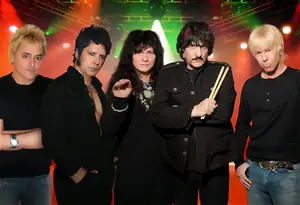

Sitting across from Kelly Keagy, you do not just see a drummer who survived the neon-soaked excess of the 80s. You see a survivor of the road. Most kids finish high school and look for a local college or a steady paycheque at the mill. Not Keagy. The day after he tossed his cap, he packed a bag and chased the rhythm. It was a gamble that took him through the grit of the club circuit before landing him behind the kit for Rubicon, a San Francisco outfit that served as the crucible for what would become Night Ranger.
Alongside Brad Gillis and Jack Blades, Keagy helped define the AOR (Adult Oriented Rock) sound that dominated FM radio. But let’s be direct: Keagy’s greatest weapon wasn’t his kick drum. It was his throat. Writing and singing "Sister Christian" changed everything. It turned a rock band into a household name. When we caught up with him, the conversation turned to the mechanics of longevity and how three guys from the Bay Area managed to stay relevant while their peers faded into the discount bin of history.
We asked Keagy about those early days, specifically what he, Blades and Gillis were actually hunting for when they first plugged in 40 years ago.
"I think in the beginning we just wanted to write good songs and present them in a certain way," Keagy says. "We love playing live and I think especially back then playing live is what it’s all about. And now we’re starting to realize just how important that is. The fact that we wrote some good songs, we did some good work and then we could continue for that many years is unbelievable. Every day we shake our heads and go, 'This is going on a long time. It’s pretty amazing.' And it’s just because we kept our focus on playing good music, entertaining people, being in that environment and live performances. I mean, it’s weird, and then you start to develop, you start to get serious about it when you make records. You start to go, okay, what is a good song? What makes a good song? It’s not just the performance, it’s the lyric and the melody and the whole thing. When you start getting serious about it. In the last like five years, we’ve been making some of the better records in our career just because we have time, you know, we’re not being pressured by a major label, we’re producing this stuff ourselves and we’re really enjoying the process at this point too, so it’s pretty interesting how things kind of evolved."
The evolution Keagy mentions is vital. Most heritage acts are content to play the hits until the wheels fall off. But Night Ranger seems to have found a second wind by cutting the tether to the traditional record label machine. There is a certain irony in a band that defined the big-budget 80s studio sound now finding peace in the DIY ethos of the modern era.
It sounds like Keagy genuinely prefers the distance from the industry heavyweights. The lack of a suit in the room telling them what a "single" sounds like has clearly cleared the air.
"Yes, we do," Keagy says. "We realize we need the industry and we need the certain formats and MP3’s and all that digital stuff. It’s nice that it makes it convenient. It also makes it easy for us to record albums now. We can send hard drives to each other and everybody can record their parts, and after we write the song and then it just needs to be recorded properly. So we’re embracing that. On the last record, we just got together to write the songs. We got in one room to write the songs, but we didn’t have to be in the room to actually record the parts."
This remote workflow is a far cry from the days of burning $2,000 an hour in a Los Angeles studio. But Keagy is quick to point out that the soul of the band still requires physical proximity. They still get in a room to sweat out the skeletons of the tracks. The digital part is just the polish.
The live show reflects this variety. They do not just lean on the Night Ranger catalogue; they pull from the entire family tree, including solo ventures and side projects. It is a smart move. It keeps the setlist from feeling like a museum exhibit.
I think in the beginning we just wanted to write good songs and present them in a certain way. We love playing live and I think especially back then playing live is what it’s all about. ...Every day we shake our heads and go, 'This is going on a long time. It’s pretty amazing.' And it’s just because we kept our focus on playing good music, entertaining people, being in that environment and live performances.
"We’re very lucky, very lucky," Keagy says. "Jack had the Damn Yankees when we took a break, and he had hits, and then we loved playing those songs ‘cause they sound like songs we would’ve done, so we embraced all that stuff. We love it. The fact that we like to get in a room together still and write and record stuff is just, it’s the biggest joy we have other than performing for live audiences."
To understand the chemistry, you have to go back to the Rubicon days. When Keagy first met Blades and Gillis, the Bay Area was a melting pot of funk, rock and experimental pop. Rubicon was not some garage band; it had serious pedigree.
"There was a band called Rubicon that they needed a singing drummer in the band," Keagy says. "And so I came up to audition and I knew about the band because it had Jerry Martini from Sly Stone and had some great musicians from the Bay Area. Johnny Colla from Huey Lewis And The News is playing horn in it. And so I was very excited when I met these guys. I was struck by how upbeat, funny, just didn’t take this stuff too seriously, but at the same time when you got in there and started making music, it got serious, and we all could relate to that. So it was great. But, I just realized that we all got along so well right away."
Keagy is a rare breed. The "singing drummer" is a technical nightmare. You are trying to maintain a steady pocket with your four limbs while managing diaphragm control for high-tenor melodies. It is a labour-intensive role that often leaves drummers sidelined in the writing room. Keagy broke that mould.
"I think that a lot of times the drummers do participate, you just don’t know how much they participated," Keagy says. "But I think as far as the writing of it, I play other instruments and so that helps, I can show somebody a song on the guitar. A lot of drummers aren’t fortunate enough to be able to play another instrument to be able to convey across like, 'I got this idea for a chorus, here it goes,' Or sometimes they can’t sing the idea. And so I was able to do all that and in a hacker sort of way, but the other members got it, and I think that’s what makes a good band too, is that whole communication thing, being able to get your idea across and convey it and then allowing the other guys to come in and mess around with it and make it better."
The technical proficiency of the current lineup cannot be overstated. While the 80s were often dismissed as style over substance, Night Ranger was always a musician’s band.
"I mean, that’s what makes a good band, when you allow the other people to bring in their expertise and their ears," Keagy says. "Brad Gillis is a guitar player and of course our new guitar player Keri Kelli, those guys are absolutely amazing virtuoso musicians. Not only can they play solos, but their knowledge of chords and different voicing’s is just, unbelievable. Eric Levy, he plays keyboards with us, was in a band called Garage Mahal, which was a total jazz fusion, like rip it up, jazz fusion playing in seven four, nines and twelves. And it’s just unbelievable, and is with us, and enjoying playing that kind of music that we’re playing. It’s been pretty amazing. We found the right combination."
But even with all that fusion-level talent, the conversation always circles back to "Sister Christian." It is the albatross and the crown. People often assume Keagy walked into the room with a finished masterpiece, but he insists the band’s collaborative "tearing apart" process is what gave the song its teeth.
"I wrote the song, it’s basically only three chords, but where they came in was, what are we gonna do for going to a different section, like a bridge or a solo?" Keagy says. "And that’s when we got in the room together, which we do for every single album, and we start playing this song and then we, well, what if this happens? And what if that happens? Basically, the song was written except for how was the band going to play it. So that’s how they contribute. And that’s how, most of us contributed to songs that were written by other people, is that we would go in there and we would tear the song apart and rearrange it and everybody had ideas and those things would make it better. So that’s how that happens."
The song was written for his sister, Christie, who was 16 at the time. It was a warning about the fast-moving world of adulthood. Decades later, the "little sister" is grown, but the sentiment remains a point of pride for the Keagy family.
"I think that her big brother was looking after her, is what it was," Keagy says. "And so she always looks at that like, yeah, I was 16 years old and my big brother was watching after me, and so she always looks at that and goes, 'That was a really great thing you did. You were watching after me, you gave me a couple of warnings about boys. You got to watch who you’re chasing after,' or whatever. So with just a simple little thing like that, and it just ended up being a great big chorus that worked great."
The song has a sincerity that many power ballads of that era lacked. It is not about a messy breakup or a fleeting backstage encounter. It is protective. That emotional grounding is likely why it survived the transition from cassette to streaming.
"Right, exactly," Keagy says. "I mean, what’s great about that, it’s not a love song. It kind of is, but it’s just a basic, an idea of asking your sister to take it easy and watch out. So it was a different play, even though it sounds like a love song."
If there is a critique to be made, it is that Night Ranger occasionally let the "Sister Christian" shadow loom too large over their later 80s output, chasing that ballad high at the expense of their harder rock roots. But hearing Keagy talk about it now, there is no resentment. He’s the guy who left home the day after graduation and never had to look back. That is more than most musicians can say. Night Ranger is still here because they never stopped being the guys who wanted to "write good songs and present them in a certain way." Simple as that.