
Windsor has always been a city that breathes through its exhaust pipes and bleeds through its blues. It is a town built on the grit of the assembly line, and that specific brand of blue-collar fatigue is exactly what The Blues Side captures in their self-titled debut album. This isn't just another retread of Delta tropes. It is a collection of original tracks that carry a classic vibe meant for the dance floor, yet weighted with the heavy reality of life in a border city.
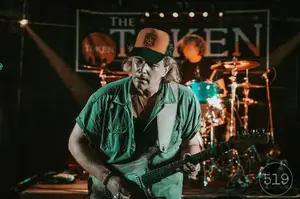
I sat down with frontman Rick Labonte and lead guitarist Denis Bastarache to dissect how a side project from seven years ago evolved into one of the most cohesive units in the local scene. The record itself feels like a physical artifact of the pandemic era—a time when the world stopped, but the songwriting didn't. Labonte is a man who understands the theatre of the stage, while Bastarache provides the technical muscle.
When asked about the genesis of the self-titled debut, Labonte explains the timeline was birthed out of necessity.
"January of this year, it was something that we had a chance to put together during the time where some of our shows were put on hold. We did some shows in 2020 but the whole dialogue of us doing an EP at first started in 2019," Labonte says. "We had a handful of songs that we were putting in our set list. The Blues Side was founded in 2014, and over the years, I was able to cover different artists from Muddy Waters to everybody from every decade, and every now and then I threw in a couple of my own tunes or I would write a song because I felt like we needed a type of song and I would present it."
The transition from a cover-heavy set to an original powerhouse happened when the lineup shifted. Bastarache brought a songwriter’s discipline that forced the band to stop looking backward and start looking at the page. Labonte recognized the shift immediately.
"When Denny came in, he was a songwriter and that’s when the wheels started turning, let’s make a blues album. Here’s a guy who is a song writer and had his own band, Bad Moustache, and we would play the same shows and he would incorporate some of his originals and I liked them. He would always encourage me, 'Hey, keep playing buddy, that’s really good stuff.' Before you know it, there was a vacancy in my band and I didn’t have to look too far to reach out and say, 'Hey, would you want to do blues?'" Labonte says.
Bastarache isn't your typical blues purist. He’s a multi-instrumentalist who treats the genre like a playground rather than a museum. That versatility is the engine room of the new record.
"He’s a hybrid player, he can do blues, country, and he’s a guy that plays guitar, bass, mandolin, banjo, but as a blues guitar player, he’s also a performer. In my band I was always known as the front man, and he came in and he was just full of energy. He wrote a few songs and he was also in a songwriting group and he invited me to help master my craft. So right from the get go, with all the different songs we wrote, we kept our blues songs for each other," Labonte explains.
The album eventually swelled from a modest five-track project into a full-length 10-track LP. But the process wasn't without its frustrations. The lack of a true collaborative track—one written in the same room—is perhaps the only minor blemish on an otherwise stellar debut.
"It started off to be only a five song EP, but then I had six and he had four so we agreed, let’s stop at ten. My only regret is that we didn’t have one that we wrote together, but it never came to fruition because of COVID and the lack of time spent together," Labonte admits.
Bastarache, however, sees the synergy in how they edited each other’s work. There is a mutual respect there that prevents ego from stalling the creative process.
"The other thing that’s pretty cool is Rick being a songwriter as well, we can throw ideas off each other and we can discuss whether a song needs this piece or not, because we understand what that piece does. Sometimes the song takes charge," Bastarache says.
The record avoids the trap of the "one-dimensional shuffle" that plagues so many local blues releases. Instead, it leans into dynamics. The standout moments on the album often mirror their live show, specifically the interplay between Labonte’s harmonica and Bastarache’s guitar.
"One of the things we were both looking for was, we didn’t want to be a one dimensional band, like have the same shuffle. Denny likes dynamics and improvisation. I like a well rehearsed band but I also like some breathing room for solos. One part of our act is a duel between guitar and harmonica. We do it where we call and respond and I learned so much about his technique and he learned so much about mine that we never throw a curveball. There’s a lot of feeling and listening on the spot," Labonte says.
But there is a friction in their methods. Labonte is the architect, obsessed with the blueprint and the rehearsal. Bastarache is the jazz-adjacent spirit who wants to blow the roof off the building without a map.
"I’m not much of a rehearsed kind of guy and I stay away from playing covers and Rick is on the other side. He likes to practice a lot and he does a lot of covers so it was a give and take where now he’s more freely throwing things around on stage and he might decide to throw in his own solo in the middle of something or add another verse or play with the crowd. He’s learned to freelance his music and I’ve had to kind of hold on to the reins a little bit and between the two of us we grew," Bastarache notes.
And that growth is what makes the album tick. It’s a balance of structure and chaos. Labonte provides the framework, but he gives Bastarache enough rope to find something inspired in the moment.
"It was the best of both worlds, we have structure, we have consistency because he’s a good singer and I want to say, 'Hey, sing like that all the time.' But I won’t know if he’s going to pull a slide or use a Wah-wah or tremolo or delay. He always comes up with different tricks and that’s wonderful, I don’t want him to be a one trick pony. I don’t want him to be predictable. We give them that freedom because we like that, we encourage it. Lately, all the shows incorporate around 50/50 originals and covers because I became a fan of his songs and he’s been a fan of my songs so we’ve been encouraging each other to do more," Labonte says.
The history of The Blues Side is a "who's who" of the Windsor music scene. The project began with Michael Hereford of British Beat 66 and has seen a revolving door of local talent that eventually solidified into the current lineup.
"At the time we started The Blue Side, we were all in active bands. I was in the band The Formula along with Kevin Gagnon or Dan Laframboise who were the bass players at the time. Mike was in British Beat 66, Jack Lehoux was in The Source, and Ron McMinn was in another band. We said this is our blues side, we wouldn’t do the songs that we did in our other bands and we got to show our love of the blues. With this vehicle and our friendship we’ve played many shows under The Blues Side banner and we’re also going to be doing some TV work for The Canada South Blues Society. They asked us to showcase three of our originals and two of our covers for a series they’re producing," Labonte explains.
I was driving my car and just crept to a stop and somebody hit me in the rear. It was a young person with a phone... somewhere on the way home came into my head, “Why don’t you put that phone down, put that phone down before you hurt somebody.”
The album credits read like a local hall of fame. Michael Hereford returned for keys, Ron McMinn added guitar, and the rhythm section features Dillon James on drums and John Kersey on bass. But the real coup was landing Kelly Hoppe on saxophone.
"Another cool thing was to bring Kelly Hoppe in to play saxophone. I already play the harp so I wasn’t going to ask him to play that, even though he’s amazing, but I thought, I can’t play the saxophone. We had some other cat in mind but Luc Michaud, our engineer, said Kelly was coming in the studio and he would ask him. He already knew a lot of our stuff because we had played together in some charity shows and he said, Yeah, I would love to. He played tenor and alto sax and did a couple solos and some harmony and he just improvised on a couple parts and I was satisfied," Labonte says.
Hoppe, ever the professional, wasn't content with just "good enough." He returned to the studio to elevate the track even further.
"Two days later, he called and said, 'I got a better one.' Even though he could have just said no, the job is done, he came back and gave me a very tasty solo, very melodic, very similar to Denny’s solo, different but the same approach. It was just so well suited for the song and to have a good guy like him and a decent name on the record," Labonte adds.
The songwriting on the album shifts the blues away from the cotton fields and into the modern digital age. "Put the Phone Down" is a perfect example—a song born from a literal fender-bender.
"I write for myself and if somebody likes it, great. The more you write, the better you should get, like golfing or whatnot. I was driving my car and just crept to a stop and somebody hit me in the rear. It was a young person with a phone and we dealt with the accident, nobody got hurt, everything was okay, and somewhere on the way home came into my head, 'Why don’t you put that phone down, put that phone down before you hurt somebody.' I’m pretty good at finding a groove in music. I really believe every sentence has a beat and every sentence has a melody as well, especially if you speak several different languages. So if I speak French and I say, 'Comment ça va?' I just gave you a whole series of notes. Sometimes when you write something down and you read it, 'Put the phone down' has a rhythm," Bastarache explains.
Labonte appreciated the Canadian specificity of the lyrics. In a genre obsessed with Route 66, hearing a shout-out to the 401 feels revolutionary in its honesty.
"What I also like about it is a lot of songs are about highways like Route 66 or traveling to Memphis, but the Canadian here says Highway 401 so I loved it right from the get go. I heard him do it live at a Christmas show before we had the opportunity of becoming band mates and that song resonated with me because I know the visual, right? The groove is almost like a hand on the steering wheel, it’s almost like a video in my mind listening to those lyrics and yeah, our songs aren’t about losing a car and a dog or your house or your wife," Labonte says.
Instead, they tackle the economic decay of Windsor. Having spent two decades as auto workers, Labonte and Bastarache have seen the dark side of free trade and political posturing.
"We do have a couple of songs about the economy, 'Times are Hard' about Windsor, Ontario and free trade and we’re both advocates against free trade and a few other things we saw in twenty years as auto workers. The politics haven’t always been in our favor and made a few people rich but a lot of people homeless and we recognize that," Labonte says.
The track "Shake my Head" was inspired by the modern shorthand of social media and the exhaustion of the 24-hour news cycle.
"I wrote 'Shake my Head' about politics because during 2019/2020 we had a lot of things on the US News coming through especially being a border town. It was Mike McCann, president of Canada South Blues Society who posted an article on Facebook and he put SMH and I didn’t know what that meant, I had to look it up. So it means shake my head and I’m like, that’s a song title. I’m in BC at this point traveling and I think, 'I’m going to make a tune about that.' So I’m asking myself what would make me shake my head and then I turn on the news and that very article that Mike had written about is enough to shake your head too so that’s when I started writing about the six o’clock news. By 6:15 they’re talking about politics, by 6:30 you’re learning about all the blues in the world, you just want to take that remote control and shut it off, and that’s how it came about," Labonte recalls.
But the heaviest hitter on the record is "The Cure." It’s an indictment of the pharmaceutical industry and the monetization of survival.
"Denny has another one called 'The Cure', do they have a cure or are they just a money machine now? A lot ask for donations and stuff and so he thought that would be a good angle and that’s blues because it’s shitty if you have a loved one dying and it’s because somebody is holding that special ingredient that can keep you alive," Labonte says.
Bastarache elaborates on the cruelty of the patent system and the astronomical costs of life-saving medicine.
"And the reason they don’t give it is because nobody’s making money or the patents have run out and we can’t make money on it. It’s a shame when you hear of somebody who has something that could make it more comfortable or maybe even heal it. And if we have this diabetes medicine right here, but it’s going to be $1,000 for that shot," Bastarache says.
The inspiration for the song came from a harrowing television segment about rare diseases and the pay-to-play nature of modern healthcare.
"There was a show on one of the major US networks the other night and it was about some rare disease and they have a cure for it, but they have to diagnose it right after birth and they have to administer a shot to a child before they reach the age of two, the earlier, the more effective it is. One shot, one treatment is two million dollars and the syringe is so big it almost looks like a joke, right? But this is real, and its two million dollars and if you don’t have medical insurance, I guess your kid’s going to die," Bastarache explains.
It is a grim subject, but that is the essence of the blues—finding a melody in the midst of a tragedy.
"And that’s what the song is about. It’s like, you get it if you can rob a bank, or you can watch your child die. That’s why in that song I talk about mothers’ crying, families praying, and the angels are dying and that’s why you got the cure," Bastarache says.
The album isn't all political fire and brimstone, though. Tracks like "Stressed Out" deal with the everyday anxieties of traffic and modern isolation.
"And I even think the song 'Stressed Out' is another way of saying the blues. People are stressed out today, right? And so we wrote about that and the traffic and how it can aggravate your day. We also wrote about loneliness. You’ve got a beautiful house, right? You can have a mansion, but if you don’t have someone to share it with and absolutely love, it’s just a house, that’s all it is. I got that from that saying. I got a beautiful house but it doesn’t feel like home. The home is where the heart is, right? So we thought that’s good imagery and people can relate. And then of course an obvious one, you don’t know what you’ve got till it’s gone, so we try to describe that in songs as well," Labonte says.
Even the personal conflicts are handled with a bit of "smoke and mirrors" songwriting. On "I Just Play the Blues", Bastarache turns a domestic spat into a reason to pick up the guitar.
"Then there’s the one I wrote called, 'I Just Play the Blues', there’s a spat so I have to walk away. But while I should be really kind of down on myself, I’m going to walk away to my guitar or I’m going to go work on my car, so in that bad moment you go, when I lose, I’m happy. Nobody gets hurt or anything, but it’s kind of a smoke and mirror. We had a little bit of a spat, that’s okay, I’ll go grab my guitar and write a song," Bastarache says.
As the world reopens, the band is looking toward a proper release party and a television showcase.
"We have a couple of venues that are interested; we’re just waiting for them to give us the green light when restrictions end but that is the idea. In fact, our game plan is not only doing a showcase of our album but also some of our greatest covers, because we do our own version to a lot of these songs and it’s awesome. We’re thinking about bringing some past members to come and play the song that they’re featured on and just have a celebration of the years of The Blues Side. We don’t know if that’s going to pan out but ultimately, that would be an idea or at least have Michael Hereford join us for piano and organ for certain songs," Labonte says.
The band is also set to film a series for the Canada South Blues Society, which will further cement their status as local torchbearers.
"They’re taping it in the summer and showing it in the fall. They just want to put enough under the belt with various artists to start pushing it, we’re the third act to be taped," Labonte notes.
The momentum is building. Bastarache has noticed that since he hopped on board, the band has started to transcend the local pub circuit.
"There have been some interesting things happening since I joined the band. Doors have been opening and we got a little bit of radio play here and there," Bastarache says.
The exposure isn't just limited to Windsor. Thanks to some savvy networking, The Blues Side is finding ears in unexpected places.
"We have one in Mexico, we have one in Hawaii playing it, there’s somebody in Texas and there’s a couple of others. It’s Denny’s networking and my networking that’s getting us more and more of that exposure. What’s next is to give Amazon the blueprint so they can start factory producing our CD, that’s what I’m planning on doing by August. Right now, people can get it on iTunes, Spotify, all these streaming and download platforms and get a hard copy from us," Labonte says.
With a new website in the works and a series of videos on the horizon, the band is no longer content being Windsor’s best-kept secret.
"We’re going to be doing videos here and there and I am looking into building a web page for the band so we can get more international ears on it. We don’t think everybody’s on Facebook so we actually could expand. We were just another local act but it’s gotten bigger than that. In terms of some of our music being heard, it’s going farther than I could ever take the band," Labonte says.
Ultimately, The Blues Side succeeds because they play in the moment. Whether the bar is empty or the festival stage is packed, the energy remains the same.
"It’s interesting, because when we put on a show, Rick is very much a performer and when I play I kind of forget who’s around me as well because I try to play in the moment so we don’t notice the things that are happening. Sometimes the bar is not that full, sometimes it’s full, but next thing you know, you get a call do this, do that. So it’s pretty cool things are happening," Bastarache concludes.