

London creator Sarah Legault is currently carving out a niche for herself in the Canadian music scene that feels entirely tactile. While most directors are obsessed with the slick sheen of 4K digital sensors, Legault is operating at a different frequency. 24 frames per second, to be exact. It is a slow, methodical grind that requires the patience of a saint and the eye of a precision engineer.
And the industry is finally catching on.
This coming Mar. 15, Legault will be heading to Saskatoon. She is not just going for the parties or the prairie air. She is going as a JUNO Award nominee for Music Video of the Year. The nod comes for her work on *Little Star*, an epic stop-motion project for the artist iskwē. It is the kind of recognition that usually goes to big-budget Toronto houses, not independent creators working out of their living rooms.
Legault is not playing it cool. She is genuinely floored by the recognition. The transition from a self-taught filmmaker to a JUNO-calibre director is not a path many successfully navigate.
“It was emotional hearing that news,” she says. Legault explains that as a self-taught filmmaker, earning an awards nod on such a grand scale was something she never thought possible. The exposure the video has already received has put her in a headspace that is hard to describe. “The fact people across the nation are paying attention to it and listening is incredible, and very overwhelming.”
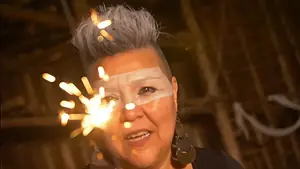
But to understand the video, you have to understand the artist behind the song. iskwē is a powerhouse. She is a Cree, Dené and Irish singer-songwriter who uses her platform as a blunt force instrument for activism. She is a communicator of movement, pictures, poetry and prose. Her resume is stacked. She was longlisted for the Polaris Music Prize for her second album *The Fight Within* and received a JUNO nomination for Indigenous Music Album of the Year back in 2018. Her latest record, *acākosīk*, is currently up for Adult Alternative Album of the Year.
This was not a standard "work-for-hire" gig. It was a partnership of two creators who occupy the same dark, illustrative headspace. Legault is a polymath. Her hands are constantly stained with paint, clay or ink. She does illustration, set design, character design, doll making, set building and photography. She is also a co-curator of The Shadowood Collective. Her work has been hung in galleries from Toronto to Berlin, Krakow and Los Angeles.
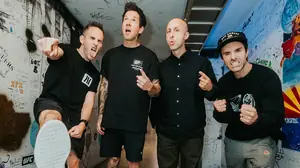
The origin of *Little Star* dates back to 2017. It started with a tag on social media. Someone linked iskwē to Billy Talent’s video for *Ghost Ship of Cannibal Rats*, a project Legault and her team had just wrapped. The aesthetic clicked. iskwē sent a private message.
And then things got real.
I really liked that idea a lot, so we did a few video chat meetings and ended up coming up with the idea of building the cityscape for newspapers... In the end the sky changes and the characters are able to turn into stars.
Legault went to see iskwē perform at The Cotton Factory in Hamilton. If you have ever been to that venue, you know it has a certain industrial weight to it. It was there that the conceptual seeds for the video began to germinate. The performance was not just about the music; it was an education.
“I was pretty moved by the show. She spoke a lot about the missing and murdered Indigenous women and I found there were all these situations happening in the country that I wasn’t personally aware of, including the story of Tina Fontaine,” Legault recalls. “It encouraged me to do some research on my own, so I went home and looked up some of these stories.”
The story of Tina Fontaine is a wound in the Canadian consciousness that refuses to close. It is one of the most high-profile cases of the dozens of missing and murdered Indigenous women in this country. It was the catalyst for renewed calls for national inquiries. Legault did not just read the headlines; she felt the weight of the injustice.
Fontaine’s story, along with the death of Colten Boushie, became the DNA of *Little Star*. The video is thick with symbolism that requires a second or third viewing to fully grasp. The red sky is a warning of a coming storm. The image of iskwē’s red dress falling into the streets is a direct, heartbreaking reference to the Red River where Fontaine’s body was discovered.
But there is a sharper, more cynical layer to the visuals. Legault took aim at the media. She looked at how newspapers represented these cases, often resorting to victim-blaming headlines that stripped the humanity away from the deceased.
And yet, the video is not a nihilistic exercise. It is a community song. The core idea is about people from all ethnicities and backgrounds coming together to force a change. It is about the collective power of the marginalized.
“I really liked that idea a lot, so we did a few video chat meetings and ended up coming up with the idea of building the cityscape for newspapers,” says Legault. She adds that the base of the project was the army of children, 41 figures to be exact, representing all walks of life. “In the end the sky changes and the characters are able to turn into stars.”
The logistics of the shoot were a nightmare of the best kind. The entire production happened inside Legault’s home in London. For six months, her living space was not a home; it was a studio. Every room was occupied by sets, lights and camera gear.
She had a team of 11 local artists and fabricators helping her build the world, but the actual filming was a three-week marathon of 24-hour days. Stop-motion is a brutal discipline. You move a finger a millimetre, take a shot, and repeat. If you bump the tripod, you start over. It is a labour of love that borders on obsession.
Now, the industry is paying its debts.
Earlier this year, *Little Star* took home Best Animated Short at the Forest City Film Festival. It was also an Official Selection at the Cinequest Film Festival in California, which happens to run at the same time as the JUNOs.
But for Legault, the hardware on the shelf is secondary. When you deal with subject matter this heavy, the only metric that matters is how it lands with the people whose stories you are telling. You can win all the awards in the world, but if the community feels exploited, you have failed.
Legault did not fail.
“It was a very emotional and political project. And while I wasn’t sure what the response would be, the subject matter was something important that needed to get out there,” she says. The reaction from Indigenous community members has been the most rewarding part of the process. “The feedback we’ve received has been so positive, and a lot of the community members said they felt it was a very healing video for them. So, it’s been an incredibly touching and amazing experience.