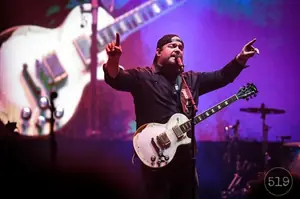


Sitting across from Gord Bamford, you do not just see a country singer with 26 CCMA Awards gathering dust on a shelf. You see a survivor of an industry that eats its own every five years. We are currently navigating a timeline where the live music business has been gutted, yet Bamford is out here in Alberta, turning parking lots into makeshift theatres and raising over $100,000 for mental health.
It is a gritty, boots-on-the-ground approach to a global crisis. While other A-list acts were busy figuring out how to use Ring lights for Instagram Live, Bamford was booking drive-in and fly-in shows. He is not just playing the hits; he is keeping a crew employed and a foundation afloat.
But the logistics of a drive-in show are a nightmare. You lose the immediate roar of the crowd. You replace it with high-beams and car horns. And yet, Bamford seems to thrive in the chaos. I asked him about this frantic summer and the pivot to these charitable Alberta dates.
"It’s been pretty good as far as figuring out what we can do in a time like this, and we’ve found a way to keep working, all while making a difference," Bamford says.
The "difference" he mentions is backed by cold, hard cash. Partnering with ATB Financial, Bamford took the Gord Bamford Foundation on the road when most charitable ventures were shuttering. It was a calculated risk that paid off for local mental health initiatives.
I wanted to know how a bank and a country star ended up saving the summer for small-town Alberta. Bamford explains: "The Gord Bamford Foundation has been going for 13 years now, and we’re very passionate about the fact we’ve raised just over $4 million. It’s really young-orientated and driven, with 90 percent of it being shared across Canada. When this pandemic came about, we didn’t know what we were going to do. Everybody was kind of down in the dumps and really wanted to go back to work, and I ended up just getting a text one night from the president of ATB Financial, which is a bank out here in Alberta. He basically wanted to do something for mental health and to give back, and we were able to get these drive-ins together. They supported our first five and then jumped on a couple others, and basically underwrote the cost for us to perform and play — so we were able to give back all of the ticket sales to mental health organizations in each of the communities we were playing. It was really the perfect fit for me because of course that’s the kind of thing we do, but when you talk mental health it’s also meaningful for us as musicians and entertainers, and it kept us working during a really gloomy time. The whole experience has been so positive for us, and that just snowballed. We’re hoping to do a few more while the snow holds off. It’s really been so good for everyone."
But where does this drive come from? Most artists start a foundation as a tax write-off or a PR shield. With Bamford, it feels more like a core business pillar. He traces it back to a suggestion from his inner circle that spiralled into a decade-long mission.
"It was a guy who was working with me at the time that came up with the idea for a golf tournament, and it just made sense to give back and do that," he says. "Then it just grew so big, and it kind of got to a place we never really expected. So, as an entertainer who’s been lucky enough to be successful in the music business over the last decade, combining the industry with a charitable aspect was a natural fit. I mean, our jobs require people buying music or coming to shows and buying tickets. We rely so much on human consumption of records or tickets, or just people being fans and coming to our events for us to make a living. It only makes sense to give back to all those people in whatever way we can."
There is a pragmatism in his voice. He understands the transactional nature of fame. If fans stop "consuming," the bus stops rolling. But there is a softer side to the machine, one that involves the heavy lifting of emotional labour.
"Most importantly, it’s probably the most satisfying part of what I get to do," Bamford says. "I get to experience seeing music change people’s lives, from children’s hospital visits to Make-A-Wish Foundation to Ronald McDonald House. Obviously when people are going through tough times, music is pretty healing, and it’s tough to explain until you experience it firsthand, but for me it’s a pretty cool life lesson every time. It really helps you to be grateful for what you have and who you are. Any one of us could find ourselves in a tough situation one day, you just never know. It keeps your whole perspective of who you are and what you do in check, really."
And checking that perspective became mandatory when the first drive-in show launched. Imagine standing on a stage, looking out at a sea of windshields instead of faces. It is a technical hurdle for any performer who relies on the call-and-response of a live audience.
When this pandemic came about, we didn’t know what we were going to do. Everybody was kind of down in the dumps and really wanted to go back to work... it was really the perfect fit for me because when you talk mental health it’s also meaningful for us as musicians and entertainers, and it kept us working during a really gloomy time.
Bamford admits the transition was jarring. "It was pretty weird to be honest. To come out on stage to a bunch of cars — and at that point, people had to strictly stay in their vehicles — it was definitely an adjustment. People honk horns at the end of your song and sometimes it was hard to read people because you would rarely see them. But eventually, the shows got to feel pretty good. Where there’s a will there’s a way, I think. You can look at this pandemic in a couple different ways; you can either sit back and feel sorry for yourself, or find a way get out there and play music, which is great for us but also great for the fans. The bonus has been being able to give back to those communities and organizations that have been struggling trying to raise money at these times too. Whether you’re playing to people on a tractor or in a truck, we’re just grateful to be playing music, and continuing to make our living that way. It was an adjustment, but it’s kind of neat now that people are able to sit in the back of their truck, so it’s almost like a little tailgate party. Some people have gotten pretty creative; they come in and cool vehicles or have different-sounding horns. The joke is, it’s not an encore anymore, it’s a honk-core. Fact is, we’re seeing all sorts of families and kids. A whole wide demographic of people come in, and they’re having a great time. You’re still able to feel the love from the audience, no question."
The "honk-core" might be a joke, but the logistics are serious. On Sept. 26, Bamford took it a step further with a fly-in show at the Lacombe Regional Airport. It is the kind of stunt that sounds like a logistical nightmare but looks incredible on a drone feed.
"Planes flew in, and helicopters," Bamford says. "They had a socially distanced area they could sit in, and it was so cool, especially since that was in my hometown. It was nice to be a part of the whole experience and the local airport and the city was awesome. We had a great time, so it was a great experience."
But man cannot live on "honk-cores" alone. Bamford has been dropping tracks like *Just Let Go*, *White Oak Cathedral* and *Father’s Prayer* throughout the year. Releasing music into a vacuum where radio tours are non-existent is a gamble for a traditionalist.
Bamford is undeterred, looking toward a March album release with a "by any means necessary" attitude. "It’s been a lot more virtual, that’s for sure. But we have a brand-new album dropping in March, and we’re planning to do things like we always would. We get in the bus and go promote it. Now, every province is different, so whether it’s 100 people in a room or 50 people in a room or a drive-in show or whatever it takes, we’re going to go out and promote the record. We’re going to be out on the road so we’re going to follow the rules and make it happen. We may not be in a big arena anytime soon, but people will have the opportunity to come out to see our show. It’s going to obviously be a bit different, as we have to probably break it down more, but our plans are to continue to work, like they always have, in a different way. Maybe we’re up to 200, or maybe we’ll be back to normal — but no matter what, we’ve got Plan A, Plan B and Plan C, so we’re rolling out the best music I’ve ever made and we’re excited."
One of those tracks, *Father’s Prayer*, hit a specific nerve. It is a sentimental play, sure, but in a year of isolation, sentimentality is the only currency that hasn't devalued.
"That was a digital release, but we had a little online Father’s Day Special that we ran with some special guests on there," he says. "The song did well and it was exactly what we were hoping for, with a lot of good feedback. That’s the beauty of music today, no matter if you have traditional radio stuff, or tracks you can release on a digital platform, we’ve got ways to put on all sorts of music out in different ways. Instead of just carrying three or four singles at radio, fans get a chance to hear a lot more. I’m a dad of three kids — two young girls and my son. I would think for anybody that has children, you know how they’ve changed your life, your outlook, and your priorities. I thought it was a song that would hit home for a lot of parents, moms, dads, or grandparents. So, it was a pretty important time for me to make sure people heard it. We knew it probably wasn’t going to be a radio single, but we wanted to find a way to get it out there so people could feel the song as much as we did."
On Oct. 1, Bamford dropped *Diamonds In A Whiskey Glass*. It is the title track of the upcoming record and it signals a shift toward a more prolific release schedule.
"It’s going to be the title track of the new album," Bamford says. "It’s kind of like a jam that I’ve been sitting on for a while and, you know, people have been waiting for it. A lot of fans have gotten to hear it already, live. The album itself is really kicking off something big we’re trying to put together. There’s going to be 18 brand-new songs coming out over the next couple years on different projects, and *Diamonds In A Whiskey Glass* is going to be the beginning of some really great things."
And this is where the critic in me has to speak up. Bamford is a traditionalist in a genre that is currently obsessed with "snap tracks" and pop crossovers. There is a risk that 18 songs of pure country grit might feel heavy in a market that wants light and airy. But Bamford has survived this long because he knows his audience better than the algorithms do.
"It’s all changed immensely — from what country music is, what the sounds are and who’s doing what," he says. "That’s the beauty of it, though. And that’s brought so many more bands into the genre. Whether it’s a pop country song or a traditional country song, it’s always continuing to evolve. With this pandemic and how things are rolling out, you’ve just got to zig and zag."
He views himself as an entrepreneur first. The music is the product, but the delivery system is what keeps the lights on. "I think you got to come up with ways to be creative. I’ve always been an entrepreneur, and even the ways to market your music became different over the years since I’ve been in it. We talk about digital, the online stuff that’s going on — it’s so different. If things are stagnant and stalling, you find ways to revive them, or to get them done, and that’s just what we’re doing."
And there is a loyalty here that you don't often find in Nashville or Toronto. Bamford talks about his crew like they are family, not line items on a budget.
"I think for me at the point where I’m at, I’m not scared to play a show for 50 people. I will never think that’s below me at all," he says. "So, whether it’s 50 or 5,000, we’ll just go out and play however we can and continue to do what we love. I’ve had the same crew around me for 10 years now, so there’s people I’m responsible for — for them to make a living. I’ve got to make sure, first and foremost, that their work continues, so we need to keep going and keep moving forward. We’re lucky because we have everything in house, from buses to production — we do everything, so the infrastructure is there, and we can go out and make it all happen."
Ontario fans are itching for a piece of this infrastructure. While Alberta has been the testing ground, the East is calling.
"We love Ontario, it’s one of our strongest markets," Bamford says. "So, obviously we’ve been doing a bunch in Alberta right now, but we’re going to be in Ontario, I promise. Early next year, and maybe even late next year. We’ll be there."
And "there" likely includes London. With the CCMA announcing the Forest City as the 2021 host, the industry is looking for a return to normalcy. Bamford, a hockey dad who knows the local geography, is already making plans.
"I’ve gotten the chance to play at Bud Gardens there a few times. My son is into hockey, and I’m into hockey, so the London Knights are a big, big thing as well and getting to be there a couple years back was awesome. London is a great city for the award show — I think they’ve made a smart move. And I know it’s going to be supported. It’s exciting to be coming back in 2021 and hopefully, we can all be there together and not have to watch it virtually. I think it’s a great move on the part of the CCMA to have it in London. I’m really looking forward to that."
It is a long road from a drive-in show in Lacombe to the stage of Budweiser Gardens. But if anyone has the stamina to make that trek, it is Bamford. He is not just playing the game; he is rewriting the rulebook for a post-pandemic industry. And he is doing it one honk at a time.