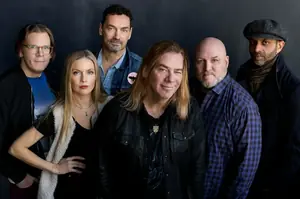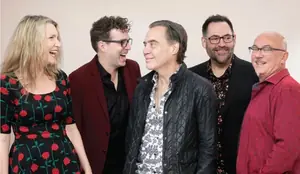

Standing on the Canadian side of the Detroit River, looking at the Renaissance Center through the hazy humidity of a Windsor summer, you realize the border is more than just a line on a map. It is a shared psychological space. Border Patrol, the indie folk-rock outfit led by Detroit’s Dave Toennies and Windsor’s Cody Howard, lives in that liminal zone. Their latest record, *The Worst Excuses*, arrived exactly when the world decided to stop turning, offering a collection of upbeat melodies that mask a deep, existential dread.
The band is a five-piece engine now, featuring Nick Angelini on keys, Adam Thompson on drums and Matt Williams on bass. But at its heart, it remains a conversation between two cities. I caught up with Dave, Cody and Nick to discuss the friction of being a cross-border act during a global shutdown and why, exactly, we are all so obsessed with the end of the world.
Releasing a sophomore album while a pandemic takes a stranglehold on the global economy is a nightmare scenario for any PR firm. But for a band that writes about impending doom, it felt almost too on the nose. The timing was accidental, yet the resonance was immediate.
Dave says, "I’m managing to keep busy but definitely have some cabin fever. I did a solo live stream show early on to keep me busy on a Tuesday night where I typically have a weekly gig scheduled. We’ve also participated individually in Andrew MacLeod’s online open mic. The response so far has been pretty overwhelmingly positive. We’ve been getting some nice reviews and have been seeing a decent amount of airtime on the local stations. Every couple days I’ll get someone reaching out who has heard something on the radio. For a couple weeks we were up at the top of the CJAM charts, which was awesome and we’re so grateful to them for really pushing it out there. Also to Dan MacDonald for promoting us and being an early adopter of the first singles."
And while Dave was navigating the airwaves, Cody was finding a strange comfort in the forced quiet. There is a specific kind of creative clarity that comes when the rest of the world is muted by government mandate.
Cody says, "I think it can be said for a lot of musicians that isolation is a muse. Being planted at home for the time has created a lot of opportunity to write and to shop around with different ideas."
Nick, who found himself back in Windsor after a stint in the American South, viewed the pause as a necessary reset. It was a chance to breathe in a world that was suddenly gasping for air.
Nick says, "The silver lining in not being an 'essential worker' gives me a rare opportunity to refresh and prepare for what the future might look like moving forward. A good time to find some unsolicited inspiration."
Visually, *The Worst Excuses* is as striking as its sonic layers. The artwork is tactile and violent, featuring a bear trap and a bottle. It lacks the polished, sanitized aesthetic of most modern indie releases. That is because Dave is a designer and illustrator by trade, treating the band’s visual identity with the same obsessive detail as a chord progression.
Dave says, "I’m a designer and illustrator by trade so I do all of the artwork for the band - all our album covers, shirts, merch, posters, and web graphics. I wanted to find a way to illustrate something that called out to the themes of the record but that specifically referenced the title. 'The Worst Excuses' comes from a lyric in the second track but we picked it because we felt like it was a thread that ran through all of the songs on the album. These songs are all dealing with excuses in some way - either making them, acknowledging them, or trying to leave them behind. I wanted the artwork to reflect that too but there’s no one image you can draw that inherently represents an excuse. But I tend to think of them as traps that we fall into. So the bear trap is a direct reference to that idea, the bottle is the bait in this situation, and the cuts on the hand are to show that this person has fallen for the trap over and over. On the back cover the bottle is broken like the trap has been sprung, but it’s being held in a way that to me represents fighting back and reclaiming your life."
But the real hook of Border Patrol is the cognitive dissonance. They play the kind of music you want to drink a beer to on a patio, but if you listen to the lyrics, you might end up staring into the abyss. It is a clever formula that tackles mental health without the performative mourning that plagues the genre.
Dave says, "I was just writing what came naturally to me. I’ve struggled with depression and anxiety for as long as I can remember and everything I write is sort of through that lens. I never really thought anyone else would enjoy it - I would play for friends but mostly I was writing for catharsis. Then once we started getting some traction people would come up and say how they could relate strongly to different songs and how they were glad to hear music that addressed it. It’s so widespread, the amount of people who struggle daily with these things and who don’t always have music to represent them. That was when it clicked to me that songs like the ones we write are important and it became more deliberate. A lot of the times we overlook just how important it is to communicate how badly we’re feeling because there’s tremendous public pressure to always present some fictionalized, perfect, happy version of ourselves. Social media has made it worse - everyone is curating an ideal version of their life to present to the world. But no one is happy all the time and everyone struggles. Society has us conditioned that we’re not supposed to talk about that or you’re somehow weak if you let that facade slip. We’re here to say, 'No, this is important. You’re not weak, you’re brave and we’re here for you.'"
Writing during a crisis is a double-edged sword. There is a temptation to document the mundane details of a lockdown, but those songs usually have the shelf life of an open carton of milk. Dave is aiming for something more permanent.
Dave says, "Absolutely. I had already started working on some new material and once everything started shutting down I planned to hunker down and write. Then right as the stay-at-home orders were being enacted I lost someone very close to me and really shut myself off from the world for a week or so to grieve and in the process I ended up trying to document a lot of the emotions I was feeling. Combined with the material I had already started on and observations of how we’re all coping with this global crisis as a species, I’ve got the framework for the next album pretty broadly sketched out. I’m trying to assemble my notes into songs now. But I’m being very careful not to have it be stuff that is directly about the quarantine, or the virus, or name-checking it because a lot of people are doing that and I think those songs will date themselves very quickly. I think a better approach is to draw from these universal experiences of loss we’re all going through and try to sing about the larger condition of human suffering we’re sharing. Then it’s something that can resonate across a longer period of time and not just during this specific crisis."
Then right as the stay-at-home orders were being enacted I lost someone very close to me and really shut myself off from the world for a week or so to grieve and in the process I ended up trying to document a lot of the emotions I was feeling... I’m being very careful not to have it be stuff that is directly about the quarantine, or the virus, or name-checking it because a lot of people are doing that and I think those songs will date themselves very quickly. I think a better approach is to draw from these universal experiences of loss we’re all going through and try to sing about the larger condition of human suffering we’re sharing. Then it’s something that can resonate across a longer period of time and not just during this specific crisis.
The logistics of being a cross-border band became a bureaucratic nightmare when the Ambassador Bridge and the Tunnel effectively closed to non-essential travel. For a band that thrives on physical presence, the digital substitute is a poor consolation prize.
Dave says, "I already work from home so being in that part wasn’t a big deal for me but being confined to the same space and not having the opportunity to play music in person has been tough. I miss seeing people. The live streaming has been a great way to make the most of a bad situation and I love seeing how creative people have gotten but there’s just no substitute for being physically in a room with people playing and listening to music. The absence is real for a lot of musicians right now. We’d like to do a live stream with the band if we could figure out the logistics but given that I’m currently stuck in America with the rest of the group in Windsor we’re not sure how we’d pull it off properly. We’ve found apps to help people jam remotely but I’m very limited in my equipment setup here and there’s not really a way for me to get new stuff right now or the budget to get it if there was."
Cody, meanwhile, has been leaning on the local Windsor scene to keep the pilot light burning. The city has always had a gritty, supportive arts community that refuses to fold.
Cody says, "If it’s one thing an artist can’t live without, it’s our craft. Thankfully, in the Windsor community there has been no shortage of it. Andrew MacLeod, of Years of Ernest, has done an exceptional job bringing musicians together every Tuesday for a scavenger hunt style open mic - one which I have been graciously a part of. Aside from that, it has been a little disheartening to be barred from playing due to the current events, especially after such a long dry-spell during the album recording process. That is something that has definitely been difficult for me. I don’t get out as much as I used to and shows are a big part of my social time."
Nick’s journey back to Ontario was fraught with the kind of stress that defines the year 2020.
Nick says, "Before the lockdown I was actually working in Dallas, Texas. I was laid off from my job and just recently moved back to Windsor. March was very stressful but I’m ultimately happy to be home and close to family during these weird times."
The origin story of Border Patrol is a classic piece of regional lore. It started at the Manchester, a legendary Windsor haunt, and grew through the grit of various open mics.
Dave says, "It’s always been a story of open mics. Cody and I met in Windsor at the Manchester open mic and stayed in touch while I was going to school in Southfield. I was living in Detroit and he’d come visit me and I’d cross to play at the ones in downtown Windsor. The band formally started when I asked him to accompany me for a feature I had booked at Audra Kubat’s Union Street open mic - which always had a fantastic lineup. We were decently well received and someone asked us to hop on a show with them so at that point we decided to formally start a group. We continued playing at open mics as a duo and slowly accumulated members who would jump in and play with us. One day we looked up and had a full band."
Cody adds, "Border Patrol has always been a band by accident. We started as two guys playing some open mics together and to this day we just keep tumbling along and growing."
While the duo remains the core, the five-piece lineup is what gives the new record its cinematic weight. Dave writes with a theatricality that requires a full stage, even if they can occasionally strip it back for a dive bar corner.
Dave says, "I’m writing with a full five piece in mind now. There’s so much musically that I hear whenever I’m putting it together on acoustic and I want to have that big, theatrical presentation. But we do also have stripped down versions of the songs for different situations if not everyone is available or it’s a smaller, more intimate type of gig. Everyone definitely contributes and adds in their parts. I write the lyrics, the melody, and the chords and I’ll often have a rough idea of where I’d like to hear something but my musical ability doesn’t lend itself to writing intricate accompaniments or solos or percussion. So the guys often have to listen to me poorly articulate an idea, tell me whether it works or not, and finesse it. As far as solos and all the pretty stuff goes, that’s all them."
Cody says, "I think that stylistically we are versatile. We have the opportunity to play stripped down as a two-piece, coming from our roots as a duo. However, the five piece is really something else. The energy and creativity that each member brings to the table during the writing and performing process really make the music."
Nick says, "In the world of indie music you need multiple people involved to move forward and progress. I think we all bring our own special something to the table. Some of us have known each other for 10 years +. It’s nice when your band members are also your friends."
Cody’s role in the band is often defined by his multi-instrumentalism. He moved from keys to guitar to the banjo, the latter becoming a signature element of the Border Patrol sound.
Cody says, "I first started playing piano when I was young. Eventually I moved on to playing guitar which opened the door to other stringed instruments. Out of necessity I took on playing the Banjo to complete the duo between Dave and me. After our first album I thought it might be time to add a little variety which led to introducing the mandolin. The banjo will always be a staple for me in the band, but expect more variety in the future!"
One of the boldest moves the band made was pressing *The Worst Excuses* to vinyl. In an era of digital disposability, holding a heavy 12-inch record feels like an act of rebellion. It is expensive, especially for an indie act, but they bypassed the dying CD market entirely.
Dave says, "There’s for sure been a lot of renewed interest in it. We just looked around and realized that fewer and fewer people have CD players - most new cars don’t even come with them anymore and neither do a lot of laptops. Cassettes are nice but are sort of a novelty because a lot of people don’t have players for them anymore either. The biggest thing for most people is that they have a digital copy for their devices that they can take with them. But people do still like to have something physical to take away from a show and there is a definite community of vinyl nerds who appreciate it. So we decided rather than, say, handing out flash drives with our music to just go big and do vinyl with a digital code included. It’s definitely a more expensive route to go. We had the album completed and we managed to get a grant from the Arts Council and did a kickstarter fundraiser/album presale that our fans fully backed and that allowed us to be able to afford it."
As for the future of the industry, Dave expects the digital shift to accelerate. If touring is off the table until 2021 or later, the screen becomes the only stage left.
Dave says, "I think it’s going to expedite a lot of trends that were underway. There’s already been a massive shift towards online releases and single releases as opposed to full albums and physical products. Your reach online is so much broader than your reach in person and the further you can reach, the better. I think you’ll also see live streaming gigs stick around even after we’re allowed to go to shows again. People will be used to them and with a small set up a musician can still be reaching their fans every night even when they aren’t playing an in-person gig."
Cody says, "I think it presents some challenges but necessity is the mother of invention. We are already seeing new and innovative new ways for artists to reach out to fans, as well as new allocations of various arts grants to fund these prospects."
Where does that leave Border Patrol? They are waiting for the bridge to open, the bars to fill and the doom to subside—or at least to become something they can play a show about.
Dave says, "We’re kind of in the same boat as everyone else, just trying to take it one day at a time and adapt as we go. We’re going to continue creating and figure out how to get it to the world one way or another. When shows are allowed again we’re going to get back to playing them but until then we’re exploring the possibilities of doing as much as we can remotely."
Cody says, "I agree with Dave, we are all kind of making our way through these uncertain times and make the most of it. It’s been a good opportunity to focus on reaching out to radio and working on our 'global' presence online. When things start to clear, you can bet we will be back to playing live, in whatever capacity that may be."
Nick says, "I read somewhere that our music sounds like it was 'written for the apocalypse' (something along those lines). If that’s still the case we may end up coming out of this with an advantage! There have been talks of doing some isolation-style concerts on social media… so please stay tuned!