
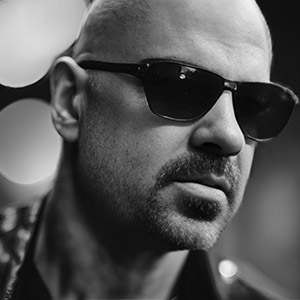
Sitting in the back of a dimly lit London club, the kind where the floor still feels slightly tacky from last night’s spills, you see artists like Paris Monroe and realize that identity is rarely an accident. Most local acts stumble into a stage name because it looks decent on a poster or sounds vaguely edgy. But for Monroe, the branding was a haunting. It was a late-night session of deep reflection on Sylvain Sylvain of The New York Dolls that triggered the shift.
And it wasn't just a casual thought. It was a fixation. The name was a collision of local history, high-fashion aesthetics and the raw grit of the 1970s glam-punk scene. He caught a thread and refused to let go.
“The word ‘Monroe’ wouldn’t leave me alone,” he says. This wasn't some calculated marketing move. It was a visceral reaction to his own history and the sounds bleeding through his speakers. The universe eventually shoved him toward the finish line when a track titled “Paris” by The 1975 started playing. It was the final piece of the puzzle. The name became a brand, a shield and a mission statement all at once.
Monroe didn't just wake up with a guitar in his hand and a dream of stardom. He was bred for this. His father was a fixture in the London music scene, the kind of guy who understood that talent is a muscle that needs to be torn before it grows. There was no "participation trophy" energy in the Monroe household.
“He firmly believed in musical development and knowledge within children was fundamental,” Monroe says, thinking back to the days when he was five years old and tethered to a piano bench. It wasn't about the kid being a prodigy for the sake of parental bragging rights. It was about the architecture of the mind.
But piano is a rigid discipline. It’s about the notes on the page. For a kid with Monroe's restless energy, the real spark didn't happen until he was 11. It was during a Christmas break, that dead zone between the holidays where most kids are rotting their brains on video games, that everything shifted.
“I immediately told my dad I needed to learn guitar and that music was my purpose,” he says. That’s a heavy word for a pre-teen. Purpose. It implies a lack of choice. He wasn't asking for a hobby; he was announcing a career.
You can’t talk about Monroe without talking about London, Ontario. This city has a weird, dark, beautiful musical history that often gets overlooked by the Toronto-centric media machine. Monroe carries the weight of that history in his pockets. He talks about the stories his father passed down, specifically the legendary moment at the London Gardens in 1968.
Johnny Cash proposed to June Carter right here in our backyard. For Monroe, that isn't just a piece of trivia. It’s a standard. It’s a reminder that this city is capable of hosting moments that change the trajectory of culture.
But the industry isn't all proposals and bright lights. It’s a shark tank, and Monroe is acutely aware of the teeth. When you talk to him about his anxieties, he doesn't worry about failing. He worries about succeeding on someone else’s terms. He’s wary of the suits who want to sand down the edges of an artist until they’re smooth enough for a corporate playlist.
“My greatest fear would be somehow ‘money hands’ dictating and controlling the art I create,” he admits. It’s a valid concern in an era where algorithms often have more say in a bridge or a chorus than the songwriter does. He’s fighting to keep the "money hands" off the steering wheel.
He’s also realistic about the stage. If you’ve spent any time in the trenches of the indie scene, you know things go wrong. Strings snap, monitors die and the crowd can be indifferent. Monroe doesn't hide from the friction. He leans into it.
He treats every technical disaster as a "teachable moment." It’s that old-school resilience. You don’t stop the show because a string broke; you play through the mess and make it part of the performance.
Paris Monroe would not exist as it does today.
Then came the pandemic. For most, it was a career killer. For Monroe, it was a forced chrysalis. Without the noise of the outside world, he was able to strip away the distractions and figure out exactly who Paris Monroe was supposed to be.
“Paris Monroe would not exist as it does today,” he says, reflecting on the isolation. That period of forced stillness led to the birth of his first EP, *Champagne & Cigarettes*, which dropped in Feb. 2022. It was a record born of silence and smoke.
But the real emotional weight of his catalogue sits with a track called “High.” It’s a song that bridges the gap between the living and the dead. The track features vocals recorded by his father, a haunting inclusion that became a permanent tribute after his father passed away shortly after the recording.
Watching the music video for “High” is a heavy experience. You see his father’s presence, you hear his voice and you realize that Monroe isn't just making music for himself. He’s carrying a legacy. It’s a sonic ghost story that actually means something.
The community took notice. At the Forest City London Music Awards, Monroe walked away with Best Video for “High.” It was a rare moment of validation in a business that usually ignores the local heroes.
“It was an honour and a pleasure to be recognized within my community,” he says. But don’t expect him to rest on a trophy. He’s already looking at the next wall to kick down.
Monroe’s philosophy on art is messy and human. He’s not interested in a polished, one-size-fits-all sound. He views his work as a vessel for the stories people are usually too scared to tell. He’s a genre-hopper, a sonic tourist who refuses to stay in one lane for too long.
“Each song is a different story, a different vibe, a different part of me,” he explains. It’s a refreshing take in a world where "brand consistency" often leads to creative stagnation. He’d rather be interesting than consistent.
And don't ask him for a formula. He doesn't have one. He’s not sitting in a room with a whiteboard trying to engineer a hook. He waits for the lightning to strike, whether it's a line in a book or the rhythmic hum of traffic on Richmond Street.
“Inspiration strikes in the most unexpected ways,” he says. It’s a romantic view of the craft, but it’s backed up by the work. He’s a hunter of moments.
His take on the modern industry is equally sharp. He knows the game has changed. We live in a world of 15-second clips and "content" rather than "art." He sees the shift toward streaming and social media as a double-edged sword that cuts both ways.
“It’s a double-edged sword,” Monroe admits. “While it provides incredible opportunities for exposure, it also imposes a relentless pressure to stay visible, to stay relevant.” It’s a treadmill that never stops, and if you trip, the internet forgets you in an hour.
But he refuses to play the numbers game. He’s not chasing viral fame or empty metrics. He’s chasing a connection that actually sticks to the ribs. He’s looking for the "ten people" who actually feel the vibration of the music.
“I’d rather play to a room of ten people who get it than to ten thousand who don’t,” he states. That’s a bold thing to say in 2024, but you believe him when he says it. He’s an elitist for the right reasons.
He credits London for that grit. There is a specific kind of camaraderie in this city’s music scene. It’s a small pond, sure, but the fish look out for each other. Whether it’s loaning an amp or a shoutout on a story, there’s a sense that everyone is in the same foxhole.
“There’s a camaraderie here,” he says. It’s that local support system that keeps artists from burning out when the rest of the world is ignoring them.
London isn't just a place where he lives; it’s the source code for his entire creative output. He doesn't see himself as an artist from London; he sees himself as a product of it.
“London is part of my DNA,” he says. “It’s in every chord I play, every lyric I write.” You can hear the city in the music—the grey skies, the brick buildings and the stubborn refusal to be anything other than what it is.
As for what’s next, Monroe is eyeing the horizon. He wants to tour. He wants to see if these stories translate in cities where they don't know his name or his father’s legacy. He’s ready to test the material in the wild.
“I want to push boundaries, to take my music to places it hasn’t been yet,” he muses. It’s the talk of a man who knows he’s outgrown the local pond but still respects the water.
And yet, he isn't getting ahead of himself. He’s grounded. He knows that the industry is littered with the corpses of artists who looked too far ahead and tripped over their own feet.
“I’m focusing on the next song, the next show,” he says. It’s a tactical approach. One gig at a time. One lyric at a time.
His upcoming material is reportedly diving into the heavy stuff—love, loss and the general disaster of the human condition. It’s the same raw honesty that made people pay attention in the first place. No fluff, no filler.
Paris Monroe is more than just a guy with a stage name and a guitar. He’s a philosopher of the local scene, a guy who understands that the heartbeat of music is found in the quiet corners and the loud, sweaty rooms. His story is still being written, but the prologue is over. The next chapter looks like it’s going to be loud.