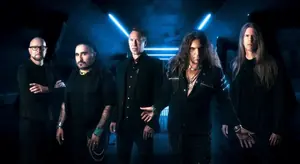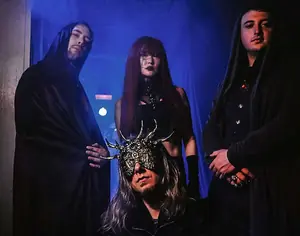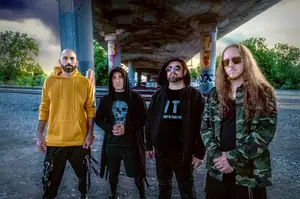

Few bands possess the sheer audacity to slap the word "epic" into their moniker, but for the Dutch symphonic metal heavyweights in Epica, living up to that bombastic branding is merely a Tuesday morning at the office. They do not just write songs; they construct sonic cathedrals. Holding the physical pressing of their eighth studio effort, *Omega*, you feel the literal weight of their ambition. It is a massive four-CD earbook that demands shelf space and undivided attention.
The record is a dense thicket of orchestrations, sprawling choirs and tracks that feel like they were written to soundtrack the end of the world. In a move that defines their "more is more" philosophy, the band released a version that includes orchestra-only, acoustic and instrumental takes. It is an exhaustive, perhaps even exhausting, deep dive for the completionists. Mark Jansen, the man who built this machine after departing After Forever in 2002, sat down to talk about the records, the philosophy and the reality of being a metal titan in a locked-down world.
**Album number eight is here. Tell me about it and what you expected when you wrote and recorded it?**
"Yeah, the thing is, I never have too many expectations. We worked very hard on it and actually, we worked longer on it than ever before. We work and put all our passion in it and then we have to let it go without expectations because you never know what people will say. I hope, of course, that everybody is going to like it, and I already saw some reviews here and there, and people seem to enjoy it. So my confidence is growing, but once you are done, you never know how it’s going to be received and I also never know for sure what people are going to say. Regardless, I’m really proud of this album," Jansen says.
There is a refreshing lack of ego in that admission. You would think a guy eight albums deep into a successful career would have a "take it or leave it" attitude. But Jansen still feels that pre-release twitch. The production on *Omega* is noticeably more polished than their earlier work, likely a result of that extended timeline he mentions.
**Sometimes people connect more with the live show than they do with albums, so this has got to be tough because you’re relying solely on the album right now.**
"Yes, but I adapt myself quickly to a new situation. Live at this point is not possible, but I am still happy that we can release the album, especially now that the people are in need of new music. I get a lot of messages from fans saying that they cannot wait for the album. Some of them are experiencing difficult moments with this pandemic and they say we cannot wait for the music because it surely will uplift their state of being. So if music can help make people a little bit more happy, then I’m extremely happy to hear that," Jansen says.
And he is right. The symphonic metal genre has always acted as a form of escapism. When the real world is shuttered and grey, a 70-piece orchestra and Simone Simons' operatic vocals provide a necessary, albeit theatrical, exit ramp. But the lack of a tour cycle for a band this visual is a massive blow to the bottom line.
**This is a question that I can’t ask most bands because they don’t go to this extreme. Tell me about the concept of the new album.**
"Yeah, the concept is the Omega Point Theory, which is stating that we are fated to swirl towards one point of unification. By we, I mean humanity, but also the universe as a whole. And I thought it was a beautiful concept and I decided to make this the starting point of the lyrical concept—and also Simone was very much into that topic. So 50/50 we wrote the lyrics and we even wrote one lyric together—it’s the song Freedom, and yet the topics of the lyrics are based on ancient wisdom teachings. So there’s some diagnostic stuff on it. Also some from the Emerald Tablets, but in general, a lot of ancient wisdom teachings and I really cannot get enough of these old beautiful teachings. There’s so much to learn and people knew so much already back then that we have forgotten, in a way, but now it’s coming back to the surface," Jansen says.
This is where Epica separates itself from the "swords and sorcery" tropes of their peers. Jansen is digging into Pierre Teilhard de Chardin and Gnosticism while other bands are still rhyming "fire" with "desire". It gives the music a cerebral backbone that justifies the grandiosity.
**What process did you go through to find a concept and how much research do you do?**
"A lot of research, but the topics come automatically to me. So it is not like I’m searching for an idea. It’s more like what I’m interested in, in general life. So always, one book leads to another and one documentary leads to another one and all the things that fascinate me find their way somehow in the lyrics. So, the topics are there first, and then I start finding ways to put them in the lyrics," Jansen says.
It sounds like a continuous feedback loop of intellectual curiosity. For Jansen, the music is the vessel for the research, not the other way around. This explains why the lyrics often feel like a thesis paper set to a double-kick drum.
**What does “omega” mean to you personally?**
"The concept of omega for me means that we as humanity are on the verge of making a huge leap forward and I think our consciousness is going to expand. A lot of things are happening now in the world in a very short moment; a lot of changes, and I think in the next one or two years, the changes will accelerate. It will be hard to process all these changes, but it will be the only way for us to make it possible to make that big step forward and people will start realizing that we are all connected instead of separate beings. So that’s what omega means to me," Jansen says.
There is a certain irony in talking about universal connection while the world is physically distanced. But Jansen is looking at the macro, the long-term evolution of the species. It is a lofty perspective, but then again, you do not name your band Epica to talk about small things.
**So in true EPICA form, the new album is going to have one version of it with four CDs. Now that’s really epic. It’s got to be a lot of work to do that.**
"We did it because there was a lot of interesting stuff this time and also, for example, when we listen to the songs, just the orchestral versions, we thought that it was so beautiful that we wanted to do something with it on its own. For some of the other albums, we did a version where people who would like to do karaoke have a version without vocals, and the fans love it, especially the singers. They can record their own versions and so there’s that version and there is also a CD with the extra tracks, the acoustic tracks and that’s also a lot of fun to make acoustic versions of the album. There’s a lot of inspiration and we decided to release all these versions as one big package," Jansen says.
The industry usually views these massive box sets as cash grabs. But with *Omega*, the orchestral disc is actually a vital piece of the puzzle. It allows you to hear the intricate arrangements that often get buried under the wall of distorted guitars. It is a technical flex, plain and simple.
**I really enjoyed the studio documentary series you did on recording this album, not a lot of bands go into that much detail or their creative process. Was it almost intimidating knowing that people were going to be watching that?**
"In the beginning, when we did that for the first time, I was feeling a bit like that but now I don’t think about it anymore. So it’s nice to have fans who want to see the process and can feel that connection with the album. The video series became even bigger than we initially thought and there was so much material that we could make a lot of flocks out of that. But it’s not intimidating anymore," Jansen says.
Transparency is the new currency in the digital age. By showing the "flocks" or vlogs of the recording process, Epica humanizes what is otherwise a very polished, almost mechanical product. You see the sweat and the frustration, which makes the final, pristine product more impressive.
I get a lot of messages from fans saying that they cannot wait for the album. Some of them are experiencing difficult moments with this pandemic and they say we cannot wait for the music because it surely will uplift their state of being. So if music can help make people a little bit more happy, then I’m extremely happy to hear that.
**Doing orchestrations and choirs involve a lot of work? As the band has progressed over the years, it has almost become bigger and bigger. How big can you get with this?**
"I think it won’t get bigger than this because we made the right balance between all the instrumentation and also, in the mix, we put some emphasis sometimes on guitar, sometimes on the orchestra, instead of having everything all the time together and so this is the maximum of what it will get. Actually, on The Holographic Principle, it was the maximum already because we felt it was getting a bit too full. So, on Omega, we gave it some space to make it a bit more even," Jansen says.
This is a crucial technical critique. *The Holographic Principle* was a sonic assault where every instrument was fighting for the same frequency. On *Omega*, there is actual breathing room. The mix allows the listener to pick out individual violin lines or a specific choral harmony without feeling like they are being hit by a freight train of sound.
**I wanted to ask about a couple of the songs in the new album. Can you tell me where they came from, what they’re about and how you envisioned the tracks? We’ll start with “Rivers”.**
"That’s a track from Rob, the bass player. We are in a lucky position to have five songwriters in the band. So we can always pick the strongest songs from everybody. For Rivers, it came from a dream he had when he slept. When he woke up he had the initial ideas in his mind, lyrically, and also the music. It’s a very nice way to start a song because of dreaming about it," Jansen says.
"Rivers" is a standout precisely because it feels different. It is a melancholic, stripped-back moment that showcases Simone's vulnerability. And the fact that it was born from a dream adds to the ethereal quality of the track.
**Does that happen to you? Do you dream songs?**
"Yes, all the time. For some reason when I’m dreaming, I have the most beautiful melodies in my mind. But when I wake up, often I have forgotten them. But sometimes I remember some and then I record them on my phone right away, because sometimes I go back to sleep. So I am always singing my melodies in the morning, and then when I start working on music, I always listen to the ideas that are recorded and these are usually the starting points for my songs," Jansen says.
It is a common trope among songwriters, but hearing Jansen describe singing into his phone at 4:00 a.m. makes the process feel grounded. It is less about divine inspiration and more about a desperate scramble to catch a fleeting thought before it evaporates.
**We’ve all heard that when Mozart created music, it was all in his head all finished. Have you had a moment like that where something was in your head completely finished?**
"Never. I think Mozart was a genius; he could hear the whole thing in his head. I cannot hear the whole thing in my head; I need to work it out on my computer. I have certain things in my head. To a certain extent I can make a song like that, but not all and not in such detail as Mozart did. That’s why he was such a genius and I’m not," Jansen says.
**I think your fans will definitely say you guys are genius.**
"Yeah, and I become happy when fans are very positive about us, but I would never like to compare myself with a genius like Mozart," Jansen says.
That humility is likely why the band has lasted two decades. Jansen views himself as a craftsman, not a deity. He uses the tools at his disposal—the computer, the software, the collaborators—to build something that his brain alone cannot fully render.
**We’ll move on to “Abyss Of Time”.**
"Yeah, that’s a very funny story. I started working with a guy named Jerome on another project, United Metal Minds, that we have together and there was a song that we were working on and at a certain point, I said this song is not so much United Metal Minds, this song could really work as an EPICA song. I said, 'I really would like to try the song for EPICA. Are you okay with that?' And he said it was fine and so I kept working on the mid part after that. Then I introduced the song to the band and everybody liked the song and we started working with the EPICA members and it became Abyss Of Time. But the initial idea was that I was working together with Jerome and he came with the initial ideas for the song actually," Jansen says.
"Abyss of Time" serves as the album's high-energy opener. It has that classic Epica gallop. But knowing it started as a side-project cast-off makes you realize how much the "Epica filter"—the band's collective input—transforms a basic idea into something cinematic.
**“Freedom – The Wolves Within”**
"This was the first song I think we wrote for the album and I had this idea already for the first riff of the song. I had this idea when we were on tour, and during sound check I was playing a bit of my guitar, and I was playing this riff of the song and so the first song of the album that we wrote was this one and it started four years ago during The Holographic Principle tour," Jansen says.
The riff in "Freedom" has a certain road-worn grit to it. It makes sense that it was birthed in a sound check. There is a spontaneity there that is often missing from the more meticulously planned orchestral sections.
**This is my favorite, “Kingdom of Heaven, Part 3”. This is a series of songs that have been used. You probably have to go back to the beginning to explain the new one.**
"If you go all the way back to the first Kingdom of Heaven, it was actually on Design Your Universe. But the first idea for that song was already 10 years before it was finished. So the history of Kingdom of Heaven already goes back to 20 years, and it became one of the fan favorites. Then we made Kingdom of Heaven – Part 2 and now with Kingdom of Heaven – Part 3, we thought there’s a lot of pressure to make a great Kingdom of Heaven - Part 3, because we have to end this part with a bang and so we were very focused on making this a great song and it really went back and forth between Isaac and I. We were throwing ideas at each other and this song became longer and longer and a certain point, we had 15 minutes of music. We cut some parts out and we only kept the strongest parts, then the band started working on it and some things were changed again. Eventually, Coen started doing his magic with the choirs. So it took a lot of time before it was finished. But then when it was finally finished, I was extremely proud and happy with this one. That’s also my favorite of the album, by the way," Jansen says.
**You said that’s the end. So is this a trilogy and nothing more?**
"Yes, this is it," Jansen says.
Ending a 20-year creative thread is no small feat. "Kingdom of Heaven, Part 3" is a sprawling, 13-minute odyssey that serves as the album's emotional and technical climax. It feels like a closing chapter, a final summation of everything the band has learned about blending death metal growls with symphonic grandeur.
**One of the things I enjoy is the acoustic side of what we’re hearing. That’s a very different side and it almost at time sounds like you’re almost a different band.**
"Yeah, it’s especially fun to make the arrangements. I made for example, the arrangements of Abyss Of Time. Due to the lockdown when actually recordings were for the acoustics I was locked in Italy. So I couldn’t be there when everybody was recording. That was a little bit of a sad moment for me. But I could be there at least by Skype and we discussed the ideas. But to actually record it, I was locked in my house. It’s a lot of fun to work on these tracks to make new arrangements for songs and to do it completely different than the original idea. We actually tried to do it as different as possible because the actual album is the typical EPICA sound, but on the acoustic versions, we want it to sound pretty different, almost like a different band," Jansen says.
The acoustic version of "Abyss of Time" is jarring in the best way. It replaces the bombast with an almost Irish folk sensibility. It proves that the core songwriting is strong enough to survive without the 70-piece orchestra backing it up.
**With acoustic, it really showcases the song writing aspect of it. When you write a song, does it really start off acoustic like that or did you actually have to revisit the song?**
"Every song starts in a different way and sometimes a song can start as an acoustic beat, but most of the time, we first write the actual song and then start reversing it into an acoustic version. Then with the acoustic version we try to do something new to add a new style to give it a new vibe or a new atmosphere. If you take Abyss Of Time, the acoustic version is very much like that of an Irish folk song and that's the fun of it—to challenge yourselves to do something different with it," Jansen says.
**The sound of the band has evolved over the years. Is there anything new that you added to this album that you’ve never used before?**
"I think Abyss Of Time has more power metal than we ever had before and we thought it’s the right time to try something like this, with a really power metal feel and try to make it as EPICA as possible within that power metal vibe. We always try to indeed do something new with our music and in order to keep ourselves fresh and to challenge ourselves," Jansen says.
The power metal influence on *Omega* is undeniable. It gives the record a forward-leaning momentum that balances out the slower, more ponderous symphonic moments. It is a smart pivot for a band that could easily have rested on its laurels.
**You briefly mentioned just a few minutes ago about not being with the band to record the acoustic stuff. Did COVID play a part of recording the entire album, or did it change the way you do things?**
"Luckily for the biggest part, everything went the normal way. COVID started in February in the Netherlands, but then still things were possible. At a certain point, the lockdown started and then we were almost done with the recordings. It’s just Simone and me—we had to record our vocals and I recorded my vocals in my own home studio and Simone recorded her vocal parts in Germany. Basically, everything went as a normal procedure, it’s just at the end it was Simone and me recording in different studios and, of course, the acoustic versions, I couldn’t be there as you know," Jansen says.
**As the screamer and grunter of the band, I always wanted to know how do you guys maintain your voice to not hurt or strain it?**
"Over the years, I started developing my technique. I started back in the days when I was in my first band After Forever and I started with just screaming—didn't do grunts yet. Over time, I learned how to do grunts and the very first time I must say, when I tried it, my throat was on fire, it was burning like hell and I thought this is not going to work for me. I found a way to make it work. Now that we are in this pandemic for almost a year, I started trying my voice again in the last couple of days and I really have to get into it again. After one year of inactivity, I noticed that my voice is not used to grunting anymore. So hopefully I will get it back on track," Jansen says.
This is the physical reality of being a metal vocalist. It is an athletic endeavour. If you do not use those muscles, they atrophy. Jansen’s "burning like hell" description is a stark reminder that this music, while beautiful, is built on a foundation of physical strain.
**You wouldn't want to jump into a tour right now today and not be ready for it because that could really hurt your voice.**
"Yeah, I really have to start vocal practicing again, because if we start sooner or later doing maybe a live stream show, I need to be ready for it," Jansen says.
**You guys have announced some tour dates at the end of 2021 and into 2022. Hopefully that happens. I bet you’re dying to get back out there.**
"Actually today we heard already that one of the festivals that we booked, Hellfest, is postponed to next year. But I was expecting something like this to happen because I don’t think this summer is going to be full of festivals yet. It’s too early and not that nothing is possible, for sure things are possible, but we’re not going to have 100,000 people in one area. That’s simply not going to happen, unfortunately. So fingers crossed that sooner rather than later, things start being possible, but it’s very hard to tell when it actually will be," Jansen says.
It is a sobering end to the conversation. *Omega* is an album designed for the biggest stages in the world—for the 100,000-person crowds at Hellfest or Wacken. But for now, it remains a solitary experience, trapped in headphones and high-end stereo systems. But if Jansen is right about the "Omega Point," perhaps this period of isolation is just the friction needed for that next big leap forward. In the meantime, we have the four CDs to keep us busy.