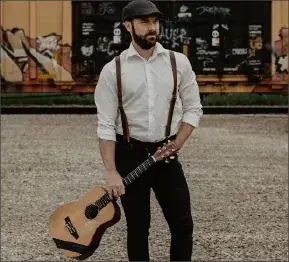

Windsor has a way of producing artists who sound like they’ve spent too much time staring at the Detroit skyline through a cracked window. Brendan Scott Friel is the latest to lean into that grit. He’s a folk singer with a penchant for the cinematic, and his latest single, "Shadows", feels like a sharp pivot from the polished singer-songwriter tropes that usually clog the airwaves.
The track arrived with a music video that looks like it was shot in the bones of a dying industry. It’s dark. It’s heavy. And it’s the lead-in to his new album, *Summer Moons*, which is slated to drop later this month. We sat down with Friel to pick apart the mechanics of his new sound.
When you listen to "Shadows", you aren't just hearing a song; you’re hearing a calculated shift in tone. Friel is obsessed with the idea of light and dark, a thematic tug-of-war that defines the new record.
"Shadows is one that I wrote actually a while back now and I’ve been waiting for a full album to finish. It’s definitely a representation of the darker side of my new album. Duality is a big theme I’ve been thinking a lot about. The first single was very much the optimism and a little bit of naivety that goes with that. This song is the opposite end of that spectrum, and I really wanted both to be present for people so they get a grasp of what this album is going to be about," Friel says.
But writing about darkness is a tricky business when your actual life is going well. Most folk singers rely on the crutch of their own misery to fuel their lyrics. Friel didn't have that luxury. He’s happy, which, for a songwriter, is a bit of a professional hazard.
He admits that the track is a hybrid of reality and imagination. "It’s interesting for this one in particular, because it’s half and half. I’m thankfully happily married, so my writing breakup songs are hopefully behind me from my own personal point of view. So that created an interesting dilemma for myself, where I really like sad songs. And I think there’s a lot to that to experience. I had to tap into my own past experiences, but very much think of a protagonist who was fictional. That was a new writing venture for me, and I hope it turned out," he explains.
This move toward fiction required a level of character work that borders on method acting. Friel didn't just write lyrics; he built a person. He credits his producer, James Bunton, for pushing him into the weeds of this fictional life.
"Yeah. And it was actually the producer I was working with on this record, James Bunton, who really got me to dive in on that. If I’m going to create these characters, it’s important that they’re fleshed out and really well developed beyond the song details. He would ask me, how long is this person’s hair? Has this person travelled? It’s all thinking and really getting this rich character that informs the way the lyrics will move forward from there. So there was a lot of thought put into the details, like how old is this person that is singing? How many experiences he had in relationships, and even though it’s not necessarily present in the lyric explicitly, it’s implied through the voice," Friel says.
And that voice is carried by a very specific, very cheap piece of history. In an era where every indie artist is chasing a $5,000 vintage Gibson, Friel went the opposite direction. He used a Kay. For the uninitiated, Kay was the brand you bought out of a catalogue when you couldn't afford a real instrument.
"This was my producer’s guitar. He had one sitting around in the corner called Kay. I believe it was from either mid 60s that they sold at department stores. This would be the equivalent of a Costco guitar today. I have this nice Gibson with me and all the standard, nice guitars that are on the rack and for some reason this guitar kept winning the shootouts, which is where we would record the track with three or four different guitars. Only he knew which one was which and I would listen and pick the one that I thought sounded best. This Kay guitar, for whatever reason, just kept winning. It didn’t sound great in the room, but when you recorded it, it just really had this dead, but beautiful quality that just I couldn’t get over," he says.
There is a lesson there for the gear snobs. Sometimes the "dead" sound of a cheap laminate top provides more character than the shimmering overtones of a boutique acoustic. It’s about the vibe, not the price tag.
I like to think of each song as a plot point on an emotional graph. In many ways, it could be someone returning to one person every summer and seeing where they are emotionally this summer compared to last. And each song builds that way. ...It is important to me that this album is experienced both privately and then in show formats.
"It’s true. And I do think it is a one of a kind thing, like I might find another Kay guitar that doesn’t necessarily do the same thing. And same with that Nova guitar. It’s really special when you find one that works. You’re lucky to have picked that up," Friel adds, reacting to the mention of a $5 thrift store find.
The recording process for the vocals was equally unconventional. Forget the isolation booth. Forget the pristine condenser mic and the perfect posture. Friel wanted something that sounded like a confession whispered in the middle of the night.
"This was another first for me. We really wanted to give over to what this song was, and that meant a couple of unorthodox recording styles. Usually, when you’re tracking a vocal, you’re wearing headphones into a condenser like this, and you’re isolated and no one else can hear it. For 'Shadows', the song was actually coming out of the main speakers, I was lying down in the couch, and we had all the lights out. I was using this old handheld mic, just laying down in the dark and singing into it with the song in the room. That was so bizarre. I’ve never done anything like that. In my head, I was thinking this is not going to work, but as it kept coming together, I fell more and more in love with the fact that there’s this odd sounding vocal and it’s going to be polarizing. I do think that ultimately, this quality is what really commits the song to what it is," he says.
The result is a vocal take that feels heavy with the weight of the room. It’s messy. It’s human. And it captures that specific brand of insomnia where your thoughts start to cannibalize themselves.
"It’s an interesting question. It was so long ago. Now, I didn’t know that I wanted it to be this brooding or moody, but I think I had less of a haunting vibe in my original vision. It’s hard to say—I might be misremembering—but I did know I wanted it to be something very intimate and speak to a select few, who I think can relate to that experience. Those nights awake, just when you’re thinking about things you’ve said and things you could have said, and what a horrible experience that is. I’d like to pretend I had it all mapped out, but I don’t know that I did," Friel admits.
The music video for "Shadows" doubles down on this isolation. Directed by Garett McKelvie, the visual avoids the typical folk cliché of the artist singing in a field. In fact, Friel isn't even in it.
"I owe a lot of credit to Garett McKelvie, who was the director and came to me. I taught him guitar—that’s how we met. And I found out he does film and I started talking about my music videos. The only real idea that I had coming in was something I knew I wanted, which was that I didn’t want to be in it. I’m very much not an actor and I’m quite uncomfortable in front of cameras, so I didn’t want to pretend that I’m an actor," Friel says.
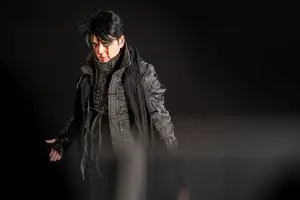
The video features an actor named Trey, wandering through a cavernous, freezing warehouse. It’s a visual metaphor for the mental space the song occupies.
"There are people who dedicate their lives to this craft, and he was excited by this premise. And that’s where we got rolling. He came back with some concepts and discussed this idea of how lonely that feeling is when you’re in your room and how your room feels like this haunted awful warehouse entity. We could literally shoot that and have it transformed back into his bedroom by the end, and I was in love. It was exactly in line with what my song was talking about and it did exactly what I hoped music videos do. Any sort of content I put out does, which furthers the original piece of work. It adds more layers and more context to what the song is. It’s not just a promotional kind of tool," he explains.
Filming in Windsor during the winter is its own kind of torture. The location was a massive brick building off Wyandotte, a place where the cold settles into the floorboards and doesn't leave.
"The location was interesting for sure. It was this big old brick building off Wyandotte in Windsor that we were lucky enough to get access to. It was freezing cold, like maybe the coldest day of the year, so hats off to Trey, who is the lead actor in the music video. He was in just this thin little coat, which must have been freezing, but he didn’t complain once—he hung in there and did all the takes. It was pretty amazing to watch," Friel says.
This shivering, bleak aesthetic is a far cry from his previous single, "Cheap String Lights". That track was a warm, nostalgic piece of indie-folk that felt like a summer evening. The contrast is jarring, but Friel says that was the point.
"It was very much a challenge. Originally, this album was seen as two separate EPs. That’s how different the song styles were coming out, but as I continued to work and craft the songs, they started to draw closer together where they could be on one piece of work if I synchronized it correctly. It was challenging to make sure it sounded like it was coming from the same voice, but the same voice going through very, very different ends of the emotional spectrum that is life. I think the challenge mostly was on that sonic end—if I could tie these songs sonically, they could be very, very different thematically, or at least that’s my hope. I’ll find out how successful I am when the album comes out in April," he says.
To understand the darkness of "Shadows", you have to understand the light of "Cheap String Lights". One is about the fear of the past; the other is about the joy of the present.
"Cheap String Lights is very much the other end, where the excitement of being up and not being able to sleep—but not out of the loss of love, but out of the feeling of love being next to you and feeling that I’m taking this for granted. I’m wasting hours by not being up with this person and there’s a whole night outside we could go explore together and reminisce on our lives together. I’m too excited to sleep next to this person right now and I need to wake them up. It comes out of my annoying habit of not sleeping very well and constantly bugging my wife Alicia," Friel says with a laugh. "So that one is very much rooted in real life."
As we look toward the release of *Summer Moons* on Apr. 23, Friel is navigating the same uncertainty every artist faces in the post-pandemic landscape. The album is a map of his psyche, but he wants it to be more than just a digital file on a server.
"The album will be coming out April 23 and it’s called Summer Moon. We touched on struggling with duality. I like to think of each song as a plot point on an emotional graph. In many ways, it could be someone returning to one person every summer and seeing where they are emotionally this summer compared to last. And each song builds that way. I would love to play these live, but of course, we’ll all see how that works. So as far as plans for 2021, I want to put this out. If necessary, I will get creative in the ways of delivering the songs with a live feel, but it is important to me that this album is experienced both privately and then in show formats," he concludes.
Whether he’s lying on a couch in the dark or freezing in a warehouse, Friel is chasing a specific kind of truth. It’s not always pretty, but it’s real. And in the crowded world of Canadian folk, that’s more than enough.