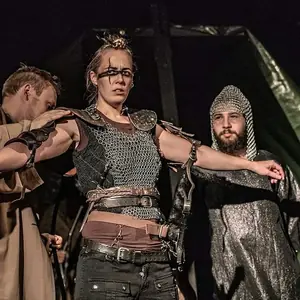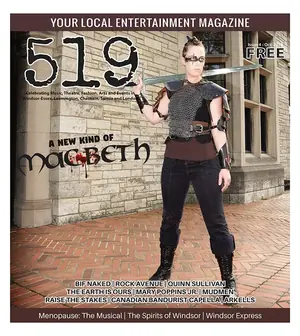

Walking into the Kordazone Theatre, you can smell the sawdust and the lingering scent of last season’s greasepaint. It is a space that thrives on the fringe, and right now, it is being prepped for a version of the Scottish Play that looks less like a royal court and more like a scrapyard. Korda Artist Productions is taking *Macbeth* and dragging it through the dirt of a post-apocalyptic wasteland.
The production, which opens Oct. 18, is a gender-free reimagining that ditches the velvet robes for something far more jagged. Directors Sean Westlake and Martin Ouellette are back together after their run with *Evil Dead The Musical*, and they are trading the campy chainsaws for a brutal, adrenaline-heavy aesthetic.
But this isn't just about putting actors in leather and calling it a day. The vision here is built from the ground up, moving the action into the laps of the audience. The "Mad Max" comparison is easy to make, but the logic behind it is more about survival than style.
When I ask Martin Ouellette why we need another *Macbeth*, he is direct about the shift in setting. Martin says, "One of the major choices that we made right away was that it had to be set in a future post-societal collapsed Scotland, basically far enough in the future that if there is any mention of the current times it would only be in legend. It’s a George Miller, very Mad Max type of vision where it made sense to me visually. Some of our weapons are just modern materials that have been fused together to make a weapon, so it makes sense from a budgetary standpoint, but I was also really interested in casting the show gender-blind and seeing how the story would work out with a female Macbeth. These are women in traditionally male roles, but we just went for the best actor who walked into the room for every role and then we worked around that."
The choice to use "fused" modern materials for weaponry is a clever bit of theatre-making. It grounds the play in a world where resources are scarce, which mirrors the lean, mean production style Korda is known for. But the real hook is the gender-blind casting, which Ouellette treats as a social experiment rather than a gimmick.
In this version of Scotland, biology is secondary to utility. The directors have created a world where identity is tied to what you provide for the tribe. It is a radical departure from the rigid hierarchies of the 11th century or even the Elizabethan era.
Martin explains the linguistic shift that follows this logic. Martin says, "One of the conceits of the piece is the references to gender – he’s, his, Kings, Queens. In our world, gender pronouns are derived from what you do in society rather than what your reproductive system says gender is. Once we made that choice, it made for some really interesting twists to the storytelling. For example, it gives a whole new story behind the childlessness of the Macbeths. These people want power, but they have no path to power in a society where power is derived only from the bloodline. If they can’t have children, what is their avenue to power? It’s obviously violence."
This adds a layer of desperation to the Macbeths' plot. In a world where your legacy is tied to blood, being a "dead end" biologically makes the crown the only thing left to grab. It turns the couple into a pair of survivalists fighting against their own obsolescence.
And it is important to distinguish this from other all-female or gender-swapped productions we have seen recently. This isn't just about putting a woman in a crown and calling her "King." It is about redefining the words themselves.
Martin clarifies the distinction. Martin says, "No. It’s not like women or men in traditional male roles. If you are the person that goes out and fights and does things out in the world that are a traditional masculine thing to do, then that makes you a 'he'—it doesn’t matter what the genitals look like. It is the same as with if you were taking care of the home front with those traditional feminine activities—that would make you a 'she'. They’re going to see a completely different production of Macbeth that they have never seen. It’s a choice we made. We weren’t sure; it was a bit of a gamble, but once we started seeing the scenes and seeing the way that it was working, we are really happy with it."
One of the major choices that we made right away was that it had to be set in a future post-societal collapsed Scotland, far enough in the future that if there is any mention of the current times it would only be in legend. It’s a George Miller, very Mad Max type of vision... I was also really interested in casting the show gender blind and seeing how the story would work out with a female Macbeth.
The gamble seems to be paying off in rehearsals. Sean Westlake notes that the concept was not a rigid cage they built before casting, but a living thing that adapted to the actors they found. Sean says, "It strengthened as it went."
Martin agrees, noting the speed of the process. Martin says, "Yeah we had the visual sense of the show very early. We went into casting kind of blind. We went from talking about the show to casting it in a couple of weeks."
Fay Lynn, who takes on the title role, did not need much convincing. For an actor in the local scene, the chance to play Macbeth—not Lady Macbeth—is the kind of opportunity that rarely comes along without a "concept" attached to it.
Fay says, "I did actually, I had seen it as a post-apocalyptic society/collapse kind of thing, which is very exciting because that is how I have always wanted to do this show. I wanted to be in this show at any capacity since I read it in high school. I considered directing it years ago with the same kind of twists, the same kind of take on it, except the vision was taken much further by Sean and Martin, so it actually worked out better. When I saw that they were going to be casting it as gender-blind, I thought it was amazing. I was just super excited about that. I had always imagined I’d play Macbeth, but I grew up in the time when you were either Lady Macbeth, Lady Macduff or one of the witches—that’s your choice and that’s what you get. Now all of a sudden Macduff, Macbeth, Malcolm and all these amazing roles—everything is open."
It is a refreshing take. Usually, when people talk about "opening up" Shakespeare, they mean adding a few laptops or suits. Here, they are opening up the very DNA of the casting process.
Martin is quick to praise Lynn’s technical ability, which is a requirement for a role this dense. Martin says, "We’ve seen Fay perform in a number of shows, and I’ve worked with Fay on a couple of shows. Fay is an autodidact and has an incredible memory. Macbeth is a huge role and it’s 63% of the total dialogue, so she’s more than capable of handling it."
The rehearsal process has been famously fast. Sean recalls a moment early on that solidified his confidence in the lead. Sean says, "It was either the second or third rehearsal and I had to ask her where her script was."
Martin adds that the luck continued with the casting of Emma Amlin. Martin says, "We really needed that, and we really lucked out, because we also found Emma, which is her first show with Korda, but her memory is just as strong."
For Fay, the mental heavy lifting of the script was a fair trade for the physical demands of the show. Fay says, "It’s great that my memory is a trade-off because I get to learn sword fighting. When I found out that Sean was choreographing it I was really excited."
The combat is where this production might either soar or stumble. In a small space like Kordazone, fight sequences can feel cramped or dangerous. But Westlake is leaning into the physicality, using real steel to provide the kind of auditory feedback that plastic or wood just cannot mimic.
Sean says, "The other thing I wanted to say too is that I’ve always been looking for that perfect production that really brings out my skills and fight choreography. For this show we brought in a steel sword for the fight sequences in the production."
There is a specific "clink" and weight to steel that changes how an actor moves. It forces a certain level of respect for the weapon. And where there are swords, there is usually a mess. Given the team’s history with *Evil Dead*, everyone is expecting a high body count and the fluids to match.
Martin confirms the gore factor. Martin says, "Hopefully fake blood, yes. One thing about going post-apocalyptic/social collapse is that we will be able to integrate modern technology without it seeming anachronistic, so we’re going to be using some projection. We’ll be using a lot of light tricks and there are a couple of things that I want to do that are from the movie Prestige—some of the magic tricks we’re going to be trying to pull off."
The mention of *The Prestige* suggests some stagecraft that goes beyond the usual smoke and mirrors. If they can pull off actual "magic" in a space where the audience is practically on stage, it will be a feat of engineering.
However, the risk with any "Mad Max" aesthetic is that it can sometimes look like a high-budget Halloween party if the textures aren't right. The "modern materials fused together" weapons need to look heavy and used, not like spray-painted PVC pipe. But with Westlake and Ouellette at the helm, there is a level of trust that the grit will be genuine.
This is a brutal tale that has been told a thousand times, but Korda is betting that by stripping away the traditional gender roles and the royal finery, they can find the raw nerve of the story. It is a gamble on the best actor for the job and a gamble on a future that looks a lot like our most violent past.
*Macbeth* runs at the Kordazone Theatre in Windsor on Oct. 18 to 21, Oct. 25 to 27 and Nov. 1 to 3. If you want to see the blood and the steel up close, you can find tickets at kordazone.com. Don't expect a seat in the back—at Korda, you're always in the middle of the collapse.
Get Tickets