Darren Lynn Bousman had something here. A con-artist thriller that pivots into body horror when the mark turns out to be a neurosurgeon with very specific plans for his captors — it's the kind of premise that, on paper, should leave you genuinely rattled in your seat. Sitting through Twisted, though, what you get is disturbing in an entirely managed, pre-approved way. Which, depending on your tolerance for films that flinch at the exact moment they should commit, is almost worse than just being bad.
Bousman directed four Saw films. Four. That institutional muscle memory is everywhere in Twisted — the dutch angles stacked like a dare to cinematographer Bella Gonzales, the whip-cut editing that mistakes speed for dread, the whole visual grammar of manufactured unease. Inside the Saw universe that toolkit worked because the trap mechanisms were doing the structural heavy lifting. Here, without that architecture, it reads as a borrowed vocabulary deployed in service of a story that hasn't actually built the menace those shots are supposed to be amplifying. Mark Sayfritz's score doesn't help: synthetic low-frequency drones that aim for subcutaneous dread but land closer to background anxiety, the mid-range frequencies fighting the dialogue mix throughout.
The setup, though. Give Bernstein and Greer this much — the first act has a procedural confidence that's genuinely engaging. Paloma (Lauren LaVera) and Smith (Mia Healey) are running a real estate scam in New York City, leasing apartments they don't own to renters who don't know any better. Watching two intelligent women work a con has a cool, specific energy that most genre films of this type don't bother earning. There's a transactional precision to how they move through the world. And then Paloma runs into Dr. Robert Kezian. The trap closes. The film begins its slow retreat from everything interesting it just established.
Djimon Hounsou plays Kezian with the kind of stillness that is, in theory, the most frightening register available to a horror antagonist. He's good. Genuinely good — there's a composed, clinical authority in how he constructs the character, something closer to behavioural observation than performance. In the film's contained middle section, you can feel the outline of a truly unsettling villain pressing against the glass of the material. The cage just never opens. The script gives Kezian menace in controlled doses when what he needed was permission to be actually monstrous, and Hounsou — who could have run with it — is left to do careful, precise work inside a frame that won't let him go far enough.
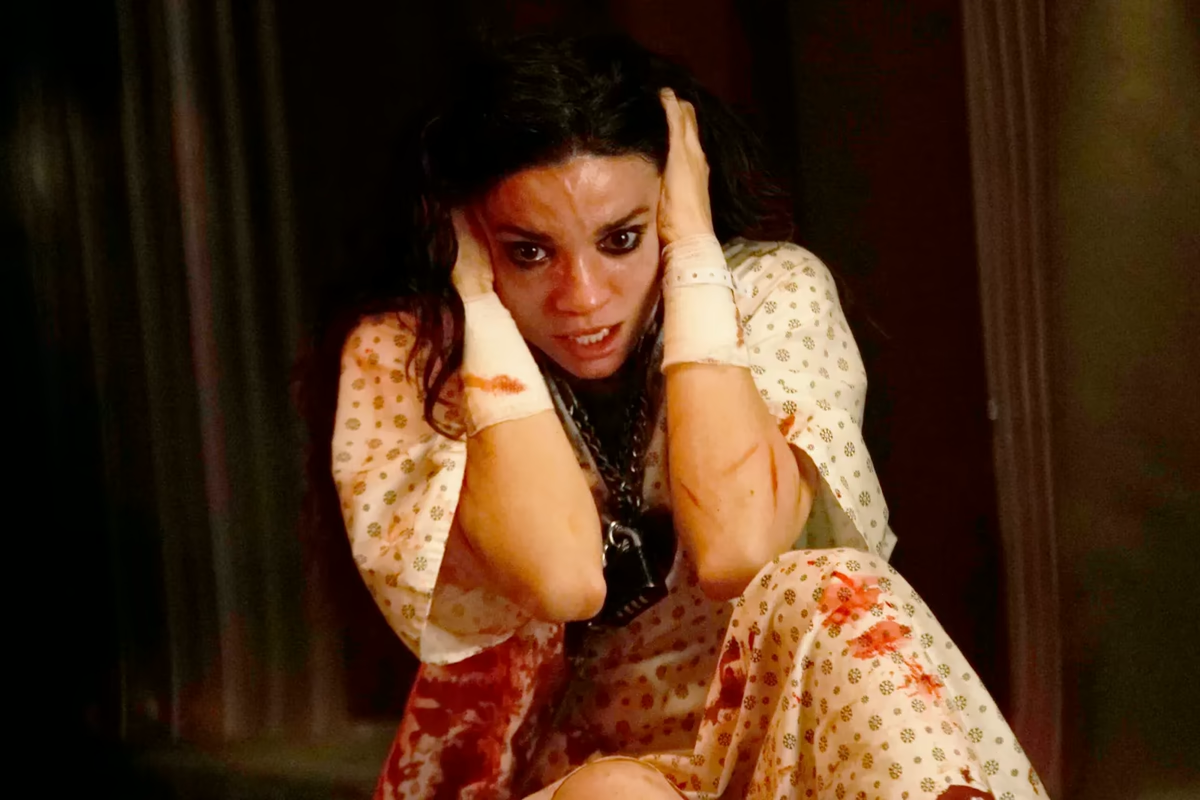
Lauren LaVera is the best reason to watch this film, and the distance between her performance and what the material asks of her is where Twisted most clearly fails itself. Coming off the Terrifier franchise, where she was handed full emotional range across sustained sequences of extreme physical horror, LaVera arrives here with the kind of genre fluency you don't have to manufacture — it's in her body, in the specific micro-hesitations of her reactions, in the way she reads as a person actively processing a situation rather than an actor hitting marks. What she finds in Paloma — the particular deflation of someone who built her entire life around controlling outcomes suddenly having zero control over anything — is exactly the psychological architecture this film needed to build around. It mostly declines the offer.
This is where Bernstein and Greer's script breaks down, and it's the single most costly creative decision in the film. The Kezian material points somewhere genuinely dark — the body horror implications, the specific horror of being treated as raw material by someone with medical precision, the psychological erosion of captivity. The film touches all of it and then retreats into safer, more conventional horror mechanics. Gore arrives in clinical bursts rather than as accumulated dread. The cognitive and psychological dimensions of what's happening — the most interesting territory available to this story — are acknowledged and released. It wanted to go somewhere harder. The script just wasn't prepared to go there with it.
The other squandered premise is the con itself. Paloma and Smith make their living reading people, fabricating false realities, manufacturing exits. The more interesting version of this film uses those exact skills as the engine of the escape, puts two professional deceivers in a room with a man who thinks he's the smartest person present, and turns the genre mechanics into a psychological match. Twisted gestures at this in its third act but backs into a more standard physical resolution before it gets there. Watching it in a near-empty theatre on a Thursday night, you keep waiting for the film to become the movie it clearly knows it could be. That moment doesn't come.
Hounsou and LaVera are worth 93 minutes of your time. The premise, in a draft that had more nerve, was worth considerably more than that. There's a version of Twisted that's genuinely disturbing rather than disturbing adjacent — something that earns its R rating from sustained psychological pressure rather than periodic violence. Bousman, chained to his own genre reflexes, couldn't find it. Tha