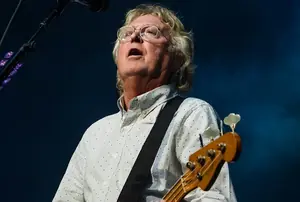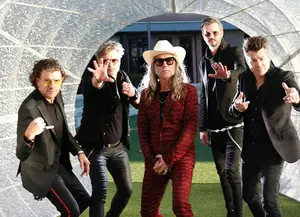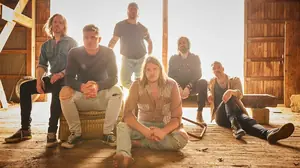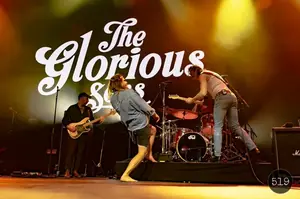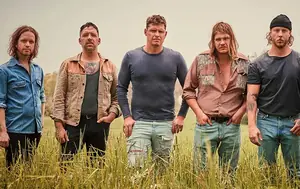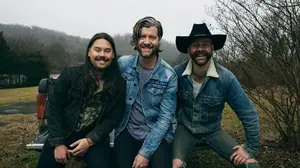

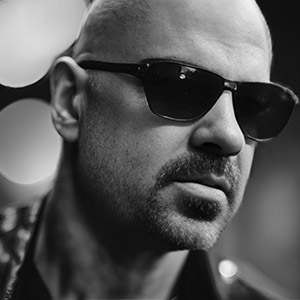
Standing in the humid air behind the stage at Park Jam in London, you can feel the shift. The Glorious Sons are no longer just that hard-touring outfit from Kingston playing for beer money. They are currently occupying a rarified space in the Canadian and US charts, fueled by the grit of "Panic Attack" and the slow-burn melancholy of "Pink Motel." With their new record, *A War On Everything*, slated for a Sept. 13 arrival, the band is squeezing in four domestic dates before crossing the Atlantic for a fall tour.
But this isn't just another album cycle. It feels like a reckoning. The band’s trajectory has been a steep climb, and with "The Ongoing Speculation Into The Death of Rock And Roll" serving as a middle finger to industry doomsayers, they are leaning into a sound that is as frantic as it is polished.
I sat down with vocalist Brett Emmons to talk about the new music, the emotional labour of being rock’s current torchbearers and a specific gaffe early in their career that still haunts him.
We started with the title. It is aggressive, sweeping and perhaps a bit misunderstood. I told him it looks like they are finally ready to declare a war on everything.
"I guess so. Everybody has been kind of saying that in the press, the way that they’re wording it. I’m not sure if that was what was intended necessarily, but sure, yeah," Emmons says.
There is a restlessness in the new material that was missing from their earlier, more straightforward blues-rock offerings. I mentioned to him that the new tracks feel like they have a bit more angst, maybe even a touch of ADHD.
"I think it could come off as a little more manic than some of the other tracks that we’ve released in the past, for sure. Definitely some anger there. I think that there’s some happiness too. There are some songs that touch on a form of happiness that I haven’t quite reached before either, in past songs or songwriting as well," he says.
The record doesn't just sit in one lane. It swerves. It is the sound of a band that has spent too much time in a van and not enough time in their own heads.
"I think it’s kind of, it’s very eclectic, manic album, to be honest. When I listen back to it, and realize what we did for the last month. I’m pretty proud of it for that, covered a wide range of emotion and time in my life. And maybe perhaps, a few issues of, you know, things going on as well, in the world today," Emmons adds.
I asked him if this manic energy is what truly sets *A War On Everything* apart from their previous efforts, like the Juno-winning *Young, Beauties and Fools*.
"I don’t know because I think that there was definitely some anger in our work before as well. You know, I don’t know if that’s really for me to decide, to be honest," he says.
The transition from the road to the studio was almost instantaneous for this record. There was no decompression period, which likely explains the raw, unvarnished feel of the vocal takes.
"It’s hard when you’re in it, you know? We got off the road and decided to go straight into the studio, and I’d been writing quite a bit over two years. Sometimes, a song is just a song. And I’m not really sure how it’s going to be interpreted or how people are going to compare it to our other work, but like I said, I’m very confident in the songs and it definitely is a lot of emotion and I hope people can relate and feel what I feel," Emmons explains.
And he isn't just looking for radio play. There is a sense of communal healing he's aiming for, even if he's hesitant to sound too lofty about it.
"I hope it helps, I guess, for lack of a better term, I hope it helps the world a little bit, helps other people, I hope that helps people understand me, maybe people will feel more understood. I don’t know," he says.
We shifted gears to his personal life. During the press run for their last album, Emmons was open about wanting to improve his mental and physical health. I wanted to know how that battle was going now that the stakes are higher.
"It’s going good, actually. I don’t think the problems that I had two years ago are ever going to completely go away. I think some of that was an inability to just kind of accept who I am as a person," he admits.
But the reality of the music industry is that it doesn't leave much room for "normal" life. The Glorious Sons are a touring machine, and that takes a toll that no amount of gym time or clean eating can fully fix.
"Things are good. I’m happy, I’m productive. I’d like to spend a little more time at home, to be honest. I have a lot troubles myself, coming off the road. You know, when you’ve been on the road for a month, two months at a time, and two thirds of the year, and you get home for two weeks at a time, and go back in, it can be hard to relate with the pace of, I guess, home life," he says.
It is a common refrain for frontmen, but Emmons seems particularly attuned to the friction between his stage persona and his actual self.
"Other than that though, I think I’m getting better at the whole thing, I’m trying to at least. And I don’t know, it’s going good. I can’t complain really, to be honest," he says.
We had to talk about "Panic Attack." It is the lead single for a reason. It captures that specific, suffocating feeling of losing control. I asked if it was a direct reflection of his own experiences.
"I’ve dealt with panic attacks for a very long time. So, I mean, that song is, it was written about, basically a panic attack. So it’s written about anxiety and maybe the thought process that one might go through during a panic attack or just maybe the thought process that leads somebody to a panic attack," Emmons says.
I think it could come off as a little more manic than some of the other tracks that we’ve released in the past, for sure. Definitely some anger there. I think that there’s some happiness too. There are some songs that touch on a form of happiness that I haven’t quite reached before either, in past songs or songwriting as well. ... It’s a very eclectic, manic album, to be honest. When I listen back to it, and realize what we did for the last month, I’m pretty proud of it for that, covered a wide range of emotion and time in my life.
The song works because it isn't a clinical observation. It is a visceral, distorted piece of rock that mirrors the internal chaos of the lyrics.
"I tried to make it more universal. I wasn’t trying to imitate one of my personal panic attacks necessarily as much as I was trying to make the lyrics a little more, I mean, they’re not vague at all, but there’s a broad sense to them, that I think anyone can really relate with, when trying to tackle that subject," he notes.
And the songwriting process for it wasn't a straight line. It was a Frankenstein’s monster of different ideas that finally clicked.
"I wrote it on tour, at least the start of it. It’s been three for four different songs. The verse turned into the chorus, sorry, the chorus turned into the verse. Then, in fact, I’m losing air, I’ve had that for, I don’t know, four or five years, just because that is a very specific thing I think that at least a lot people go through. I do, when I have a panic attack," he says.
The production on the track is intentionally abrasive. It lacks the polish of modern active rock, opting instead for a "dirty" aesthetic that feels more authentic to the band's Kingston roots.
"When I brought it to the album to release it, we want it to be, a really dirty, fast, hard-hitting song and we knew we wanted to open the album with it as well. So, I mean, I guess, that’s all I got for that one," he says.
Being the frontman means you are the lightning rod. I asked him if he’s ever had one of those attacks while standing in front of thousands of people.
"No, no. I’ve definitely been angry and been very nervous and been very dismembered on stage before, but I’ve never experienced a panic attack on stage, that would be complete hell. I don’t know how I’d be able to deal with that. Not a real panic attack, no," he says.
The response to the music video has been overwhelming, with fans using the comment section as a makeshift support group. I asked if he ever expected the song to become a therapeutic tool.
"No, I didn’t. The thing is the lyrics that I write are always kind of like this: They always have to do with real life themes and have some dark undertones. They’re meant to make people think. But, when I was thinking of that song, after writing the lyrics originally, and getting some of the melody down, when we were in the studio, we just wanted to make a barn burner, to be honest," Emmons says.
But sometimes the artist’s intent is eclipsed by the audience’s needs. The song has taken on a life of its own.
"In hindsight, the lyrics and the music definitely fit together to create, I guess, an overarching feeling of panic and chaos, and what that might feel like during a panic attack. But that was never really the intention because a lot of the lyrics that I write are like that anyways," he adds.
There is a specific duality to The Glorious Sons. They have these massive, melodic hooks that feel like they belong in a stadium, but the lyrics are often rooted in the gutter.
"Whether it’s a fast song, a happy-sounding song, a slow song, a lot people like to characterize our music, or are starting to at least characterize our music as like, sometimes happy-sounding, and melodic-sounding but with very dark undertones," he says.
Then there is "Pink Motel." It is a beautiful, tragic song that ends in a total emotional collapse. I told him it felt like he just said "fuck it" to everything by the end of the track.
"I was kind of going through a breakup when we were in the studio. I had Pink Motel for, a year and a half, two years and the song was about the distractions that we face to keep us from one another and how that can really damage a love-life, and take people away from one another," Emmons reveals.
The ending of the song isn't scripted. You can hear the genuine frustration in his voice as the track unravels.
"The last part is kind of like, not to get too vulnerable, but it’s kind of like, I just wanted to say, I put it at the end of this song, we didn’t know that we were going to record it that way. We knew that the first part of the song was really good, but we didn’t necessarily know that that part was going to happen," he says.
It is a moment of pure, unadulterated honesty that is rare in modern recording. It wasn't about the perfect take; it was about the right feeling.
"I was sitting there with the lyrics, and I’d finished writing them and then I just started writing the things that I wanted to say. And it kind of poured out of me. I guess it’s me trying to have the last word, selfishly, if you will. But I hope that it also comes off as helpful. And maybe other people can hear their own problems, and hear themselves in those lyrics," he says.
We moved on to "The Ongoing Speculation Into the Death of Rock and Roll." It is a mouthful of a title, and one that has led to some misinterpretation about where the band stands on the genre’s health.
"I think a lot of people are maybe misinterpreting the message of that song because of the title. I mean, The Ongoing Speculation Into the Death of Rock and Roll, it was never really me speculating about the death of rock and roll," Emmons clarifies.
For him, the proof of life is in the sweat and the decibels he sees every night.
"I’m up on a stage with gigantic amps and electric guitars, pretty much five nights a week. I believe in rock and roll, I don’t think it’s dead. I think that if you go into so many clubs and bars across Canada and the States, you’ll see kids shouting their heads off, playing the electric guitar, and kids sweating their asses off, and cheering as loud as they can, in cities and towns everywhere," he says.
The song is less a eulogy for a genre and more of an homage to the icons who lived it to the extreme.
"I don’t think the genre is dead at all. It was more, the song was a nod of the cap to, people who pursued lives of “rock and roll”, I guess, in quotations because, it mentions Marilyn Monroe and Tupac Shakur as well," he says.
And it’s that pursuit of freedom that defines the spirit of the music for him, regardless of whether it’s coming from a guitar or a microphone.
"I mentioned people who pursued their dreams in the name of freedom. Freedom for themselves in their lives and had that kind of taken away from them, stripped from them, while doing what they loved. And then doing what they loved and then it seemed to become more than they anticipated it to be and I kind of thought, Tupac and Marilyn Monroe, what’s more rock and roll than people just trying to be free? That’s how I’ve always kind of interpreted rock and roll. The lifestyle and the ‘60s," he says.
With all this new material, I asked how the live show is going to change. The Glorious Sons are known for their high-energy, no-bullshit performances.
"It’ll allow us to have a little more room to breathe, a little more to choose from, in order to give people more of a dynamic experience every time they come out to the show. I think that that’s definitely going to add," he says.
But don't expect them to start using backing tracks or adding a string section. They are purists at heart.
"I don’t see us ever not making the electric guitar our main thing. We are what we are at this point," Emmons states firmly.
And that identity is non-negotiable.
"Of course we want to write new things and make songs unique to the last song we released and we’re always going to do that. But we’re not going to be a band that uses tracks and has 50 people on stage and it’s just not our thing. We’re a rock and roll band," he says.
That steadfastness is likely why they were tapped to open for The Rolling Stones twice. Their most recent stint was at Burl’s Creek in Ontario, a massive homecoming of sorts.
"It was really, really exciting. We’re gigantic Stones fans in the first place. I’d seen them three times before we ever opened for them. And, it’s such an honor," he says.
But playing for Stones fans isn't like playing for your own tribe. It is a different kind of pressure.
"It was nerve-racking, there was a lot of people there. But, other than that, it’s not a very long set. Stones fans are already known to be extremely, I don’t want to say difficult, but they’re there for The Stones, so we knew going into the second show, this might not feel like Glorious Sons’ hometown crowd. Just being in front of 71,000 people is electric. There’s not really a word to describe what it’s like to look out and see the outline of people, slowly blend together because there’s so many people, and they’re further away than you’ve ever seen them at a rock show, that’s just wild," he says.
As they prepare to kick off their tour at Park Jam, I asked about his history with London. The city has always been a stronghold for the band.
"London’s a great audience, they’re always pretty wild there. The last three or four times we’ve been to London Music Hall," he says.
But it wasn't always smooth sailing. He told me about a specific night early on that served as a massive reality check.
"I remember one of the first times we ever played London. We were opening for The Balconies. We got a little bit cocky and it was our first tour ever. And we started drinking really early in the day and we forgot to set up our gear. We were five minutes before we were starting the show and we were scrambling around trying to get our gear out. We finally managed to get our gear on stage, and we were playing after this band called Motorleague. We got on stage and I said “Give it up for Motorhead!” And the whole crowd started laughing, and I realized my mistake, it was Motorleague. It was one of the most sobering experiences of my life," he says.
It is that kind of humility—earned through public embarrassment and years on the road—that makes The Glorious Sons feel real. They aren't manufactured; they are a work in progress. And with *A War On Everything*, they are inviting everyone to watch the struggle in real-time.