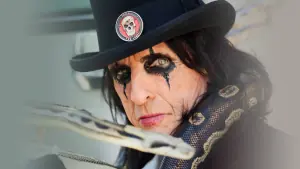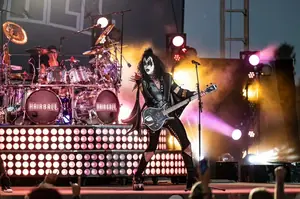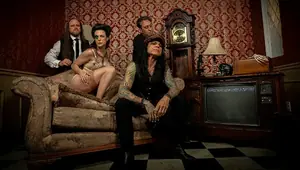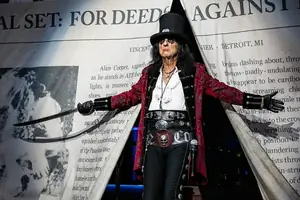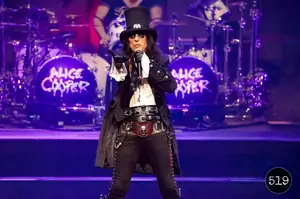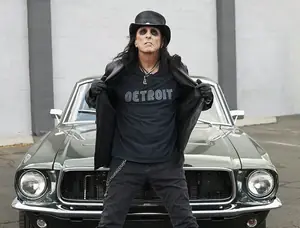
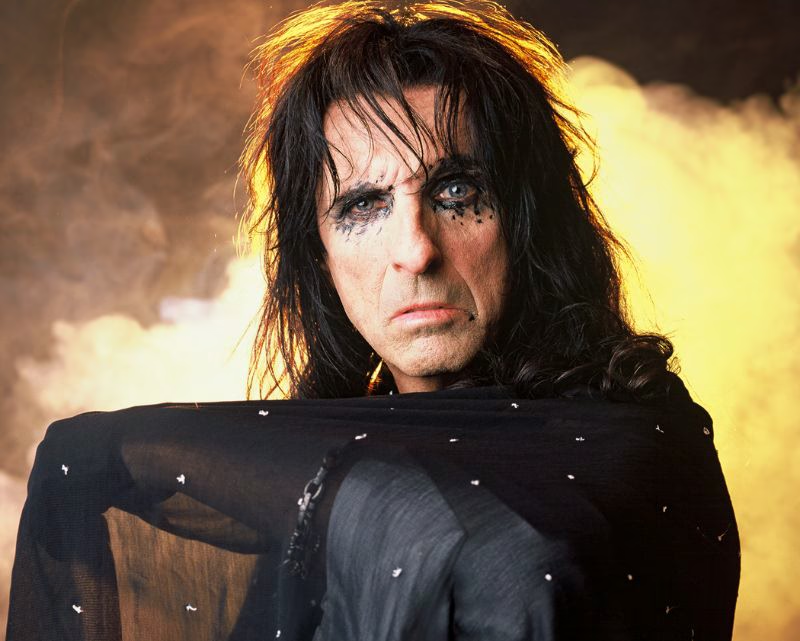
The sun in Phoenix does not just shine; it punishes. It is the kind of dry, kiln-like heat that turns asphalt into a liquid state and makes the very idea of physical exertion feel like a fever dream. But for Alice Cooper, the man who essentially invented the rock and roll nightmare, it is just another Tuesday morning on the links.
We caught up with the architect of shock rock as he was transitioning from the quiet intensity of the fairway to the high-octane grind of the California coast. He sounds remarkably grounded for a man who has spent five decades being executed on stage via guillotine, gallows and electric chair. There is no trace of the "arrogant villain" in his voice today. Instead, there is the relaxed cadence of a survivor who has traded the needle for a nine-iron.
"I am doing great," Cooper says, sounding far more refreshed than any man facing triple-digit weather has a right to be. "It’s 105 degrees in Phoenix today. I’ve already played 18 holes of golf and getting ready to drive to California for two days."
It is a routine that would break a man half his age. But Alice is built differently. The Detroit-born legend has 27 studio albums under his belt and a touring schedule that puts most indie bands to shame. His connection to the Windsor-Detroit corridor remains the backbone of his identity. He is a creature of the Great Lakes, even when he is baking in the Arizona desert.
The golf is not a hobby. It is a lifeline. In the mid-70s, the Alice Cooper persona almost swallowed the man whole. The transition from the "dead drunk" era to the sober, athletic lifestyle of the present is one of the great redemption arcs in music history. He does not hide from his past; he uses it as a cautionary map.
"Well, I just play it every day at six in the morning," he explains, detailing his dawn ritual. "Since I have an addictive personality, I had to find an addiction that wasn’t going to kill me. All my addictions from the ‘60s and ‘70s were all deadly. This one, I play six days a week."
This discipline carries over into his creative output. He is currently obsessing over a return to his roots, heading back to the Motor City to bottle that specific brand of Michigan aggression. The Detroit sound is not just a genre; it is a blue-collar ethos defined by high-output humbuckers and a lack of pretension.
Working with longtime collaborator Bob Ezrin—the man behind *Billion Dollar Babies* and *The Wall*—Cooper is looking to recapture the lightning. Ezrin is the only person who can tell Alice "no" and get away with it. Their relationship is symbiotic, a shared frequency of the macabre and the melodic.
"I’m from Detroit, and it’s in my DNA," Cooper says. "I think the one thing that is consistent in an Alice Cooper album is that it’s guitar-driven rock and roll, very Detroit-oriented hard rock, and it always will be. Of course, we put all kinds of different flavors on it. I’m working with Bob Ezrin. Bob is one of those guys that has a darker sense of humor than I do. So when it comes to some of those songs, and for lyrics especially, working with him is like working with another part of myself. Yeah, the new album will be a pure Alice Cooper rock album. I don’t want to give anything away, but I can just tell you that it’s a guitar-driven rock album, but it’s got a lot of different flavors on it. The new Vampires album is entirely different in that it’s a much more modern sort of rock sound and doesn’t sound like Alice Cooper or Aerosmith. It sounds like the Vampires."
The Hollywood Vampires project is a fascinating pivot. What began as a high-end bar band paying tribute to the legendary drinking club at the Rainbow Bar and Grill has evolved into a legitimate creative entity. It is a bizarre alchemy of celebrity and grit, featuring Joe Perry’s bluesy swagger and Johnny Depp’s surprisingly capable rhythm work.
Critics often dismiss these "supergroups" as vanity projects, but the Vampires have managed to avoid the usual pitfalls of ego. They are moving away from the safety of covers and into the treacherous waters of original material.
"Oh yeah, most of it is original," Cooper confirms. "I think the only covers are Johnny sings Heroes, and those were the people that died. And then Joe sings a Johnny Thunder Song. Other than that, the other 12, 13 songs are all brand new original songs."
The lack of friction in the band is the most shocking thing about them. You have three men who have spent their lives being the centre of attention, yet they function with a democratic grace that is rare in any industry, let alone the toxic environment of rock and roll.
"Here’s the crazy thing," Cooper notes. "You’ve got Alice Cooper, Joe Perry, and Johnny Depp. Those are the three main Vampires, right? We’ve been together five years. We have never been in an argument at all. During rehearsal, during recording, during anything, there’s never been an argument. You have three Alpha males who totally look at the other guy and go, “What do you think?” rather than, “This has to be my way.” We don’t do it like that. It’s like everybody’s very, very cooperative, and that’s what makes it great."
The project is rooted in nostalgia, but it is a heavy, whiskey-soaked kind of remembrance. They are essentially a living wake for the icons who did not make it out of the 70s alive.
"There was immediate magic because we started out just saying, “Look, let’s pay tribute to our dead drunk friends,”" Alice says. "And there was a lot of them, Jim Morrison and Jimmy Hendrix. Between the three of us, we knew everybody."
The sessions for the Vampires have produced some surreal moments, none more so than an impromptu visit from a certain knight of the realm. It is one thing to be a rock star; it is another to have a Beatle walk into your session and start directing traffic.
"We brought Robby Krieger in and said, “What do you think Robbie?” He says, “Well, let’s do Five to One and To Break on Through.” I went, “Absolutely. It’s a great idea.” And then Paul McCartney walks in and sits down at the piano and says, “Two of the guys from Badfinger committed suicide.” He says, “I wrote this song for them.” He sits on the piano and starts playing, “If you want it, anytime, come and get it.” He goes, “Alice, you sing that middle part.” He says, “Johnny, you do this” We’re all sitting there with our jaws open, going, “It’s Paul McCartney.” Being in the studio with Paul McCartney ... I’ve known Paul for 35 years. I’ve been to his house, and everything. But being in the studio with Paul McCartney is an entirely different thing because now it’s not just a Beatle, he is the Beatles."
The chicken thing. You couldn’t write this. ...I’ve never been on a farm in my life, I’m from Detroit. It had feathers and it had wings. I figured, “Well, it’ll fly. If I just kind of chuck it in the audience, it’ll fly. Somebody will get it and take it home and have a cool pet and they’ll name it Alice Cooper.” Chickens don’t fly as much as they plummet. The audience tore the chicken apart and threw the parts back up onstage. ...Right there, I understood one thing, that the rock audience was hungry for a villain. They wanted a villain. I was more than happy to be that character. I said from then on, “Okay. You want villain? I’ll give you a villain.”
This duality—the fan and the icon—is what keeps Cooper grounded. He views the "Alice" character as a distinct entity, a theatrical tool rather than a personal identity. It is a psychological firewall that has kept him sane while his peers were burning out.
"Oh, absolutely," he says of the separation. "When I play that character, he’s an arrogant villain. He’s a condescending Alan Rickman kind of guy. He looks down on everybody. Right? That’s part of the fun ... that’s why he’s funny because you can tell he’s so arrogant, that you know he’s going to slip on a banana peel at some point. You know?"
The Alice character is a silent, judging presence. He does not engage in the usual "How’s everyone doing tonight?" banter that plagues modern arena shows. The Vampires, however, offer a rare glimpse of the man behind the mascara.
"That’s what makes that character fun to play," Cooper says. "He never talks to the audience, never says thank you, till the very end of the show. When I’m with the Vampires, I don’t play that character. I talk to the audience all night. I tell them stories about Jim Morrison and myself. I tell them stories about Jimmy Hendrix, about Bowie, about all these, because I was there for all of it. People then get the insight, we’re not just going to do these songs but I used to get drunk and high with these guys."
His history with Toronto is particularly storied, though not always for the right reasons. On Aug. 19, 1980, a scheduled performance at the CNE turned into a legitimate riot when Cooper failed to appear. Fans tore the place apart. For years, it was a black mark on his record, but the reality was far less scandalous than the headlines suggested.
"It was the only show I ever missed in my entire career, and the reason was I was born with asthma," he admits. "I mean, I had asthma all my life. That was the highest pollen count ever recorded in Toronto, that day."
The physical toll of the road is something he usually ignores. He has performed through injuries that would sideline an athlete, but the lungs are the one thing a vocalist cannot compromise.
"I was having a hard time breathing," he recalls. "It was just one of those things. If I’ve got a migraine headache, if I’ve got the flu, I’ve played with six broken ribs. I’ve played with 28 stitches in my head. I could not sing because I couldn’t get any breath. There’s just no way I’m doing a show. I didn’t think it was going to be that big of a deal, but that place went crazy. We’ve played Toronto 25 times since then. Every time I played Toronto ... and I also did three or four albums in Toronto, at Nimbus 9, with Bob Ezrin. I knew Toronto probably as well as I know Detroit. It’s always been one of my favorite cities. Every time we play Toronto, we always go out of our way to make sure that audience, that we kill that audience, because that one show is in the back of my mind, that I had to miss that show."
Of course, no conversation about Alice Cooper in Canada is complete without mentioning the Toronto Rock and Roll Revival on Sept. 13, 1969. It was the night the chicken died and the legend was born. It is the kind of accidental myth-making that PR firms dream of today.
"The chicken thing. You couldn’t write this," he says. "Here we are. We’re going on between The Doors and John Lennon. We got Jim Morrison and The Doors, and we knew them, they were old buddies of ours, on one side. And then we got John Lennon and Yoko on the other side watching the show. There’s feathers’ going and then I look down, and there’s a chicken. No, I didn’t bring the chicken. I can’t imagine anybody saying, “I got to go to The Peace Festival. Oh, and let me see. I have my tickets and my wallet and my chicken.” Who brings a chicken to a rock show?"
The incident remains a masterclass in unintended consequences. Cooper, a city kid with no knowledge of avian physics, assumed the bird would simply fly away.
"Anyways, there it is. It’s onstage," he says. "I’ve never been on a farm in my life, I’m from Detroit. It had feathers and it had wings. I figured, “Well, it’ll fly. If I just kind of chuck it in the audience, it’ll fly. Somebody will get it and take it home and have a cool pet and they’ll name it Alice Cooper.” Chickens don’t fly as much as they plummet. The audience tore the chicken apart and threw the parts back up onstage. Now the kicker to this is, of course, the first five rows were all in wheelchairs."
The image is gruesome, absurd and perfectly Alice. It was the moment he realized that the hippie era of peace and love was over, and the audience was looking for something darker.
"Well, how weird is it that all the people in wheelchairs destroyed the chicken? That’s even more bizarre," he muses. "And then it’s in the paper the next day, Alice Cooper kills chicken and drinks the blood and duh, duh, duh. Right there, I understood one thing, that the rock audience was hungry for a villain. They wanted a villain. I was more than happy to be that character. I said from then on, I went, “Okay. You want villain? I’ll give you a villain.”"
This theatrical instinct predates the band. It started in high school, where a group of track stars and art students realized that the stage was just another canvas for their weirdness. They were the Earwigs, then the Spiders, and eventually, the Alice Cooper Group.
"Well, it was really one of those things where it was in our DNA, I swear," he says. "Dennis Dunaway and myself and John Spear and Glen Buxton all went to high school together. We were all on the newspaper together. We were all in the art class together. Three of us ran cross country and track together and were four-year Letterman. Even before the band, we knew each other really, really well. When we did our very first show, knowing nothing about anything ... We were in beetle wigs. We were making fun of the Beatles kind of, and on that stage there was a coffin and a guillotine because, if you were late with an assignment at the Tip Sheet, that was the name of our newspaper, you had to stay in the guillotine. They’re hitting the guillotine for 5 or 10 minutes, which was very uncomfortable."
The transition from student pranks to professional grand guignol was seamless. They understood that rock and roll was missing its sense of theatre.
"When we get ready to do the show, I said, “Let’s put the guillotine on stage.” And then the guy that introduced us was another guy on the cross country team, and he came out of a coffin. It never ended. That, to me, just felt like rock and roll and horror and comedy should all be in bed together."
But here is the critique: in an age of digital desensitization, does the guillotine still have teeth? Cooper is aware that you cannot compete with the evening news for sheer brutality. His show has shifted from genuine shock to a sophisticated form of vaudeville.
"You know, you can’t shock an audience anymore," he admits. "Back in those days, it was really easy to shock an audience because nobody ever ... everything was shocking. Now, nothing is shocking. I use shock, if you call it shock. It’s really illusion. It’s really just misdirection. You have to do it with an attitude of this is real. This is for real, this is what we do, and people want to believe that. People want to believe that I live in a big dark castle somewhere and that I drink blood at night and things like that."
It is a willing suspension of disbelief that the audience craves. They want the wood chipper. They want the blood. They want the pantomime of the damned.
"I think so. I’ll never ever go away from that," Cooper says. "I think that that’s what God gave me to do was this sort of show. Everybody that I work with, we’ll sit in there and we’re going, “Okay. Now…Do you think we should use a wood chipper?” And everybody looks around and goes, “Well, of course.” If we’re thinking maybe we shouldn’t, then that’s the cue to, yes, we absolutely should."
The commercial engine for this madness was fueled by the legendary CKLW in Windsor. The "Big 8" was the tastemaker for the entire region, and legendary music director Rosalie Trombley was the gatekeeper.
"Oh my gosh. Without CKLW - they were the ones that got us going," he says. "Rosalie was everything to us. Her son loved the song I’m Eighteen. When he heard the song, he says, “Mom, this is where rock is going.” She went, “Okay, we’ll put it on.” When we heard our record on CKLW, I’m Eighteen, believe me, we stopped the car dead and just sat there with our mouths open. Trust me, we never thought we’d ever have a hit because our image was so strong. We were such a notorious band that we never thought we’d ever get any kind of commercial success. Well, we ended up having 14 top 40 hits."
The success was dizzying. Suddenly, the freaks from Detroit were outselling the gods of the British Invasion. It was a surreal shift for a band that still viewed themselves as outsiders.
"Can you imagine us sitting there when Shep Gordon comes in and he goes, “Oh, by the way, School’s Out’s number one.” Then we go, “What?” And then he comes in again the same year and goes, “Oh, by the way, Billion Dollar Babies is number one.” When that happens, you would think that that would be an egocentric moment. It was humbling and embarrassing because we were such fans of The Who and The Rolling Stones and The Beatles, and that’s who you’re up against right then. When your record is higher than theirs in the charts, you almost want to call them up and say, “I’m really sorry. We don’t deserve to be ahead of you. If it was up to us, we would be number five and you guys would all be number one, two, three, four.” Honestly, that’s the way we felt about it. That’s how much we loved those bands. When you see your band competing with them, you kind of feel embarrassed because you’ve know how good they are, and you don’t really think of yourself as being in their league?"
Despite the global fame, the Windsor-Detroit connection remained personal. Cooper spent his youth crossing the border, enjoying the quiet of the Canadian side of the river.
"My uncle lived in Windsor. My Uncle Jerry lived in Windsor," he recalls. "He lived right on the lake, and we used to go over to Windsor all the time. It was so cool because you’d have barbecues right on the lake. Yeah, we were there all the time."
The current iteration of the Alice Cooper band is perhaps the most technically proficient he has ever led. Nita Strauss, in particular, has brought a modern metal sensibility to the classic arrangements.
"We’re going to be doing the brand new show," Cooper says with a spark of pride. "The great thing is is Nita Strauss, our shredder - she looks like a Victoria’s Secret model, and she plays like Steve Vai. She just got voted best female guitarist in the world. And our drummer, Glen Sobel, got voted best drummer. This band is awfully good. When you put Chuck Garric in there and you put Ryan Roxie and Tommy Henriksen and all those songs, it’s amazing. I love it when I read the review and it’s not about the theatrics, it’s about how good the band is."
At 70+, the question of retirement is inevitable. But Alice does not see a finish line. He sees a horizon. As long as the theatre is full and the voice holds out, the villain will continue his nightly executions.
"I always said if we ever book a concert and nobody shows up, then I know I’m done," he says. "Or if there was something physically wrong or something happened with my family where I couldn’t tour, then I would say, “Man, I had an amazing career.” But right now, I look at it this way. I don’t think I’ve done my best show yet. I don’t think I’ve written my best songs yet. If you don’t have that attitude, you should stop. I sit around thinking about McCartney sitting at a piano going, “Okay. I’ve written all these songs, but you know what? I have not written my best song yet.” That’s why he keeps writing songs.
Get Tickets