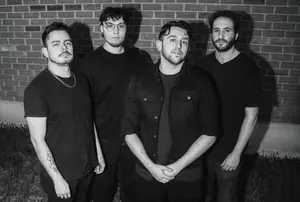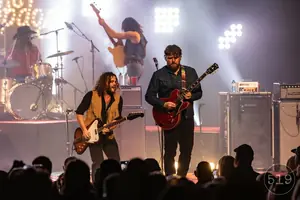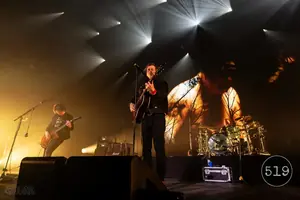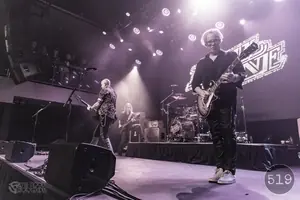

Walking into the Colosseum at Caesars Windsor this Saturday, Sept. 7, you won’t just be seeing a rock band. You’ll be witnessing a survival act that has outlasted every trend the industry tried to bury them with. For over 40 years, The Cult has functioned as a volatile, brilliant partnership between Ian Astbury and Billy Duffy. They’ve moved from the shadowy fringes of Southern Death Cult and Death Cult into a global machine that refuses to settle for the nostalgia circuit.
The current '84 24' tour isn't some dusty look back at the archives. It’s a sharp, futuristic presentation of gothic evolution. Astbury isn’t interested in being a museum piece. He’s looking at the horizon, even when the fans are screaming for the hits of the Reagan era. The tension between what the audience wants and what the artist needs to survive is where this band lives.
"Cults evolved. You know, we're going to continue to evolve," Astbury says. "There's been a conscious effort to it. I mean, there's certain times when there's a lot of resistance to growing and, you know, burning everything down again, like after Sonic Temple, especially because that was such a commercially successful record."
That resistance to success is exactly why they’re still relevant. Most bands would have ridden the *Sonic Temple* wave until the wheels fell off, playing the same three chords in ever-shrinking arenas. But Astbury and Duffy have a habit of setting fire to their own house just to see what the smoke looks like. It’s a punk ethos wrapped in a stadium-sized sound.
The DNA of this band is a mess of high-art influences and raw power. Astbury’s internal jukebox is a strange mix of David Bowie, Pink Floyd and the jagged edges of early punk. It’s not just about the riffs; it’s about the atmosphere. He remembers the exact moment the light went on, and it wasn’t in a small club. It was in a massive arena where the scale of the music matched the ambition of the performers.
"T. Rex, the Dolls, then my brother and I saw Pink Floyd in 1975 - that was a lightning bolt moment," he says. "I can't explain the voltage that went through me at that moment. And so Pink Floyd have always been in the background."
That "voltage" is what separates The Cult from the pack. They understand the theatre of rock. While the world often tries to pin them to the 1980s, their impact on the 1990s—specifically the Seattle grunge explosion—is a piece of history that usually gets glossed over. They were the bridge between the hair metal excess they despised and the raw, rainy-day grit of the Pacific Northwest.
"The Cult had a top 40 single in Seattle in 1985 with 'She Sells Sanctuary'," Astbury says. "We played the Paramount and it was the biggest gig of the whole tour. Everybody came to see The Cult."
It wasn't just a fluke. They were the cool older brothers to the bands that would eventually define the decade. When Astbury put together the Gathering of the Tribes festival, he didn't look for established giants. He looked for the future. Soundgarden was the first band he asked to play. He saw the shift coming before the record labels even had a name for it.
But before the world tours and the Seattle influence, there was Hamilton, Ontario. Astbury’s time as a British immigrant in the Hammer was a formative, grinding experience. It wasn’t the gentrified, hipster-friendly Hamilton of 2024. It was a grey, industrial landscape that demanded a certain kind of toughness just to walk down the street.
"It was a tough city, blue collar. Very different than the Hamilton I perceive it to be now," he says. "But that pushed me further into music, visual arts."
That blue-collar grit followed him back to the UK, where he met Billy Duffy. They were two Northerners who spoke the same language of The Stooges and Johnny Thunders. It was a match made in a very specific kind of rock and roll heaven, or perhaps hell, depending on the day. Their partnership is the engine of the band, but even engines need to be turned off occasionally to prevent a total meltdown.
"You've got to go away and recharge," Astbury says. "It's unsustainable to stay out there touring and touring."
We've always remained curious and inquisitive, trying to consume as much information about the present moment as possible. That gets dropped into the creative process, performances, visual narratives. It's like, keep moving, keep moving forward.
This distance is the secret sauce. By stepping away, they allow the creative friction to build up again. And when they do come back, they usually do something that confuses the casual fans but delights the critics. Take their 1994 self-titled album, often referred to as the "Black Sheep" record. It was a violent departure from the polished rock of the previous years.
"We decided to strip everything away that we knew about ourselves and kind of rebuild it. Like, literally just, you know, that was a great 13 year run or whatever it was. Let's just close everything down and start from scratch," he says.
They weren't just changing the clothes; they were changing the mechanics of how they made music. They were looking for something more primitive, something less reliant on the tropes of the genre. It was a move that showed a band willing to risk their commercial standing for the sake of an honest sound.
"That was a point where we decided to strip everything away that we knew about ourselves and kind of rebuild it," Astbury says. "We were doing things like flipping over the bass drum, you know, like, on the floor and playing, like Mo Tucker from the Velvet Underground and listening to way more progressive music."
But even a band as storied as The Cult has to deal with the soul-crushing reality of the modern music industry. The shift from physical media to the digital void has changed the way music is consumed and, more importantly, how it’s valued. Astbury is acutely aware of the "content" trap that many legacy artists fall into just to stay visible.
"To maintain the engagement on social media is you got to maintain the algorithm, which means you've got to have a lot of content," Astbury says. "Obviously, streaming has crushed CD and record sales, and it's also changed the formatting of streaming and the attention span of music."
And yet, despite the shortened attention spans of the TikTok generation, The Cult manages to keep people focused for two hours a night. The Windsor show promises to be a visceral experience, stripped of the bloat that plagues other 40-year-anniversary tours. They aren't here to ease you into the evening.
"It's The Cult and we've got better production so it's going to sound incredible. We've got 19 shows in us right now," Astbury says. "We pretty much come out swinging. We come out swinging straight away. There's no slow build up to our show and it's a good time to see the band."
The band’s longevity isn't a result of luck. It’s a result of a restless, almost obsessive need to stay current. Astbury doesn't sit around listening to 1970s rock all day. He’s digging into the subcultures that most people his age have long since ignored. He’s looking for the next "lightning bolt."
"We've always remained curious and inquisitive, trying to consume as much information about the present moment as possible," Astbury says. "That gets dropped into the creative process, performances, visual narratives. I mean, you know, it's like, keep moving, keep moving forward."
This forward motion is why he bristles at certain labels. Don't call them a classic rock band. That term implies a finished product, a closed book. The Cult is a living, breathing entity that still has something to say, even if the industry isn't sure which shelf to put them on.
"I don't think of The Cult as a classic, like a classic rock band," Astbury says. "People go, no, you're kind of post classic rock and post punk."
His current playlist is as eclectic as you’d expect from someone who has spent four decades reinventing himself. He’s looking at the dark corners of the electronic scene and the raw energy of modern hip hop. For Astbury, the spirit of the music is more important than the instruments used to make it.
"I like what's happening in hip hop music and progressive R&B," he says. "The kind of dark wave electronic scene, though, is really fascinating. So much going on in that sector. And, you know, in Europe, you have like, a new folk movement, which is kind of gothic."
That gothic sensibility returned in full force with their 2022 release, *Under the Midnight Sun*. It was a record born out of the isolation and uncertainty of the global pandemic, a time when the world seemed to stop but Astbury’s mind kept racing. It was a difficult birth, but the result was some of their most atmospheric work in years.
"Under the Midnight Sun, of course, we made that during COVID which was challenging," Astbury says. "So that record's got a lot in it. The last four albums, you know, they just, I think it's probably because we don't have a central record label. We've been on a few different labels. The complete model's changed."
Looking ahead, there’s no sign of the band slowing down. There’s talk of opening up the vaults, not just for a cash grab, but to provide the context that has been missing from their discography. Astbury wants to show the work, the influences and the stories behind the songs that have become anthems for millions.
"There's always something floating around. You know, I feel that at the right moment, who knows? We may go back in the studio and pull something out," he says. "At some point I'd like to do something that's got a little bit more description and about the influential elements, notes, some of the background to some of the songs, because you put these things out and everyone has their own interpretation of what it's about."
Until then, the focus remains on the stage. The live show is where the improvisation happens, where the songs breathe and change shape. It’s not a note-for-note recreation of the records. It’s a conversation between the band and the room.
"We've been kind of improvising quite a lot in certain songs and that's something new for us," Astbury says. "So you might hear improvised versions. There's a few poignant ballads in the set that people may not have heard live before."
And as they wrap up this leg of the tour, the momentum is clearly on their side. The '84 24' celebration is just the beginning of this latest chapter. In the world of The Cult, the past is just fuel for whatever comes next.
"Now we've got this body of work and we're in this moment. We're getting loads of offers for 2025 and continuing this," Astbury says. "So 84 24 may very quickly evolve into 85 25.