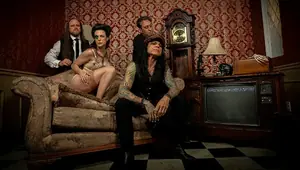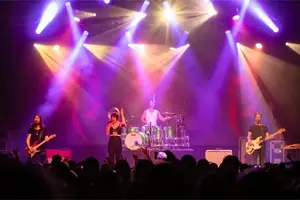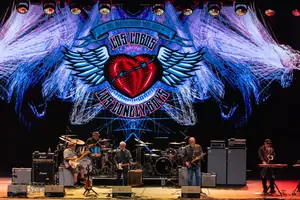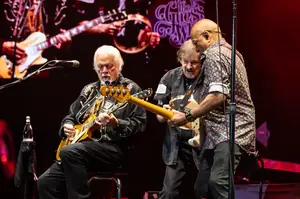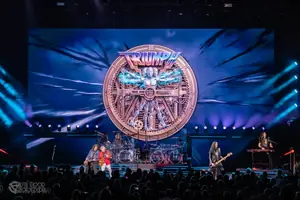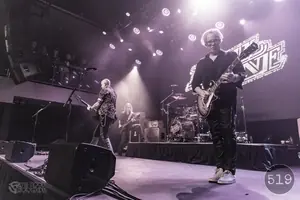

Standing in the third row of London Music Hall, the air thick with the scent of stale beer and anticipation, you don’t just hear Beastö Blanco. You feel them in your molars. It has been a full year since this motley crew of sonic terrorists stormed across the border for their Canadian touring debut alongside Halestorm and Palaye Royale. The lineup is a pedigree of rock royalty and road-hardened vets: Alice Cooper bassist Chuck Garric, the formidable Calico Cooper, Christopher (Brother) Latham, Jan LeGrow and Sean Sellers. They trade in a brand of grit that feels like a serrated blade to the throat of polished radio rock. It is back to basics, sure, but with a theatrical flair that suggests a Mad Max fever dream.
We caught up with Brother Latham and Calico Cooper to dissect the anatomy of the band and the chaos of that northern run. Latham, the band’s guitarist and a man who carries the rugged aura of his Alaskan roots, is currently navigating the industry standstill like a captain in a fog bank. He is not just a riff merchant; he is a technician of the frame.
“I’m doing good, real good, just trying to navigate the times like everybody else,” Latham says. His day job, or rather his other creative life, involves the meticulous world of audio post-production. It is a sharp contrast to the high-decibel theatre of Beastö. “I do audio editing for TV and film on the post production side so a lot of that has been on hiatus until things get back to normal because most production companies are shut down right now. Hopefully those things will be picking up again mid summer or end of summer once people start getting back to work.”
The origin story of Beastö Blanco is not one of corporate assembly but of a decades-long brotherhood. Latham and Garric are the kind of friends who don't need to finish sentences to understand the groove. They are transplants who found a common language in the neon grime of Los Angeles during the late 80s.
“Yeah, Chuck and I go back to, I’m dating myself, 1986/87,” Latham notes with a chuckle. “I’m an Alaskan transplant and Chuck’s a Tahoe transplant and so when we both moved to L.A. to pursue music and whatnot we were one of the first people each other met and we’ve just been best buds ever since. We really hit it off and what stemmed Beastö is we had a band prior to this called The Druts in the late 90’s and it was a three piece and had a lot of fun with that but a few years back Chuck was working on some songs and he’s like man, I’ve got some songs, I want to record them, just do something fun with it. We only had 4 or 5 songs and we ended up recording those and they just came out really good. We were recording with Tommy Henriksen from Alice Cooper’s band as well who’s also a wonderful producer and mixer. And so we did these four songs and said holy cow, listen to what we’ve done here and that’s where Calico got involved as well because we had her come in and put her flavour to a lot of that first record, and it was really our way of suckering her in to being a part of the band.”
And while Calico is now the focal point—the "Machine Girl" who commands the stage with a spiked bat and a snarl—she wasn't always the designated frontwoman. She was a collaborator who eventually became the catalyst.
“Well no, I don’t think she was reluctant,” Latham explains when asked if she hesitated to join the fray. “I think at that time Calico had been touring with her dad for quite some time and she was taking the time off to work on some of her own interests and career. I think that pretty much fell in line with when Beastö started up and once we got her out and she heard what’s happening you could see her eyes light up and she was yeah, this is so me, I’m part of this.”
But the real revelation was the voice. Calico possesses a chameleonic vocal ability that the band didn't fully exploit until they were deep into the recording process. She can pivot from a soulful croon to a bratty punk sneer without losing an ounce of her menacing charisma.
“Calico has definitely become more at the forefront of singing the songs,” Latham says. “When we were doing the second record, we came up with some songs and she got into the studio and I knew she could sing well but she was doing all sorts of really cool stuff and really opened our eyes to the potential of what Beastö could be as far as future music and getting her more involved singing those vocals. She has a great range of ways to sing. If you want her to sing really soulful she can do it, if you want her to sing like a snotty brat character she can do it. It definitely helped us tailor songs and grow in our song writing and try different things. She has a lot of great ideas as well and I think we’re always evolving as song writers. We’re getting her more into that now. We’re actually writing a batch of tunes now that we’re just saying, here you go, would love to hear what you’ve got and man, there’s this one tune we’re working on right now that I really like that she came up with and so does Chuck so we’ll just move forward with this and involve her as much as she wants to be involved.”
The debut record was a statement of intent. It opens with a cinematic, spaghetti western instrumental that feels like Ennio Morricone on a bender before slamming into high-octane rock. It was a gamble that paid off, even if the band was flying by the seat of their pants at the time.
“That’s exactly what it was, and again, we didn’t have any intent in how this was coming out,” Latham recalls. “We’re in there with Tommy and Chuck and I were looking at each other like oh my god, this is something really special. Maybe we should take this further instead of just having fun, and not only having fun and recording as we always do together but let’s see what we can do. In fact, we booked our first European tour back then and we didn’t even have a band yet. We got offered a tour and just said let’s do it, and we only had a portion of the songs that were on that record about to be released. That’s where Jan LeGrow, our bass player came in the picture and at that time and Tim Husung came on as our drummer. So we got those guys from Europe and bam, we hit the road. Then the second run we had Calico and we had the full show and that’s when things really started coming together for us and we became a real cohesive unit.”
Europe has always been a stronghold for the band. They spent time opening for Böhse Onkelz, a band whose massive footprint in the DACH region (Germany, Austria, Switzerland) is hard for North Americans to fathom. They are the stadium kings of the Fatherland.
“Yeah, saying they’re a really big band is an understatement, they’re like the U2 of Germany and that region but it’s funny because you get them out here or other places in the world and they might draw 5 people,” Latham says. “Over there, they sold out this tour 10 months in advance, every arena throughout Germany, Austria, and Switzerland. So it was a real privilege to be with those guys and when Chuck said hey man, I think we’ve got this tour, I was like who? So I looked them up and I saw this festival that said it was named after them and this festival had 300,000 people!”
The band’s visibility has been bolstered by the Cooper connection, but they have fought hard to ensure Beastö is viewed as a standalone beast rather than a side project. Advertising on guitar picks at Alice Cooper shows might get bodies in the room, but the music has to keep them there.
“It really does you know and we’re fortunate enough with Chuck being with the Alice camp and doing that sort of stuff that we’re getting the visibility through that and he’s been able to promote the heck out of it as best as he can and it’s really gotten the word out,” Latham admits. “It helps get bodies out so they’re like, I’ve heard of this band because Chuck’s in it or Calico and it’s growing and growing and it seems like we’re an underground band.”
But the underground status is precisely what gives them their edge. There is a sense of dangerous, unpolished culture in their music that feels increasingly rare in an era of quantized drum tracks and pitch-corrected vocals.
“Absolutely, and when we did our first couple tours I felt that this band, the songs and the way we are as people, I don’t know, there’s something about the vibe of it and I always say I feel like we’re kind of bringing the culture of rock and roll back to the music,” Latham says. “I very much think that Beastö is standing on its own two feet and it’s great to have a coat tail or two to get you right there but we are definitely our own entity and we love what we do.”
The Canadian tour with Halestorm was a triumph, despite the weather gods conspiring against them. Late April in Ontario often feels like a cruel joke, and the band found themselves ill-prepared for the meteorological assault.
“Enjoy is an understatement, it was absolutely awesome!” Latham says of the run. “We’d been wanting to get to Canada and again, thanks to Halestorm and Palaye Royale for having us a part of that whole thing. The only thing that was kinda crappy was I am an Alaskan native as you know and I’m very familiar with the weather so I was thinking late April/May, spring weather I’ll probably be ok with a light jacket. Dude, it was blizzards all over the damn country! None of us had winter clothing. It was so funny we were driving through Ontario and we just went through our second blizzard. I’m not kidding when I say blizzard. Windshield wiper broke off the bus, my ass on the edge of the seat trying to find one little clear spot on the window to drive up this pass. Get to the top of the pass, hit a Wal-Mart so I can get a jacket and I go in and say “Where are your jackets? Something wintry.” She says oh I’m sorry, we had that sale back in January. I said, “Have you been outside”? Besides that, the Canadians have always been warm and I have a real soft spot for Canada in general just being from Alaska and spending a lot of time in the western part of Canada in Vancouver and Yukon Territory, I pretty much grew up in that area.”
When the world ground to a halt, the band pivoted to digital performances, including a stripped-back set for Rolling Stone Germany. It was a high-wire act with zero safety net.
“We had about a day and a half to prepare and one of those songs we have never played live,” Latham reveals. “I don’t think we’ve even jammed it in a rehearsal. So, it’s a little nerve wracking because you have to sit down and really practice because you don’t have the loud PAs and everything that if you mess up a little bit you can hide behind it.”
The acoustic setting allowed the individual musicianship to breathe. In a band this heavy, the nuances can sometimes get buried in the distortion.
The test of everything is if you unplug, what do you sound like? I was probably more surprised than anyone else, I said 'Oh wow, look at that! I guess I can sing.'
“Every member of this band is so awesome, Sean, Jan, Cali and Chuck, and I’m very privileged and blessed to say I’m in a band of badasses,” Latham says. But they are accessible badasses. There is no rock star ego here, just a group of fans who happen to be on the stage instead of in the pit. “No, you know, we are fans. When we put these shows together we think, if we were sitting out in the crowd, we want to be taken away. Chuck and Cali obviously they’ve been taking notes over the years of what’s good and what’s not good. It’s not like we plan things out, we may have a blueprint of things but every night changes. We could try to rehearse a dance move or something and never get it right or something else will evolve during a show. We might have the bullet points of what we’re going to do at a certain part of the show, like during Perception of Me we have this section where we know she has the chair and we know she’s going to step on this light and it’s going to flash, but what’s going to lead up to that, we have no idea.”
That lack of rigid structure leads to some genuine danger. Calico’s spiked bat is a legitimate weapon, and when the adrenaline is pumping, the margin for error is razor-thin.
“No blood spilled, some really close calls,” Latham says. “I remember playing Monsters of Rock and Cali’s bat, it’s not a fake bat and neither are those spikes in it and we’re all pretty conscious of where it’s at but there was one point, I forget which song, I think it was Death Rattle or something and Calico was swinging a haymaker with the bat and I was in motion and I just remember doing this whole Matrix bend and could feel the wind from the bat over my head and I was thinking oh my God oh my God that was close! She knows she’s baring a weapon in her hands so she keeps her space in mind during a performance. She has actually hurt herself more than anyone else in the band. I know that bat has stuck her a couple times.”
And then there were the shoes. Watching Calico and Lzzy Hale navigate a stage in precarious heels is its own kind of athletic feat.
“I think they were trying to outdo each other every night,” Latham laughs. “I don’t know how they get out of those shows without a broken ankle.”
The road is a chaotic mistress, and Latham has the stories to prove it. From literal fires in Spain to the claustrophobia of lockdown, the band has seen it all.
“We had a speaker catch fire in Spain,” he recalls. “Tim was playing and his drum monitor caught on fire and it caught the set list on fire as well. I don’t know how it happened, some wires crossed or something and flames started busting out. Well Calico did because she’s the one that turns around and the rest of us are facing forward rocking out and she’s tapping Chuck with the bat to let him know and he’s like leave me alone kind of thing. So then she comes over to me and hits me in the back of the leg with the bat and I’m like what the heck are you doing? So I turn around and she yells FIRE! And I look and I’m all holy shit! It could have lit these curtains up and that wouldn’t have been fun. So, we’ve got a lot of stuff like that, we always have fun.”
The lockdown was a forced hiatus that Latham spent pining for the waves and the fans. “This whole thing’s a trip, in Los Angeles or California State you can’t go to the beaches, I love the beach, I love the outdoors so for me, I love to surf, I’m not very good at it but I can’t even do that right now,” he laments. “Touring, we got called off this last tour because everything got shut down and we do like to be around our fans. We have a lot of fun with them and many have become friends over the years so not being able to see some of these folks is tough. We will some day when everything gets back to normal or somewhat normal.”
Calico Cooper, meanwhile, was hunkered down in Phoenix, turning the family home into a high-functioning production studio. While the rest of the world was baking sourdough, the Coopers were making art.
“Yes, we made a pact at the beginning of all this to do it together at my parent’s in Phoenix and let me tell you, it’s been so great,” Calico says. “In this position we’re in there is so much work to do. My dad is finishing his record in the house. We’re both talking to Bob Ezrin over the phone and we’re shooting music videos and luckily there are so many people in the family with the capabilities of knowing how to do that. My husband owns a commercial production company, I know how to direct and we’ve been shooting every day. It’s almost like being on a film set where there’s a schedule where we’re doing this at 2:30, something else at 3:00 and this at 5:00 etc. By the time you go to bed at night you’re exhausted. I’ve also been working nonstop with Beastö. We did our lives stream for Rolling Stone Musikexpress and that was something. We’ve never done any of our songs acoustic before.”
That acoustic session was a moment of self-discovery for Calico. Stripping away the "Machine Girl" armour revealed a vocalist of surprising depth.
“You know it’s a learning experience for us too because no matter how cool you think you are or how good you get there’s another challenge dead ahead for you and for us it was such a vibe that you forget that these guys are really good musicians and you forget that I really can sing but the show is so big and the production on the records is so big and the test of everything is if you unplug, what do you sound like? I was probably more surprised than anyone else, I said “Oh wow, look at that! I guess I can sing” (laughing).”
She never actually set out to be a singer. Her background is in the theatre, in the discipline of the actor. Singing was just another character she had to inhabit.
“Yeah, I think it’s because I never wanted to be a singer,” Calico admits. “I don’t think that was ever anything I was super passionate about. My grasp about it was more on the performing side. The very first Beastö record my voice was nasally because they asked me to do a character, then the second album when we did (Feed My) Frankenstein, nobody had any idea that I could do that sort of smokey lounge singer voice, including me. So all you have to say to me is, sing like “blank”, and it’s better if it’s not a singer, if it’s just a vibe of a person. So he said, sing like Mae West and I just thought of her sort of oozing everywhere and then the last record, “We Are”, Chuck said, “I want to know, what you can do.” So we did stuff like “Solitary Rave” and “Perception of Me” and there’s a line in Perception where I sing “Let me hear you say my name” and they didn’t tell me how to sing it and my chest just burst open and that came flying out and we kept the first take.”
The songwriting process in Beastö is a collaborative machine. Chuck and the boys handle the grooves, while Chuck’s wife Lindsay provides the poetic foundation. Calico then steps in to translate those words through the lens of her persona.
“Yes! So basically how the machine works is Chuck, Chris and Jan come up with the grooves and lines and all that and Lindsay is more of a poet so she’ll go poetic into it and then it’ll have to get modified to fit in the song,” Calico explains. “Then they’ll bring the lyrics to me and I say yes, I love that, I feel that but I would say “this” or my character would say this instead of that and then it’s the way that you sing it. It’s a lot like acting really. I get a script; it’s just words on a paper even though the writer could be brilliant. I have to read it the way the writer intended it and then put my own personality into it, and that’s when you get magic. So, I’ve kind of brought that over into the music world.”
Take the track "Perception of Me." It was born from a conversation in a Nashville bar, a moment of raw honesty about the psychological space women occupy during conflict.
“I remember the exact night,” Calico recalls. “We were in a bar in Nashville and I said, “You know how when girls are in a fight and they say, I’m outta here! And they walk away, and you’re supposed to follow them? I guess? Is the unspoken rule? I’m like no no, don’t go! And I never learned that and she was laughing and I said, “If I look you in the face and say, I’m outta here, do not follow me! Because where I’m going is for your safety.” I’m going into this headspace and then I tell her I’ll hold it together and then I get into my space and I’ll yell and scream and create and break stuff and take a nap, wake up and do it again. And then I come out of the room like steel, I’m good. What happens in there is such a mystery, she thought that was great so she wrote from the stories I was telling her, the song, and when I sing it, it has to be truthful so it has images in my head from times that I’ve done that and it came out in the attitude of the song.”
Calico’s acting training is the secret weapon of Beastö Blanco. She has spent two decades honing her craft, and she brings that same intensity to the stage every night.
“Yes, I think it still is because in Beastö, I as Calico am in the shadow of whatever character I have created here,” she says of her passion for acting. “I am so classically trained in acting, I’m talking 20 years of the best schools and teachers and when I commit to something I go in so hard, first one there last one to leave kind of thing and pushing my limit. And so I took everything I learned, and I still do in film and television and applied it to Beastö, but Beastö became a platform where a writer wasn’t giving me lines and direction and I was completely able to create what this was. It was such a unique opportunity I literally built her live as the shows were happening. Something would happen and I’d go, that’s it, I get it. So I’m understanding this part of myself more and more, and now it’s always going to evolve but I feel like it’s the most powerful, dark side of me that I feel completely confident to let her do what she wants for an hour.”
There are obvious parallels to her father’s work, but where Alice is a master of controlled showmanship, Calico’s "Machine Girl" is a creature of chaos.
“Yeah, a little bit, I get now where it comes from because he more controls his environment, he is the showman,” she notes. “I feel like the difference between that and the Machine Girl really is I’m partially worried about what she’s going to do, you know what I mean? I don’t know, and in an Alice show it’s very important that certain things happen at certain times. In his show it looks very free and off the cuff, but I heard an old saying that’s always going to be true and that is the harder you work at something, the easier it looks. I did for years so I know how the machine works and so for Beastö, I took the idea of an alter-ego but ours is more chaos. You see a Beastö show and it’s never the same twice ever because how am I going to tell you what she’s going to do, I don’t know.”
That chaos is a physical demand on the rest of the band. They have to be ready to dodge a bat or a boot at any moment.
“I’m usually never in the same place twice so it you’re in Beastö you have to be a musician and a dancer because if I’m coming forward you have to know the ratio of that bat,” Calico warns. “I’m aware of where I’m at but every stage is different and sometimes someone will blast a spotlight and blind me. There’s a lot of chaos but it’s controlled chaos. Most of the time if anybody gets hurt it’s myself. He had a close call on that one.”
Her creative control extends beyond the stage. For the video for "The Seeker," Calico took the reins as writer, director and producer. It was a moment where she had to demand absolute trust from the band.
“I did, I heard the song and once they said that was going to be the single, I wasn’t sure,” she admits. “I said really? Not let’s Rip or any of those other songs? No no, the label and test audiences say it’s the Seeker. I liked the song but I was trying to fall in love with it the way I loved some of the other songs and I was driving home from my parent’s house across the desert listening to it over and over and then that sky cracked open moment of aha and I saw the story. All of a sudden it clicked in my brain and I saw this girl running through the desert with no shoes on, beat up and I’m desperate to know where she was going, what she was running from and boom, The Seeker just appeared in my head. Try calling Chuck up from the middle of the desert and say “Hey, I’m going to rent an old western town”. (laughing). They let me do what I want, but this was kind of big. This was the single for this album and a lot of work went into the album so I sat everybody down and I just had a Rudy moment where I said, you have to trust me, I’m good, I can do this. I’m confident in my directing ability, I’m confident in the story, the visuals, the editing, I can do this. I need you to promise me though I don’t get 75% creative control, I get 100%. It’s hard to describe to people the process you know, they say “why are you doing this?” or “That’s not going to look good”, but I see it from the perspective of someone’s who’s in the video, in the band, wrote the song, but I see it from an editor/director point of view where you gotta trust me, it looks weird here but it’s not going to look weird on camera. So after about maybe 20 minutes pep talk they said it’s all yours. After the video came out my phone was ringing off the hook not from our band but from other bands going hey, how much do you charge to direct videos {laughing). I was so proud of myself at the end of it. I sent it out and I got emotional because it was exactly the way I had seen it in my head. We’re currently working on the video for the third single, the ballad Down, and it’s really beautiful.”
The 2019 tour with Halestorm and Palaye Royale was a masterclass in diverse billing. It was a triple feature of theatrical rock that shouldn't have worked on paper but was electric in practice.
“I’m so blown away how certain things come together and you would never think to put Halestorm, Beastö and Palaye Royale together on a bill,” Calico says. “The thing is it went so well and that really is Halestorm. They saw our show and Palaye’s show and we’re all rock and roll but different kinds of rock and roll, but what we all have is a stage show. That’s what links it all together. It’s like seeing a triple feature, you know, horror movies are not just horror movies, there’s all different kinds, same with comedies, so opening the show with something as visually assaulting as Beastö with a woman up front was a statement. And then to follow it up with these guys, I mean, I had no idea. I heard of Palaye Royale but it was a completely…we are Motörhead, they are Iggy Pop and Halestorm is Van Halen, and it works.”
The discovery process for the fans is what makes those tours special. It is about being exposed to something you didn't know you needed.
“Don’t you love that though?” Calico asks. “I remember the first time that ever happened to me. As a teenager I went to Warped Tour and it’s no secret I’m a huge Blink 182 fan and I went to see them and I got there early and I was never a get there early, opening act kind of person and I got there when it opened and I saw Taking Back Sunday, Jimmy Eat World, all these bands that ended up being up to this day, some of my favorite lyricists, favorite bands and those are the experiences that I think you take with you in life and say, how did I not know about this band? I love them! It’s the discovery process. I think a lot of people who put together tours look at the draw and Pollstar and this and that and the experience of that tour was so great because we all have such a passionate love for rock and roll and putting on a show. Every person that walked off that stage from their respective sets was thrashed! I mean sweat, blood, everything every single time and we would go sit out in the parking lot out back after the set and have drinks and cool off and it was such an amazing experience, I would do it again in a second, absolutely loved it. It couldn’t have happened in a better place than Canada, I mean they got it, they completely got it.”
And then there was the ice storm. The story of Wilderness Chris (Brother Latham) driving the bus with his head out the window is already a piece of band lore.
“There are a million stories. We’re such a group of insane people that it’s impossible to not happen,” Calico laughs. “I don’t think we’ve ever had a tour where something didn’t happen like it belongs on Seinfeld, there’s no way that this is real. We were driving through Canada on last years tour and Chris (Brother Latham) was driving and the driver’s compartment is separate from the rest of the bus so we have no communication with him. We all have U.S. cell phones which normally work pretty good but on this day we were caught in an ice storm, snow sleet, rain and Chris is driving about 20 miles an hour because he couldn’t go any faster. I wouldn’t trust anyone else with driving because Chris grew up in Alaska and we call him Wilderness Chris because he could kill a bear with his bare hands. So we’re looking out the windows and there are all these trucks in the ditch on both sides and we’re counting them, ten, twenty, thirty trucks and all of a sudden the bus slows down and pulls over. So we’re going uh oh and Chris comes in and he’s completely covered in ice and snow. He’d been driving with the window down and his head out the window because one of our wipers broke. He couldn’t stop because he couldn’t see in front of us or behind and kept going until he was frozen and couldn’t take it anymore. What ensued was the band, and you’ve seen these rock and roll dudes, rock guys in a band, well what I saw was their inner, blue collar working man, caveman come out. Every single guy dressed in as much clothing as they could, including mine so they were wearing pink hoodies and stuff, got out of the bus and were chipping ice off the windshield as trucks are flying past the bus and working away and taking breaks and we’re thinking we’re going to have to cancel the show. So during all this our bass player Jan is sitting on the bus in his sweat pants drinking a tea, and they must have been working at it an hour, he finally let’s out a sigh, puts on a hoodie and goes out to take a look and comes back 5 minutes later and says, “fixed”. He says, “I don’t understand what the problem was, it was very easy”.”
Jan LeGrow, the band’s German bassist, was also the key to their success in Europe. When they opened for Böhse Onkelz at the Mercedes Arena in Berlin, they were warned that the crowd was notoriously hostile to opening acts.
“We did our Beastö Blanco Live in Berlin there and it was our second night at The Mercedes Arena,” Calico recalls. “We were on tour there with a German band called Böhse Onkelz and they’re like the U2 of Germany as far as popularity, so we were playing these sold out hockey arenas two nights in a row every city we played. The first night, someone says good luck and kind of shakes their head, and we’re like, what do you mean by that? Well, it’s tradition at the Onkelz shows to completely terrorize the opening act, you know, throw things, boo and they said they had other bands like Limp Bizket and other bands open and the fans just decimated them. They’re a great band but this was just the tradition. They boo the opening band off so they can get the Onkels on. So they tell us this right when we’re about to go on stage and I remember thinking in my head, not today! So the lights went out and out intro started and I thought, I’m going to go deeper than I’ve ever gone and I’m going to command you to bow down, right? So the lights came up and I just went blind, I don’t remember any of the show and we came off stage and all the road crew were hugging us and they’re saying it was unbelievable, nobody threw anything (laughs). Afterward people were coming up and saying we loved the music and we loved the show and we sold so many records, it was so great.”
Whether it is an arena or a dive bar, the intensity remains the same. The performance is a living, breathing thing that adapts to the space.
“You’re never going to get the same performance but it’s the same intensity. I feed off of a crowd completely,” Calico says. “If we’re in a theatre and there’s 500 people, it’s going to be different than if you’re in a little rock and roll dirtball with 100 people, not any less intense, it’s just different because it’s real, I’m interacting with who I can see. I become something different in an arena because then I’m doing it for the people in the very back. So that’s fun, it keeps it alive and fun for me.”
Beastö Blanco is a band that defies easy categorization. They are a product of their influences but they are entirely their own animal. It is an authenticity that fans can smell from a mile away.
“We only did it the one year because other years we were on tour in Europe, but the year that we did it was so great,” Calico says of playing her father’s Christmas Pudding show. “That show is notorious for being a potpourri of performers. You’ve got everything from KISS and Rob Zombie to Kenny G but it works. Half the people knew who we were basically via Alice but the other half of the people who didn’t know, those are the faces that I hung on. Those were the big eyed open mouth looks and we’re not doing anything shocking which is funny, it’s just the way we are. That’s the reason we named our latest album We Are. People say define Beastö Blanco, I don’t know, we just are, we are Beastö. You can’t fake the funk. If we were phoning it in or any of it was not authentic, I think people can read that. When it’s really coming from a place of discovery and explosive energy and that’s another thing that Halestorm and Palaye had in common with us, it was all real and I think every generation relates to that.”
And despite the spikes and the snarls, they remain some of the most grounded people in the business. It is a lesson learned from the top down.
“Absolutely, that’s something else that my dad taught me that it’s so much harder to be a jerk, it really is a lot of work,” Calico concludes. “And he says, your number one detriment is A, if you buy your own hype, which means if I walked around as the Machine Girl, if he walked around as Alice, and you never gave yourself a break, you’re going to self destruct, you’re going to implode. Be proud of what you’re selling but you’re a human, there’s more to you than that. So being a human you’ve got to interact with other humans, thank you for liking what I did, thank you for loving my art, of course I can sign that, of course I can take a picture, thank you for listening. There is no us without them.
Get Tickets