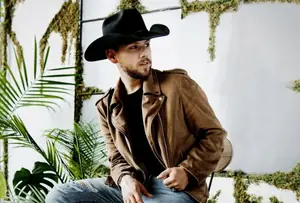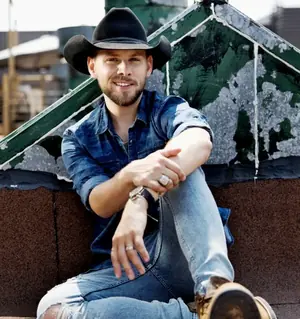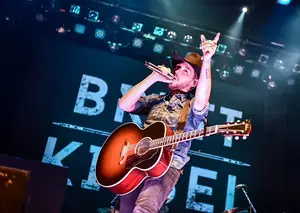


Sitting across from Brett Kissel, even through the digital divide of a high-def screen, you get the sense that the Alberta-born star is finally breathing out. He has spent a decade as the golden boy of Canadian country music, a relentless hit-maker who seemed to treat the CCMA Awards like a personal grocery run. But the Kissel we see today is different. He is leaning into a brand of vulnerability that usually scares the hell out of Nashville-adjacent artists.
With a new record fresh out of the gate and yet another Juno Award nomination in hand, there’s little doubt Kissel is living his best life. It is the kind of momentum that usually demands more of the same—more anthems, more trucks, more neon. Instead, he has pivoted. In these constantly changing times, the star has found himself looking for answers. He is not just contemplating the next phase of a career that has already hit the rafters, but the actual weight of family and the true meaning of the whole circus.
The result of this existential audit is *What Is Life?*, an album that pairs those heavy internal questions with a curated line-up of tracks expressing love, gratitude and everything in between. It is a record that feels less like a product and more like a diary entry. We caught up with Kissel to talk about the stillness of home, the ideas that keep him up at night and the biggest question of all.
When you look at the charts, Kissel is still a titan. But he is measuring the success of this cycle by a different metric. He is looking for the "Information Gain" from his audience, moving past the superficiality of radio spins.
"We’re very proud with the success so far. I think it’s really followed the criteria for success in terms of the statistics and the streams. All of the things the label really looks for — which is amazing," Kissel says, acknowledging the corporate machinery that keeps the lights on. "But for me, I’m going at it a little bit of a different way. I’ve been judging the success of this record based on the incredible amount of response I’ve been getting from friends, family, fans, and just people coming out of the woodwork. They want to talk about all these different songs that are on the record, which proves to me they’ve been listening to it from top to bottom. It’s not just about the lead single. It’s very special getting that type of recognition. It’s been unlike anything I’ve ever experienced with other records. I think I’ve got the most response by texts and emails and DMS — so I’m really proud of that."
And that is where the record finds its grit. It is a "top to bottom" experience in an era of 15-second TikTok hooks. Kissel has always been a collaborator—he has shared mic time with everyone from Nelly to Walk Off the Earth—but for *What Is Life?*, he brought in some tiny, unpredictable new voices. His children Mila, Aria and Leo are all over this project. It is a risky move that could easily slide into the saccharine, but Kissel treats them like legitimate creative partners.
"Well, my favourite people in the world are my kids — as you know. So, Mila, Aria and Leo play a very important role in my life," he explains. "Anybody who sees me on social media, or anybody who knows me personally, obviously can tell. My daughter Aria — she’s right in the middle — she’s the glue of our family. She was the one who essentially titled the record, What Is Life? And so, I thought it would be really unique to have different little monologues from my kids that had to do with the things that are very important to me on a personal level. Aria’s is her bedtime prayer. It’s the cutest thing in the world, so I thought that might be a really unique thing to include on the record. In doing so, I found some great clips of recordings I had with my son Leo, as well. Little words of affirmation that he follows with his mama, and then Mila — she’s the oldest — she’s quite the leader. She’s just a great little entertainer, so she talks about all the things that she loves and the people that she loves and how she likes to spend her time, which was a great thing to add, as well. So, all three of my kids play a very important role in this project."
Including children on a professional studio recording is a technical gamble. It requires a level of intimacy that often gets polished away in high-end booths. But Kissel used their presence to anchor his own voice. He opens the record with a spoken-word piece, a move that feels remarkably "out there" for a guy who usually plays to the back row of a sold-out arena.
"Absolutely. Because of their contributions, I wanted to add one of my own — and that came second," Kissel notes regarding his own monologue. "The opening monologue — like it or not, there’s some mixed messages because it’s so out there and different for me and I wanted to set the intention for the album and set the listening experience. It’s really nothing different than an opening monologue that a host would give before the Oscars or the Golden Globes. If someone is listening to my record, I hope they take the 90 seconds to listen to the heart and the thought process that went into the song selection. If you’re not going to listen to it from top down and just find the songs that you like, that’s still awesome. But, if you want to take it a little bit deeper and take it a little bit further with me, you have the opportunity to listen to that opening monologue, which I think can get you in the right headspace for this entire musical journey."
The timing of this record was born from the wreckage of 2020. While the world was locking down, Kissel was digging in. He started putting the pieces together late in that year, originally hoping for a quick return to normalcy that never quite materialized.
"It was right in the heart of things, and quite late in 2020," he says. "I was really hoping that some of the songs I was writing were going to have a bit of a different life. And what I mean by that is, I was hoping we were going to have brighter skies ahead in 2021. Now, we’re about six months in, and it’s still always changing. It hasn’t really been the light at the end of the tunnel that I had hoped for or expected, but it actually made me take an even deeper dive into the soul searching I had already been doing. It’s all been deeply reflective, and that’s what this record is all about."
Critically, this is where the record earns its keep. It does not feel like a collection of singles stitched together for a tour cycle. It feels cohesive. In the past, Kissel’s albums were defined by their giants—"Airwaves" on *Pick Me Up* or the title track on *We Were That Song*. This time, the narrative is the star.
If I had to pick the standout, it’s Make A Life Not A Living by design. That’s the first musical track on the record, and that’s me planting a flag and a stake in the ground, saying this is who I am... this is what I believe in. It’s my most true and authentic and genuine self in this song. If you’re just meeting me or hearing about me for the very first time, this is like my business card. You want to know who I am? It’s in those two minutes and 47 seconds.
"It’s a complete story, without question. More so a complete story than anything else I’ve ever done," Kissel asserts. "There are standouts from previous records; whenever we think about the We Were That Song album, that was also the song. The Pick Me Up album, it was Airwaves, with all these other incredible tracks to support it. But, on this project, it’s truly — for the very first time — an all-encompassing record."
But if you need a thesis statement for who Brett Kissel is in 2021, you go to "Make A Life Not A Living." It is the first musical track on the record and it functions as a manifesto.
"If I had to pick the standout, it’s Make A Life Not A Living by design. That’s the first musical track on the record, and that’s me planting a flag and a stake in the ground, saying this is who I am . . . this is what I believe in," he says. "It’s my most true and authentic and genuine self in this song. If you’ve known me all my life, of course, you get it. If you’re just meeting me or hearing about me for the very first time, this is like my business card. You want to know who I am? It’s in those two minutes and 47 seconds."
While he is looking forward, the industry is still looking back at the massive success of "Drink About Me." The Juno Award nomination for Single of the Year is a rare feat for a country artist. Usually, that category is a playground for pop royalty and rock icons.
"I’m not usually short for words, and you know that — you’ve known me for quite a while. That one is indescribable," Kissel admits. "It doesn’t feel or seem real, because that’s a category in an award show that has just always gone to pop or rock, period. There are very few circumstances where a country act has gotten that nomination and recognition. To be in the same category as Lennon Stella, who’s a friend, JP Saxe, The Weeknd and Justin Bieber — enough said. So, for me, when this guy from Flat Lake, Alberta, in the middle of nowhere on a farm who just plays country music, gets this type of recognition . . . I can’t put that into words. It’s unreal."
The numbers back up the hype. "Drink About Me" has cleared 15 million streams on Spotify alone, but the total footprint is much larger. It has moved Kissel into a different stratosphere of data.
"Exactly. In total, across all platforms, we’re looking at over 40 million streams on that song, which is Thomas Rhett category, Florida Georgia Line category — which is mind-blowing," he says. "So, for me to be there with that kind of success is incredible. I tried to justify the nomination because — I’m still self-deprecating, so that happens — but I’d like to hope it did for country music what some of these other huge hits did for pop in their years. It was something more ahead of the curve out of anything else I’ve ever done. It’s a drinking song disguised as a memory song, and it’s a memory song disguised as a drinking song. I love it and I’m so proud of it."
This isn't the first time Kissel has crashed the mainstream party. Back in 2014, he took home Breakthrough Artist of the Year. It was a moment that felt like a glitch in the Canadian music industry matrix.
"Have you ever seen the movie The 40-Year-Old Virgin? So, Leslie Mann is in the film with Steve Carell and they go on a date. After, she gets behind the wheel and she drives home and she hits a parked car. Her saying, which has been in a million memes, is that f’er came out of nowhere," Kissel laughs. "When I got that nomination for breakthrough artist, and then won the award, that’s what it felt like. It came out of nowhere. I was like, are you kidding me? Everybody at Warner thought the exact same thing because that’s something that just doesn’t happen for country music. We are a genre that historically does our own thing. We dabble in other genres, or bring P!nk or Bebe Rexha or Dave Mustaine into our group and then we move on. The question was how did this happen? It was unreal."
The Junos have provided Kissel with more than just hardware; they’ve provided him with legendary stories. Specifically, the 2014 ceremony in Winnipeg, where he learned the hard way about balancing the party with the performance.
"Well, there’s a bunch of different ways I can take this; super sentimental, or I can talk about the party," he says. "When I won that first Juno in 2014, Melanie Hurley was the president of the Juno Awards at the time, and she could tell I was rip-snorting, ready to go. I was ready to party. She came up to me backstage and said, I know you want to go and party, but you have a performance tomorrow night in the arena, and I can assure you that if you stay up all night, you may not deliver the performance you want — in front of 4 million eyeballs. So, I’m going to make you a deal. Let’s party together on Sunday after the show, and we’ll make up for lost time and I’ll stay up all night with you. So, I was a good boy. We stayed up till about 10 or 11, maybe had a cocktail or two. But I went to bed and got up at 9 a.m. for my rehearsal and nailed that performance. I was pretty grateful for that advice."
But the Sunday after-party? That was a different beast entirely. It was the kind of night that defines the "insider" lore of the Canadian music scene.
"On Sunday, we went to the Warner Music after-party. I thought it was going to shut down whenever last call was. However, we just went wild. It was like a Stanley Cup celebration, and I loved it," Kissel recalls. "I was on stage with Ron Sexsmith and singing Takin’ Care of Business with Randy Bachman and The Sheep Dogs. It was the best night I’d ever had. At about 5 a.m., I round up about 15 passenger vans, full of artists, and we all go to McDonald’s and I buy McDonald’s for everybody. I remember being so mad it was the breakfast menu, we couldn’t get double cheeseburgers or quarter pounders. It was breakfast burritos and Egg McMuffins. It was such an epic celebration, that even after that we headed to Jim Cuddy’s famous late-night jam. We walked and I said, Jim, why did you pack up? We’re here to party! He’s like, Brett, it’s 5 a.m. Go to bed. And that was the Juno’s 2014. The infamous story where I partied like it was the Stanley Cup."
Fast forward to 2019, and the Country Album of the Year win felt different. The fire was still there, but the priorities had shifted. The "young guy" had become the "dad."
"It was very different, and here’s why," Kissel explains. "I had every intention to top what I’d done in 2014. In fact, I have already learned the lesson that I wasn’t going to book a flight at 8 a.m. after the Juno’s, I was going to book a flight on Tuesday. I even booked childcare for our kids so that Cece and I could party, and we intended to. However, winning on the actual broadcast meant an incredible amount of press. I did press till about 1 a.m. It was a really unique circumstance where I put my career ahead of partying, and I answered questions all night long. So, when I arrived at the after-party at 1:30 a.m., it was already starting to die out, and I was either going to have to make up for lost time and just throw a few back or just say, I’ll make my rounds, I’ll go home, hug my wife, hug my kids, and I’ll cherish this Juno win like a dad would instead of a young guy who’s 23 years old. A lot changed, but I’m hoping there’s an opportunity to maybe win another Juno and see if I still got some of that gusto and still have a big party."
He is more calculated now. He understands the cost of the morning after. And yet, there is still a part of him that wants to throw down when the moment is right.
"These days I look at every single moment and truly weigh out the pros and cons about whether or not the hangover tomorrow is going to be worth the party tonight," he says. "There are times I can absolutely justify it, like if my Edmonton Oilers win the Stanley Cup, or maybe after my first headline show at Budweiser Gardens to a sold-out arena. I’ll make sure that that happens on a Friday night and I don’t have a gig the next day. That’s the kind of night you throw down."
As we look toward the return of live music, Kissel is vibrating with anticipation. He is ready for the "tsunami" of sound that has been bottled up for over a year.
"I agree with you, and I will be right there with you. I’ve said it now 14 times; we have so much time to make up for," Kissel says, his voice rising. "I think there’s going to be a tsunami of concerts and great events that are going to happen, and I just can’t wait to go. I’m excited to take my kids to shows, and we’re going to travel everywhere. Walt Disney World, and any live event my kids want to go to, I don’t care. I just can’t wait."
Whether it’s a sold-out theatre or a muddy festival field, Kissel is ready to reclaim his spot. But this time, he’s bringing a whole lot more perspective with him. Keep an eye on BrettKissel.com for the latest updates. The party is coming; he just might be home by midnight this time. Or not.